Wednesday, 29 June 2016

ENO: Tristan and Isolde ★★★★

Many opera lovers know that there is much luscious music to discover with Wagner’s Tristan and Isolde. The climactic love-death song that is Liebestod (otherwise known as Isolde’s Verklärung), the glorious intensity of the score alongside the romantic verse written by the German composer himself are a few reasons, out of many, as to why it is considered a landmark opera which has influenced music history. Not forgetting the tragic story where two lovers down a love potion which leaves them stuck in a world they cannot exist together in.

The English National Opera (ENO) last staged Wagner’s visceral opera twenty years ago, yet its newly appointed artistic director Daniel Kramer has introduced a new production with grand designs by award-winning contemporary artist Anish Kapoor – the man who designed the Orbital Tower at the heart of the Olympic Park and controversial sculptures for the French palace of Versailles. 


The inspiration behind Wagner’s four-hour opera includes his admiration for Arthur Schopenhauer and his metaphysical ideas of the annihilation of the self, as well as his keen interest in medieval literature and another love; a love that is revealed through various letters he wrote to the wife of his benefactor, Mathilde Wesendonch.


Although Wagner was already married, living in exile in Switzerland for his part in the Dresden Uprising of 1894, he felt compelled to write the ‘most full-blooded musical conception’. One could describe Wagner’s reasons for composing his monumental opera as a way of hammering out a message to Mathilde or releasing his own frustrations on such a sensitive situation. Regardless of his motivations, one thing that cannot be negated is the biopic nature the opera had on Wagner, where ‘words, stage setting, visible action, and music come together in closest harmony towards the central dramatic purpose.’


The ENO’s previous musical director Edward Gardner returns to his former residence, and in this case for Wagner’s Tristan and Isolde, which he performs with warmth and vitality from start to finish. The ENO Orchestra also presents Wagner’s Gesamtkunstwerk (total artwork) exquisitely - the prelude and lovely ‘Tristan chord’, which lingers throughout the opera are a wonder to hear. 

Following the nihilistic notions of Schopenhauer; the yearning for the dark, escape from the realities of the day in exchange for an existence beyond the physical, light plays a huge part of the production's staging and this is executed by Paul Anderson’s light designs, which assists Kapoor’s large scale artworks. However, some audience members may feel a bit left behind with what they see before them.

A golden stage divided by three, a huge ball sliced in half with our lovers hiding in its inner cave, and a ripped out hole, which releases blood, are the artist’s ‘vision for a complete artistic experience’, yet these abstract works can appear ambiguous unless one is familiar with Kapoor’s work. Much praise goes to the visual lighting effects that take place on stage, but a visually stimulating stage isn’t necessary for a grand opera that is already a musical masterpiece in its own right.


The production’s costumes, designed by Christina Cunningham, are filled with characteristics from a Star Wars movie, which also seem weak in relevance to the opera or Kapoor's complex staging despite their craft and sophistication.


Nonetheless, justice can be found from outstanding performances including Stuart Skelton as Tristan. His robust and silvery voice makes his Tristan a triumphant performance which is no surprise for a tenor who received positive reviews for his role as Peter Grimes at the ENO. Karen Cargill, as Brangäne, and Craig Colclough, as Kurwenal, sing effectively and energetically while Matthew Rose deeply impresses and charms the audiences as elderly King Marke. 


Making her debut at the ENO is Heidi Melton. Many members of the audience sob as she closes the opera with her version of Liebstod. Singing the role of Isolde is a tough challenge, bestowing a devoted and headstrong princess but Melton doesn't falter. She is solid in the beginning scenes, but performs best at its conclusion, rendering the auditorium speechless. It is a touching sight seeing Isolde sing romantic words, similar to a sonnet, as she holds Tristan's face - an image that will stay with me for a long time. 


Tristan and Isolde is playing at the London Coliseum until July 9. Click here to book tickets. 

Thursday, 16 June 2016

The Curious Incident of the Dog in the Night-time, West End ★★★★★


Just like three years ago, when I first saw the National Theatre’s production of The Curious Incident of the Dog in the Night-time, I had a warm fuzzy feeling as I left the Gielgud Theatre last night. It was just as inquisitive, visually stimulating and theatrical as I recall. Back then it was staged at West End’s Apollo Theatre and suffered from its stage ceiling collapsing which meant that the show was absent from the West End for a few months, yet it soon returned, in a new location.

Since 2013, the production has gained international recognition and continues to pull in new audiences. Writer, Simon Stephen adapted Mark Haddon’s acclaimed novel for the stage (now used in the classroom as a children’s textbook), which blew both West End and Broadway away; last year it won five Tony Awards including Best Play and Best Director.

The show itself has so many things to love about it. Firstly, its lead character - the socially awkward 15-year-old with behavioral issues - Christopher Boone is something out of the ordinary and I don’t mean that to highlight his mental disability, in this case Asperger Syndrome, but that it pinpoints the difficulty endured by those who can't interact or engage with others, who detest human touch and physically lash out when stuck in an uncomfortable situation. Often the actor who plays Christopher has a tough challenge, remembering line after line of theorems and algebraic formulas whilst pacing fast up and around the stage (literally!) – it takes real courage and skill to play the role.

I’ve had the pleasure of seeing the original Christopher played by Luke Treadaway. He was a wonder to watch and truly encapsulated the attributes of Christopher’s peculiar personality and wild imagination. Sîon Daniel Young is the most current version of Christopher who also provides a memorable performance, bringing the human story much closer to the audience. Both brilliant actors, there is no set way of showcasing the traits of a person with Asperger Syndrome, and I doubt this was their intention, nor the director’s, Marianne Eliott.

The second reason I love this production is that the staging is utilised to the T. It lights up like stars, beams at you in emergency red and has layers of hidden cupboards and doors filled with LEGO models and other surprises. Given the logical and systematic mind of Christopher, the stage is fashioned as a place to see Christopher’s thought process as he identifies who killed Wellington, the neighbour’s pet dog. With dreams of becoming a scientist, and - perhaps - travelling up to space and in it, Christopher’s mathematical ability is explored - it is a mirror of today’s university departments that have a high concentration of mathematicians with Asperger’s; it is associated with their brain's capacity to focus on a problem and cancel everything else out.

Adrian Sutton’s music – a whiff of electronica and moving themes – also sets the tone for a play not solely based on a dog murder mystery. Stephens is known for writing stage works of a macabre and realistic nature, as I've seen in his other work, Wastwater (click here to read the review), and in Christopher's case it’s a slightly abusive, jilted father and a depressed mother who left him as a result of the hardship of raising him. Without giving any spoilers away, it’s a real human story that has its poignant moments that are lifted with some dark humour, smart stagecraft, and ambient lighting.

My third reason for admiring the show is the ensemble, of up to nine cast members. On top of being skillful and energetic, they are a significant force that pushes Christopher through his mathematical adventures and dog investigation. Together they play over thirty characters whilst physically carrying Christopher on their backs, holding him up to the wall and turning him around in mid-air. Overall, it’s a fast-paced, intelligent and entertaining show that will remind audiences' of the chaotic journey commuters have to take on the TFL, and somehow come out alive once they have reached their destination.


To book tickets, please click here for Box Office.co.uk. - It is showing until February 2017.

For more information on the production, please click here http://www.curiousonstage.com


Monday, 6 June 2016

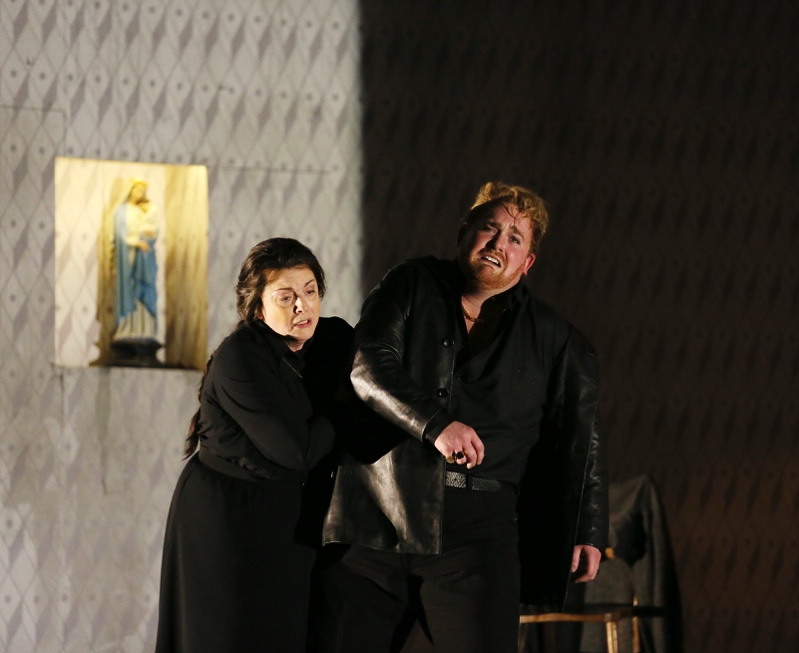
ENO: Jenůfa ★★★★

Photo by Donald Cooper.
Despite how musically rich and sensitive Janáček’s opera Jenůfa is, its grotesque storyline, which includes the murdering of a child, is not. It captures a sample of small-town life in Moravian Slovakia during the mid-1850s, which first influenced Gabriela Preissová to write Její Pastorkyňa (“The Stepdaughter”), which inspired Janáček to compose his opera.
Photo by Alistair Muir
It took 10 years to complete and during that time Janáček’s work took an autobiographical turn as his daughter, also caught up in an unhappy affair and a similar fate to Jenůfa, died from typhoid fever. Janáček takes us to a sound world of grief, shame and guilt in a society where tragic consequences, prejudice, and hypocrisy took place for a woman who bore a child out of wedlock – it was considered a mortal sin.
Janáček’s musical achievements are often neglected, unfortunately, and underperformed, though in the last couple of years there has been a surge of his great works programmed at some the UK’s top concert halls; The Cunning Little Vixen and Jenůfa is one of them. David Alden’s 2006 production, of the latter, has returned to the London Coliseum in luminous and triumphant form.
Photo by Donald Cooper
Back then the production won an Olivier Award for Best New Production, and if the 2006 production was as good as it was last night, then much credit is due to the intense focus of its outlandish characters, dramatic and minimal staging as well as its refined and impassioned melodies.
An empty run-down Eastern bloc of a factory yard, plucked from a Communist system, is how Charles Edwards’ displays Janáček’s Moravian Slovakian community. Jon Morrell presents simple costumes for the cast, drawn from a closed off society, while the lyrical score is welded together by the unwavering prowess of the ENO chorus and the finesse of the ENO’s most recent music director, accomplished Mark Wigglesworth. (He resigned from the position over controversial disputes with ENO’s senior management this year.) 
Stage and vocal performances from the lead cast are courageous too. Nicky Spence provides a vivid picture of Jenůfa’s lover Steva; he’s an obnoxious alcoholic and reckless womanizer, yet he sings with a rich and fluid voice. His brash character is so superficial that he leaves Jenůfa after his jealous half-brother Laca, sung impressively by Peter Hoare, slashes her cheek with a knife, out of frustrated love for her.
Laura Wilde offers a true and honest depiction of a troubled woman starved of love, childless, and left bitterly disillusioned. Although Wilde’s vocal lines brim with empathy and sentimental force as Jenůfa, it isn’t as powerful as I would like. Hopefully, this is insight based on the first night only and her performance enhances as the production goes on.
Michaela Martens, on the other hand, took charge of the stage as Jenůfa’s paranoid and concerned stepmother Kostelnicka – her voice is utterly spellbinding. Her character is the catalyst in the opera, and Martens encapsulates the trauma of a mother consumed by a community controlled by religious and social pressures.
Rarely performed, David Alden’s production at the ENO is worth the watch even if it is almost three hours long. Any die hard Janáček fan should make it their mission to see it.

This production is showing until the 8th of July. Click here to see the ENO website and purchase tickets. 

Saturday, 14 May 2016

The Dark Mirror: Zender's Winterreise at the Barbican ☆☆☆

Ian Bostridge in The Dark Mirror ©Hugo Glendinning

First, I must admit that I am more familiar with Schubert's Wintereisse through the voice of Ian Bostridge, but sung 'straight' with nothing else but a piano to accompany the tenor. Last year, I was completely absorbed by Bostridge and international pianist, Thomas Adès’s intimate concert at the Barbican (click here for review), when it was performed to coincide with Bostridge's book, Schubert's Winter Journey: Anatomy of an Obsession. Bostridge’s take on this landmark piece encapsulates the literary movement, Romanticism, which also inspired many cultural icons including Samuel Beckett.
Wintereisse is regarded as one of the greatest song-cycles ever written. The emotional impact, the sense of longing and loss, which also influenced German poet, Wilhelm Müller who was known by his contemporaries as the 'German Bryon.' Schubert’s music and German poetry stirs and captivates audiences, and gets them to ask, 'who is this young man in despair? Why does he depart and wander into the cold? And why does he lament lost love? Schubert - who died at the young age of 32 - has written a work that hones in on the darker reflections of man, the meaning of existence and the human condition.
Now, we are back again at the Barbican, a year later, to hear the same delightful voice, but not to the tone or source of Schubert, but Hans Zender in a multimedia staging directed and designed by Netia Jones.
The Britten Sinfonia, robustly conducted by Baldur Brönnimann, are located on the right side of the stage and begin with scratching, blowing, wind-like sounds. It doesn't get straight into the first piece 'Gute Nacht', but has you lingering for a while as it builds to a formidable crescendo, subtly and elegantly ceased by violinist Thomas Gould with the beginning bars of our much-loved first piece. Zender's music distorts, echoes, re-records, and stretches - you simply don't know what to expect. With more than twenty musicians of the Britten Sinfonia performing, ranging from a guitarist, harpist and accordion player, the work is unusual and full-on experimental. Though there are many moments where the impressive music sends you off, drifting to a cold and empty place.
Ian Bostridge in The Dark Mirror ©Hugo Glendinning
First performed in 1993, Zender's re-laying of the work exemplifies the loneliness and depression of our protagonist, providing a different interpretation to the Winter's journey for a modern audience. This interpretation being far more distant and harsher, and, at times, uncomfortable through Jones's visual projections, bold lights and moving imagery. Bostridge had performed Schubert's cycle for a TV film, under the direction of David Alden, which was first broadcasted in 1997, and there in the background are huge projections of Bostridge's younger self, singing the same words as his current 51-year-old self.
This somber imagery is mesmerising - Bostridge is confronted face-to-face with his youth. One side of the screen is a side profile of himself while the other is his former self looking back at him. It is a pinnacle moment - audiences' will reflect on their youth in a split second. The use of black and white, even gray, instill Winter hues and allude to memory and recollection. The monochrome display and use of film also suggest various genres from film noir, black and white film and Weimar cabaret.
Jones's multimedia moves us into freezing temperatures, murky shadows, fields and landscapes of snow, rain storms and oceanic waves. The camera, also known as a 'dark mirror', is a powerful source of presenting another version of reality, which rings true for many film-makers. Yet Jones's vision, although ambitious and unique, can be distracting and overwhelming. Sometimes, it felt like I was watching a cheap karaoke film, except we, the audience, aren't allowed to sing along.
However, Bostridge did not disappoint. His tenor voice sung with deep sorrow, which is spellbinding for an audience, which would most likely be filled with many of his fans. My favourite pieces - Der Lindenbaum (the Linden Tree), Der Leiermann (the Hurdgy-Gurdy man), Die Post (the Post), Die Krähe (the Crow) - were just as eloquently and vividly sung. In summary, I prefer my Winterreise 'straight', not shaken, but any Bostridge devotee would be silly to miss out.
This event took place from 12 - 14th May 2016. For more information about the event, or events at Barbican, please click here.

Wednesday, 11 May 2016

The Magic Flute: Budapest Festival Orchestra and Iván Fischer ☆☆☆☆

Last night saw the fabulous Budapest Festival Orchestra and its characterful conductor, Iván Fischer present The Magic Flute at the Royal Festival Hall. The evening was an enjoyable one, and the 'staged concert', the maestro had called it, brought to light what can – really - be recreated at the Royal Festival Hall. Most operas and concerts at the Royal Festival Hall involve soloists with scores read from a music stand and the orchestra behind them, yet this event was a special one - a proper stage for Mozart's action to take place, with the orchestra delightfully performing below in the pit.

The Budapest Festival Orchestra, known as one of the top orchestras in the world and winner of various accolades (including New York Magazine's 2013 list of the city's top classical music events and numerous Gramophone Awards for their orchestral albums), is currently on an international tour amid funding cuts decided by its city's General Assembly - cuts from 260 million forints (US$938,000) to 60 million forints (US$217,000). That being said, the performance last night proved how solid and defiant the orchestra and its maestro were at such a crucial time; only last Saturday they protested in Vörösmarty Square, central Budapest.

Last night, Fischer displayed his inner child as both conductor and director of the production, with singspiel successfully presented by English actors, (though I must admit, I wasn’t privy to this and thought Mr. Fischer actually needed real audience members to play a role in the opera. Damn it!) Originally performed in German as Mozart’s librettist Emanuel Schikaneder wrote it in the 18th century, Fischer had adults, teenagers, and children enjoy an evening of German singing and English dialogue, with large visual projections of pages plucked out of a children’s storybook.

This crafty technique meant fewer issues with moving around props or set designs, which hardly happens at the Royal Festival Hall, and, therefore, more visual stimulation and absorbing imagery for the audience. Actors and singers worked in sync with one another – Scott Brooksbank would translate the words and feelings of Tamino just before Bernard Richter projected Tamino’s deeper emotions and love for Pamina with his beautiful voice. The same can be said for actor, Bart Van Der Schaaf who’d bring the English crowd back to London, out of the dream-like fantasy, as lonely bird-catcher, Papageno. He released some light humour here and there, which was tidied up by bass-baritone Hanno Müller-Brachmann’s impressive voice.

The conceptual and creative imagery deserve attention too. Much scholarship has been invested into the hidden meanings in Mozart’s ‘grand opera’, most of which has alluded to the overtly Masonic nature of the piece, coinciding with 18th century Enlightenment, and in this production images of the sun and moon were prominent throughout. Though the opera is perfectly accessible for children, there are elements of opera-seria cleverly implemented with the symbolism of the Queen of Night, which was performed by Mandy Fredrich last night. Her voice hit the royal high-Fs but, from my rear stalls, it would have been nice to hear her sing a little louder, otherwise she gave a good enough performance of ‘Der Hölle Rache’, which kept the younger audiences happy. Particularly memorable was Hanna-Elisabeth Müller as the captured princess, Pamina. She has a distinctive colouring and sung with particular control and composure, which made her voice shine in ‘Ach Ich fühl’s’.


Krisztián Cser, Norma Nahoun and Rodolphe Briand gave confident and reassuring performances as Sarastro, Papagena and Monostatos. The three ladies in purple and blue wigs, sung by Eleonore Marguerre, Olivia Vermeulen, Barbara Kozelj also gave brilliant performances. And not forgetting the three boys, also dressed up as little lions, from The Hungarian State Opera Children’s Choir. They were squeaky clean on stage, and a delight to see and hear.

There were some unique moments to remember including an English speaking, and older version of, Papagena attempting to communicate with a German speaking Papageno, desperately trying to wake up his English counterpart. And towards the very end, when Papagena and Papageno come together to sing their duet, ‘Pa Pa Pa Pa, their puppy love is expressed by mushy imagery of children sprouting in the background. Yet mushy pantomime aside, Fischer seemed excited and pleased to be performing this night. The Budapest Festival Orchestra performed with flair yet they weren’t on fire - they honed in their enthusiasm enough to perform the opera in a light-hearted and leisurely pace. That’s not to say the opera was slow, but indeed, a playful and fun production, safe enough for children. Yet, it would have been nice had Papageno been a little bit wittier with his jokes - nevertheless a fun night at the staged concert. 

For information on classical events at the Southbank, click here http://www.southbankcentre.co.uk/.

For more about the Budapest Festival Orchestra, click here http://www.bfz.hu/.


Saturday, 9 April 2016

Deutsche Oper Berlin 2016: Salome ★★★ and Elektra ★★★★

 
Salome: Photo by  Monika Rittershaus

This month sees many operagoers heading over to Deutsche Oper Berlin for a Strauss extravaganza.  Der Rosenkavalier, Die liebe der Danae, Elektra and Salome are a few of the operas scheduled in and I had the pleasure of seeing Evelyn Herlitzius as Elektra and Allison Oakes as Salome this weekend.

It was my first time at the oper haus and I learnt much about its individuality and uniqueness from its friendly staff, quality of productions and audiences. For a start, while I fretted over finding an English translation of the librettos for these operas, it really wasn't needed. Deutsche Oper provides surtitles in both English and German - simultaneously! Not only does it make life easier for people like me who can't speak or read German, it can be very appealing and encouraging for its international audience. The productions (having seen both Salome and Elektra on consecutive nights) were irrefutably modern and abstract, yet I’m aware that I’m limiting my judgement based on two productions only. And there's no problems on the acoustics side either. Although it is large auditorium there was hardly any obnoxious echoes. Pretty solid sounds if you ask me.

Other things that added to my pleasurable experience at Deutsche Oper included the dress code which is practically nonexistent (not that I have a hard time deciding what to wear for the ROH OR ENO). Also, how easy it was to grab my jacket without having to worry about a stampede of fussy people, shoving and elbowing each other to get their belongings. In fact the cloakrooms are conveniently located at the entrance – it’s the first thing the staff attendant will bring your attention to. There’s also a decent bar on the first floor to grab a drink before the show.


Salome ★★★

I saw the Deustche Oper Berlin orchestra perform Salome back in 2014 at the BBC Proms, under conductor Donald Runnicles, so I knew musically I wouldn’t be disappointed. Tonight saw Alain Altinoglu conduct the orchestra, and although it was my first time seeing him perform, I was more than impressed as he encapsulated much of the drama and intrigue of this fascinating opera.

Vocally it was its lead soprano Allison Oakes who was the diamond in the production. Through and through, she portrayed a cold and cruel Salome, wary of her step-father’s lustful infatuation with her. Vocal quality was undoubtedly top-notch for many of its lead soloists including Michael Volle (Jochanaan), Herodias Jeanne-Michèle Charbonnet (Herodias) and Burkard Ulrich (Herods) who I had seen at the BBC Proms 2014 as well. However it was the staging that failed to move me. Oscar Wilde’s Succès de Scandale (1891) which Richard Strauss adapted into an opera, seemed not so scandalous here on stage.

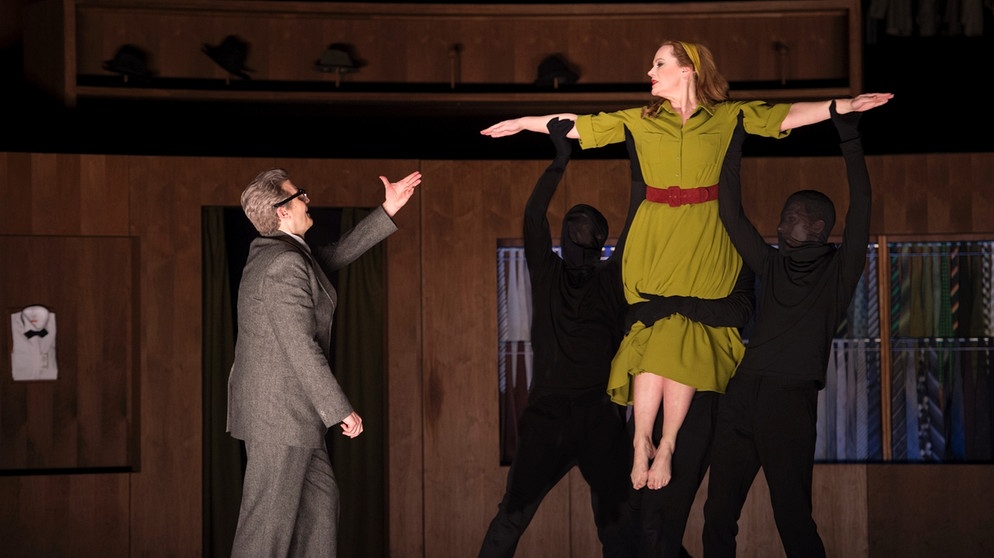
Director Claus Guth designs the stage as a high-end tailoring store for men with silk ties and mannequins on display. Herod’s soldiers including Narraboth (Thomas Blondelle) are suited up and just as robotic and zombie-like as the mannequins. Guth has six young girls running and dancing on stage randomly. All different ages, they resemble Salome at various phrases of her childhood and adolescent life, and this could be interpreted as Herods seedy perception of Salome. Its paedophilic nature is made known and deliberately perverse, though Strauss’s opera deals with a variety of sensational and biblical notions, not just necrophilia, that caused much controversy at its premier in 1905. In this production, however, Guth leaves it to the Deutsche Oper Berlin orchestra, Altingoglu and the expert soloists to unleash the emotional turbulent music of Strauss to carve out the sensationalism, blood and moral destruction for the audience, made not explicit on stage.

The sensational part of this production, however, is how drip and drab the staging was. Jochannas is introduced as naked and found in a rubble of clothes. As he sings and tells Salome to stop trying to tempt him, he slowly puts on a suit and I wonder whether this has anything to do with Salome’s power and authority in the narrative... (I don't know, the mind boggles.) Either way, I found myself wasting time attempting to decipher the abstract symbolism on stage than actually enjoying the performance. Oakes, Altinuglo, Volle and Ulrich and the music seemed to be the production's saving grace.

Elektra ★★★★ 
Photo by Bettina Stöß

Having seen Donald Runnicles conduct for Salome at the Royal Albert Hall back in 2014, I knew I was guaranteed a solid performance. Here Runnicles as well as the Deutsche Oper Berlin orchestra were tenacious and much has to do with Strauss’s score, full of dissonance, leitmotifs and chromaticism. It’s hard to fall asleep when the music screams revenge!

Evelyn Herlitzius as the bitterly resentful Elektra is the tour de force of the production, and this is shown from the moment she sings the first few bars of "Allein! Weh, ganz allein.” The singing is praiseworthy and engaging; you forget where you are and all eyes can’t stop themselves from gazing at Herlitzius calling for her father Agamemnon. Though distinguished vocals aside, her potrayal of Elektra is toxic, psychotic and even scary. She describes Elektra as obsessive. Addicted to the idea, and willingness, to kill her mother and her lover. It's not a pretty picture and Herlitzius transcends that.

This opera of disjointed family relations, Greek royalty and murdering backstabbers takes place on Bernd Damorsky’s soil and dry mud stage, enclosed in golden painted walls. Is this the mind of Elektra? Shrouded in gold but stuck in limbo? The staging has nothing else to distract us but a door that opens above Elektra where her treacherous mother Queen Klytämnestra watches down on her. This minimal staging worked appropriately and permitted the audience to focus on its performers, Strauss’s phenomenal music did the rest. Doris Soffel as Klytämnestra hit the notes needed, even though her red couture made her look like Cruella de Vil's doppelganger. Her hideous laughing was effective, making her character easier to hate.

Elektra’s sister Chrysotemis - who Elektra attempts to get kinky with, attempting to engage in some incestuous kissing, fondling and rolling around on the soil - was sung by Manuela Uhl. I wasn’t entirely convinced by Uhl’s singing, which managed to move some of the audiences (as I saw at the curtain call). What she successfully did, however, was manage to irritate me with her innocent and non-confrontational depiction of Elektra’s sister. I found her annoying, but perhaps that’s the point. Chrysotemis doesn’t want to help her sister avenge her father’s horrific murder because, essentially, she is a coward.

Tobias Kehrer was mighty impressive. I had seen him at the Royal Albert Hall singing as Osmin in Glyndebourne’s 2015 production of The Abduction of the Seraglio, which made my viewing of him in the role of a serious and semi-heroic character more intriguing. From an oafish and comedy character to seeing him as Oreste, the son of Agamemnon, was marvellous. I’m a fan of his rich bass voice and to see him running around in anger through the soil and grace us with a sentimental scene reunited with his distressed sister only proved how versatile he can be as a performer.

Out of the two operas (Salome and Elektra), I felt much more pleased with the second opera, given the less-is-more concepts on stage. Director Kirsten Harms (who was given a
honorary membership of ! at the curtain call of the night I saw her) seemed to have harnessed the best of Elektra, Strauss’s and librettist Hugo von Hofmannsthal‘s highly-powered opera.


The productions of Salome and Elektra have ended but here are various Strauss operas available. Please have a look at their website here. 

Friday, 1 April 2016

Musical - London Coliseum: Sunset Boulevard with Glenn Close ★★★★


"Glenn Close is ravishing. She reprises the role of Norma Desmond, making her debut in London which has won her several awards in Los Angeles and Broadway. Dressed in silks, furs and sophisticated couture, made exclusively for showbiz royalty and divas, she engages the audience’s eyes and converts them all, even those who don’t like musicals. She is a charismatic beaming star when she sings songs including ‘Surrender’, practically whispering before she gives vocal bravado to ‘As if we never said goodbye.’"

Click here to read my 5-Star review at www.LondonTheatre1.com.
https://www.londontheatre1.com/news/134953/5-star-moving-unique-ingenious-production-sunset-boulevard/