


I didn't get the chance to see as many musicals and plays in London this year. However, having viewed thirty-four shows, there was still a lot of theatre craft and creativity to praise. Here are my favourite shows from Theatreland; from the West End and Fringe world.
Other links:
Opera at a Glance in 2015. My review from major opera houses in London (Click here)
Fringe Opera Favourites for 2015: (Click here)

Theatre and Opera Reviews by @MaryGNguyen
Showing posts with label Almeida Theatre. Show all posts
Showing posts with label Almeida Theatre. Show all posts
Thursday, 31 December 2015


Monday, 15 June 2015
Almeida Theatre: Oresteia by Robert Icke ⭐⭐⭐⭐⭐

Theatre lovers will know Robert Icke for directing the
pathological whirlpool, 1984 with Headlongt heatre-company. The
production has gone from strength to strength and returns to the West End this
week. As part of the Almeida’s summer season – devoted to classical Greek
theatre – Icke has righteously kicked it off with his new, cool and jaw dropping production
of Aeschylus’s 2,500-year-old play, Oresteia. It’s a supremely important canon
of Greek drama and arguably the life-blood of theatre.
Icke translates Aeschylus’s text for a contemporary setting that is highly relatable, minus the kinship blood bath. (Those new to Greek tragedy are welcome). Aeschylus’s emblematic narrative highlights family sacrifice, Greek deities, death and morality and although there’s much talk of the supernatural Icke’s production is entirely modern and doesn't try too hard with theatrical tactics.
Icke translates Aeschylus’s text for a contemporary setting that is highly relatable, minus the kinship blood bath. (Those new to Greek tragedy are welcome). Aeschylus’s emblematic narrative highlights family sacrifice, Greek deities, death and morality and although there’s much talk of the supernatural Icke’s production is entirely modern and doesn't try too hard with theatrical tactics.
The subject matter is barbaric: father kills daughter; mother
kills father; then, son kills mother. There’s
shocking scenes of violence, seeping blood and raging arguments, which is
mellowed with crafty moments of silence, which go part and parcel with
Icke’s Greek tragedy. The trilogy lasts, just under, 4 hours and although this might sound long it is
cleverly timed and fails to bore the audience.
Stage director, Hildegard Bechtler utilises a table and large glass panels, with subtle modes of technology (e.g. digital clock). The rest, of the imagination, is left in the hands of its outstanding cast who play characters with their own depth of fascination.
Stage director, Hildegard Bechtler utilises a table and large glass panels, with subtle modes of technology (e.g. digital clock). The rest, of the imagination, is left in the hands of its outstanding cast who play characters with their own depth of fascination.
Angus Wright as Agamemnon is a ballsy, authoritative leader but
shows pithy signs of fatherly fragility and warfare indecision when left with no
choice but to appease the gods and drug induce his daughter. Wright presents a
harrowing scene as a TV cameraman zooms into Iphigenia’s
face, played by little Clara Read, and the blood absorbs the poison and
she slowly closes her eyes.
Downtown Abbey’s young beaut, Jessica Brown Findlay, is the anxious, angry and disturbed daughter, Electra who moans the death of her father and makes a moving and empowering statement on stage. And Luke Thompson as the ‘snake’ born from his mother’s womb, Orestes gives a fine performance of a deeply distressed and psychopathic son.
Downtown Abbey’s young beaut, Jessica Brown Findlay, is the anxious, angry and disturbed daughter, Electra who moans the death of her father and makes a moving and empowering statement on stage. And Luke Thompson as the ‘snake’ born from his mother’s womb, Orestes gives a fine performance of a deeply distressed and psychopathic son.
Lia Williams, as Klytemnestra, however steals the spotlight and
acts as a focal point of the tragedies that befalls her house. We see her as a
mother, wife, queen, supporter of her husband’s political battles and a monstrous
betrayer. She appears seamless in the role, as if Klytemnestra was written for
her. What’s
more interesting is how intelligent and tremendously irresistible Icke’s
adaptation is even though the stage is prosaic. Icke’s serious overtones, poetic
imagery with Greek drama qualities is inventive and authentic and
makes for an exciting and thought provoking show. Although the last segment,
where the Athenian jury judge Orestes for his barbarous crime, is slightly off
from the rest of the play, it’s a tense and interactive scene. The audience can decide whether or no Orestes
is guilty.
Icke manages to get the audience to put their thinking caps on. Do we look at Greek
tragedy as a form of theatre that should be left as it is or a genre that can be
moulded into another contextual environment? Almeida’s
other two Greek season "modern" productions, Bakkhai
and Medea
of Euripides, may help assemble our answer.
Complimentary ticket not provided. Pictures courtesy of Guardian and Almeida Theatre. Theatres for Oresteia is available until July 18th. Click here to purchase tickets and more information. Running time 3 hrs 40 with 2 intervals.
Lia Williams as Klytemnestra in @AlmeidaTheatre is dynamite. Robert Icke’s tense interpretation of Aeschylus' greek tragedy is worth seeing
— Mary Grace Nguyen (@MaryGNguyen) June 13, 2015
Oresteia @AlmeidaTheatre is as outstanding as theatre critics say. Anyone who has seen Strauss' opera, Elecktra should go and see it.
— Mary Grace Nguyen (@MaryGNguyen) June 13, 2015
I'm here for the Greek season! @AlmeidaTheatre #Oresteia .Three stories in one!
Aeschylus' greatest and final play. pic.twitter.com/hLUhSJ7Mtd
— Mary Grace Nguyen (@MaryGNguyen) June 10, 2015
Sitting by Downton Abbey’s Jessica Brown Findlay who plays Electra in @AlmeidaTheatre #Oresteia.She's stunning in person as she is onscreen
— Mary Grace Nguyen (@MaryGNguyen) June 10, 2015
Friday, 19 December 2014
The Merchant of Venice ★★★★ All that glitters ...is marmite

Just look at the posters and banners of the
production. It’s a neat photograph of a golden hamburger. What does this have
to do with Shakespeare 16th century play The Merchant of Venice?
Zany as it may seem but artistic director Rupert Goold has rolled the dice and
partook in some risky business by - somehow – merging Shakespeare’s Elizabethan
script with the money gambling world of Las Vegas. Shakespeare purists and
traditionalists may want to look away as this modern interpretation is more of
a Goold special minus the literary flourishes and peculiarities of
Shakespeare’s highly contentious play, known for its antisemitism.
Pop-culture and American accents take to The
Almeida Theatre’s stage more so than Shakespeare’s own words. If you don’t like
the idea of an Elvis impersonator interjecting - at random- Elvis’ best love
ballads, or new hip club numbers or US rapper Jay-Z for that matter, then forget it! There are shades of Crime TV drama, The Sopranos at work too. However, if you like modern
experimentalism and something extremely different, then you’re in for an
evening of entertainment and tacky American fun.

Despite exposing a tacky golden stage it’s quite
accurate of real Las Vegas, which is, in actual fact, very filthy and
cheap-looking. (Trust me! I've been there.) Tom Scutt’s set design is authentic and no stranger to Sin
City’s superficial nature. He designs it as the fruit machine and commercial
ridden television screens of Belmont Casino where Portia (think American sweet
heart meets Alicia Silverstone from Clueless with a Southern twang),
righteously played by Susannah Fielding, has to marry a suitor on the request
of her father. The suitor who chooses the right casket out of three: gold, silver
or lead, wins her hand in marriage, all of which is televised on a TV game
show. Our Prince of Morocco is a boxer flaunted by Vinta Morgan who
impressively manages to shadow box and speak in iambic pentameter at the same
time. The buffoon Prince of Aragon (Vincenzo Nicoli) is freshly delivered from
Mexico and can do many things whilst dancing his feet away to dodge bullets. He
shouts ‘Viva España’ with a thick South American accent and welcomes a
pantomime boo from the audience. Yet it is her true love Bassanio (Tom
Weston-Jones) who chooses the right casket but gets himself into a financial
pickle with the supposed Jewish anti-hero Shylock (Ian McDiarmid), which puts
his good friend Antonio’s (Scott Handy) life at risk, potentially losing
‘a pound of flesh', literally!
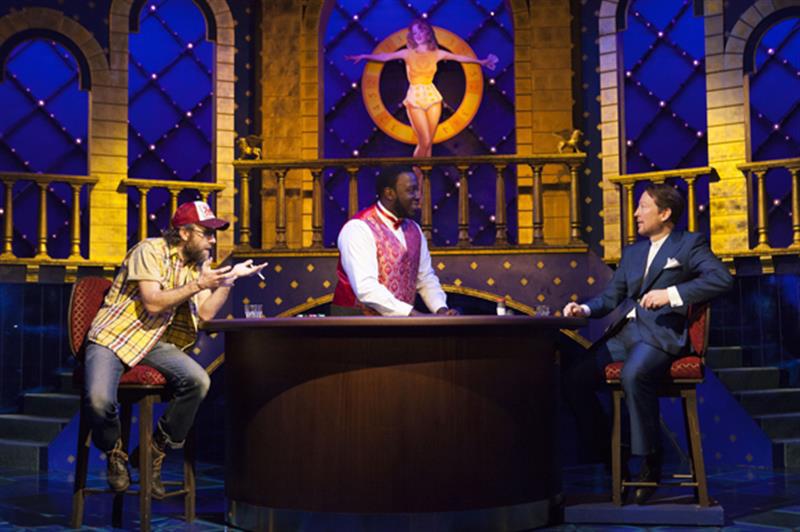
McDiarmid, the former artistic director of the
Almeida who is known for his role as Palpatine in the Star Wars films, portrays
Shylock as a casino owner with a strong Germanized accent. Although a
controversial and villainous character in Shakespeare’s play, notably for his
devotion to Judaism, Goold’s production paints religion as a hypocrite - dialogue is brutally cut throat but doesn't make the production, on the whole, antisemitic. In
the final scenes where Shylock is forced to convert to Christianity, there’s
both a sense of cruelty from the Christian side and vulnerability from Shylock.
The pity we first felt for the Christian Antonio, who’s inches away from losing his own flesh, is transferred to Shylock who is spat at and physically abused, which is
an uncomfortable sight, repeatedly depicted in most productions of Shakespeare’s
play. Yet despite bringing in an interesting version of Shylock, McDiarmid
unfortunately leaves out the gravitas of Shylock famous 'hath a Jew not eyes'
monologue, which is a distinctive part of the debate surrounding his character.

Nonetheless, the production has cast members who are a sight for
sore eyes such as Rebecca Brewer as Stephanie, Emily Plumtree as Nerissa and
Merry Holden as Conscience. Anthony Welsh as Gratiano and Raphael Sowole as
Salerio play honourably on stage as well as Tim Steed as Solanio. And Jamie
Beamish as Gobbo, aka Elvis, does his best at singing until his heart’s
content.
Brewer and Fielding serve justice on a silver
platter as they disguise themselves as male lawyers in the final act and
together save Antonio’s life. Particularly with Fielding, she takes care in
reinforcing Portia’s dissatisfaction with her own marriage dilemma and
acknowledges fake from reality. As much as her life is showcased on
television, she takes off her wig and stilettos to reveal her
inner self to her true love.

There’s a lot to admire in Goold’s novel
production, but it may be deemed as marmite for some – not everyone will like
it.
Showing until the 14th February 2015. Click here to purchase tickets Photos courtesy of Almeida Theatre.
#TheMerchantofVenice @rupertgoold @AlmeidaTheatre If anyone can merge Jay- Z& Shakespeare then they have my respect pic.twitter.com/O7ERTuwK0I
— Mary Grace Nguyen (@MaryGNguyen) December 19, 2014
Subscribe to:
Posts (Atom)