Showing posts with label Rose Theatre. Show all posts

Monday, 13 October 2014

Christopher Marlow: The Massacre at Paris ****


The Massacre at Paris is one of Christopher Marlow’s most known plays amongst Faustus and Tamburlaines. Once again we face the conundrum of a 400 year old neglected play that has been hidden away from wider audiences. This year celebrates the 450th anniversary of Marlow’s birth and it’s a pity that not enough theatregoers have been exposed to The Massacre at Paris as it has undoubtedly played a massive part in the history of theatre, film and directors today. However the Rose Playhouse and The Dolphin’s Back theatre company have come to the rescue; they have created two productions of The Massacre this year both directed by theatre virtuoso James Wallace, staged like it was back then in 1593, where The Massacre premiered.

As the title suggests there are a lot of murders; eighteen staged murders to be precise.  Without saying too much, The Massacre refers to St Bartholomew’s Day when thousands of protestant Huguenots (men, women and children) were brutally killed across France. Marguerite, played briefly by Ella Road, the daughter of the Queen Mother of France (Kristin Milward) married the Protestant Henry de Navarre (Rhys Bevan) and from then, hell broke loose. Up to 3,000 people were slaughtered in Paris alone, which was, arguably, orchestrated by the zealous and tyrannical Duke of Guise (John Gregor).
Elizabethan plays have their charm in eliciting witty poetry however some of these flourishings were beaten up in The Massacre by bad exit lines with the stereotypical, and dramatic, ‘I die’ lines, which was nicely achieved by Beth Eyre. Due to the number of characters – up to forty- which, the actors and actresses had to play, it’s a bit of a memory job having to keep up with whose playing who yet the psychological thriller and slasher-type performance is easy on the mark; the audience do not need to know the finer details of the plot to understand what’s going on.
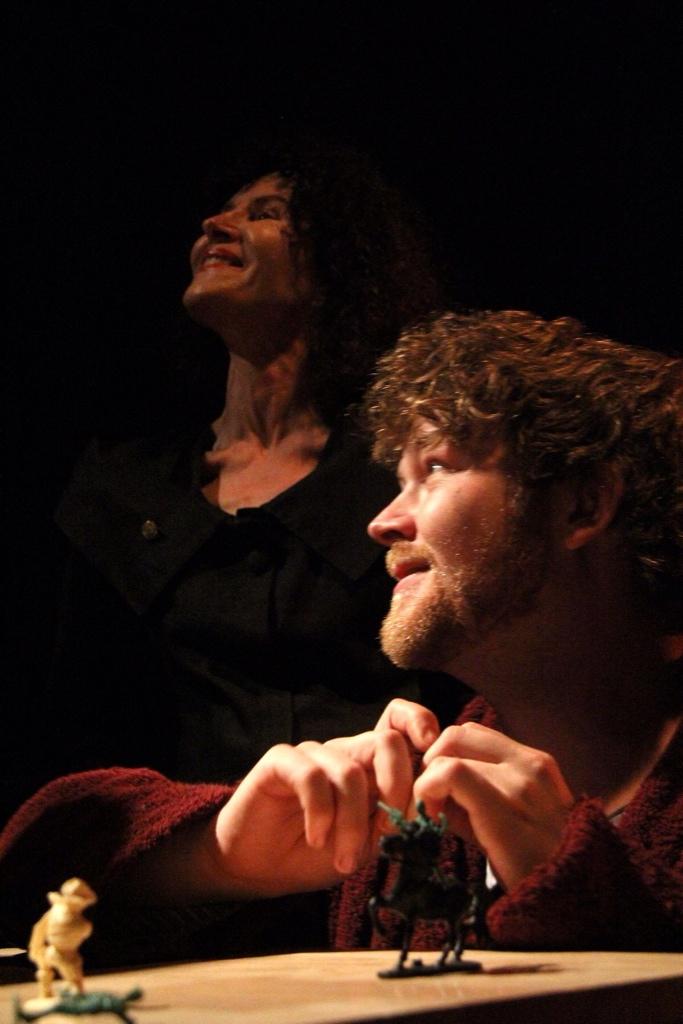
The Royal mother and Son: Kristin Milward &
James Askill
Fake blood, paint, ink or any form of liquid is devoid on the Rose’s stage; yet it is just as effectively spilled through plenty of red, yellow and white confetti - it never runs out. I had the privilege of being showered by red confetti, myself, when a baby –made out of cloth- was slashed in Ella Road’s arms.  
Kristin Milward bestowed an evil queen and she made this apparent from the outset with her husky voice and Cruella De Vil demeanour. David Meunier-Palmer’s coordination of light is an important element to this production as used in the Duke of Guise’s dark monologue. John Gregor owns the stage at this point swinging his golden cross medallion whilst repetitively sneering the word ‘religion.’ When he depicts violence or self-pity, by parallelling Guise with Julius Caesar, he retains a sense of malice, which continually surges in his gripping, yet obnoxious character. 
John Gregor as the Duke of Guise
James Askill and Rhys Bevan were recently in the Rose’s production of The Woman in the Moon, also directed by James Wallace, which was welcoming to see. Askill retained the humour he had as a shepherd, from the previous play, yet his moments as the stern and royal Henry III were riveting and hair-raising. He seemed comfortable with Marlow’s text and knew when to drop the comedy. Bevan, on the other hand, had less dialogue as the King of Navarre yet, I felt, his words had little conviction; this king seemed, almost, clueless and indifferent about the massacre where there should have been inklings of remorse.
Overall, all cast members did a brilliant job of handling this multidimensional and wordy play.  With screaming, bodies being dragged on the floor and a shocking scene where we watch a cardinal get strangled to death in a space of a minute, I'd say, it’s definitely worth a look into if you haven't seen the The Massacre before. Don't be surprised when you hear Tarantinoesque music playing in the background as it fits in too well with the frantic mob and confetti bloodbath scenery. Midway through the play Guise stamps on a dummy head twenty times; but don't be put off - I found it rather funny, even if it wasn't meant to be.
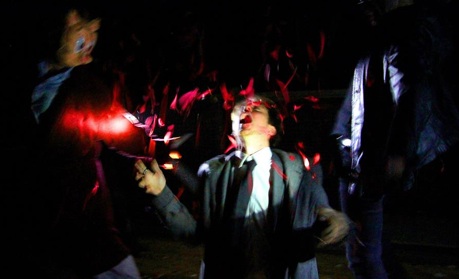
Slasher movie? No, it's Christopher Marlow's Massacre at Paris


The Production takes place at The Rose Playhouse, Southwark until the 26th October. Click here for more details. Click here if to read more Rose Playhouse reviews.

Sunday, 5 October 2014

The Woman in the Moon - John Lyle - The Rose Theatre ****

Timothy George as Sol with Bella Heesom as Pandora
[Date Written:3rd October 11am London time]
I’m currently typing away from Amsterdam’s Schiphol airport awaiting my transfer flight to Munich. While I wait, I thought I’d share with you some of my views of the magical and mysterious play I saw last night at the Rose Playhouse theatre.
The Woman in the Moon by John Lyly is rather unknown however it boasts luscious poetry and blank verse interweaving mythology and stories from Ancient Greece with intriguing notions of Utopia, which deserve a larger audience, and particular attention from, more, theatre companies. It was written during Shakespeare’s day in the 1590s. Shakespeare and Christopher Marlow were, undoubtedly, Lyly’s contemporaries at the time.   
At first, it was ‘presented before her Highnesse’ at court during the Elizabethan era. Since then, it has been performed, but only in a few places; more recently in universities in Pennsylvania, London, Toronto and Sussex. It has also been performed at the Shakespeare Globe as a two-staged reading, the old Bear Gardens Theatre and at last year’s Glastonbury Festival. Following on from Glastonbury, James Wallace directs this unique play dubbed as ‘an astrological sex comedy’ at the Rose, which is the first of its kind after four hundred years.
Lyly found inspiration through an illustration introduced by the astrologist and mathematician Robert Fludd, which underpin renaissance philosophy and its conception of man being made up of the four elements (earth, wind, fire and water) and attributes of the seven celestial planets. The Woman in the Moon puts a woman at the center of this macrocosm that shows how the female form is threatened by forces external to the world around her.

Julia Sandiford as Nature
At the dark and intimate setting of the Rose, with the excavation area speckled with brightly lit umbrellas, we find Pandora, diversely played by Bella Heesom, sleeping soundly in a bed. The Queen of Nature (cast by the eloquent Julia Sandiford) commands and summons her gods, goddesses and handmaids to watch her create the greatest gift on earth; yet the gods selfishly, in turn, manipulate and recreate her personality, emotions and bodily form, which we see through the way she treats her servant Gunophilus (James Thorne) and the four naïve shepherds; Stesias (Joel Davey), Learchus (Rhys Bevan), Iphicles (James Askill) and Melos (Robert Heard) who are enchanted by her beauty. Thorne and the four hapless shepherds are like the seven dwarfs (five dwarfs in this case) that stick together and gather pity from the audience through their clown-like charms and witty catch phrases stylised by Lyle’s words. 
Our four shepherds: Stesias (Joel Davey), Learchus (Rhys Bevan), Iphicles (James Askill) and Melos (Robert Heard)

The comedic aspect of the play is hot and fertile on the Rose theatre's stage with much movement and momentum from all cast members particularly Thorne, Davey, Askill, Heard and Bevan. Davey plays Pandora’s husband who suffers the most in this play as he is plagued with jealousy and goes a bit mad dressed in drag, as Pandora, chasing down whoever maybe condoling with her.

We watch as these mortals loss themselves in Pandora’s temperamental and easily changeable moods which are orchestrated by the multiplicity of the animated gods and goddesses; Saturn (Llywelyn ab Eleri), Jupiter (Gareth Radcliffe), Mars (Adam Cunis), Sol (Timothy George), Venus (Keira Duffy), Mercury (Theo Kingshott) and Luna (Lila Whelan). Each of them are dressed as if they are attended a fancy dress party and depict their godly powers. The most interesting dress goes to Duffy in a long green wig, glittery stilettos and PVC skirt as the temptress Venus. When she reforms Pandora, she sexualises her by showing her how to move her female body and accentuate her curves to groovy dance music.
Bella Heesom as Pandora

Jupiter’s spell makes her proud as he hands her his golden sceptre (and makes an orgasmic sound after). Mars makes her a bit war-like and, rather, scary whilst Mercury makes her sly and cunning which almost divides the shepherds'.

At its conclusion, Nature is angered by the gods’ malicious and greedy intentions with Pandora and give her the choice to choose which god she’d want to stay with for eternity and after hearing Pandora’s argument for and against each of them, she sides with the goddess that I least expected. She chose Cynthia (or Luna) because she made her ‘fickle’, ‘foolish’ and, a tad, mad.
In these last scenes (just before this one), we see Heensom become confused and neurotic, which, marginally, mirrored  how she was under Saturn's control. Having read more about Lyle, I appreciate that he was in favour of womanhood as he said, ‘It is no second thing to be a woman’ yet without taking the feminist stance, I personally think, it may offend some and encourage audiences to think that this was the way Lyle viewed women.

Through and through, the show made the audience laugh which made me think that the outcome would be, a little, light-hearted, yet, for me, this was not the case. I am not insisting that the play is entirely misogynistic. I am aware that the play was written during a time when women weren’t allowed to act on stage and understand how relevant it may have been then, but perhaps not now. Nevertheless, it was a funny show, after all.
The cast gave a triumphant display of a work that should be reproduced again and again. The Rose theatre's successive sold out production is testament of this alongside the intrigue of Lyle's satirical and mesmerising play.


The show has ended however, please click here to view more of the Rose theatre's current and future productions.

Sunday, 8 June 2014

Orpheus and Eurydice to celebrate Gluck's 300th anniversary at the Rose Theatre ****


Pamela Schermann, international opera and theatre director has teamed up with the young and diverse theatre company, Time Zone Theatre, to produce Christoph Willibald Gluck’s most popular and reformed opera, Orpheus and Eurydice at the Rose Theatre, which also celebrates Gluck’s 300th anniversary.

Schermann says, ‘…which other venue could have provided me with an Underworld like that…?’  And the audience couldn’t agree more. The Elizabethan theatre that has been undergoing construction since 1989 has proven theatrical zeal and potential. The cave-like pit, which is covered with water to avoid cracks from developing, is an ideal replica of a River Styx.

Gluck’s 18th century operatic vision of the Greek mythology was grounded on placing emphasis on the simplicity of both music and drama to accompany an uncomplicated plot and given how small the Rose theatre is, it delivered a close and personal show with singers (and choir ensemble) with captivating music with the use a humble quartet. Violinist (Julian Fish), flutist (Hannah Grayson,) harpist (Anne Denholm) and pianist (as well as conductor), Andrew Charity gave a performance that made eyes lock onto their instruments which is a rarity in traditional auditoriums where orchestras are hidden in the pit.   

Lyric Tenor, Robin Green who was Orpheus, had a chest infection this evening, yet given the circumstances did his best to enthral the audience. One can only imagine how fruitful he would sound on a better day. Gluck warned that for any singer casted as Orpheus, they faced the challenge of counteracting dullness that can easily settle with the opera’s harmonious music; by nature, the songs do not sound mournful. The expressive recitatives used in ‘My sad complaining’ and ‘I have lost my Eurydice’ were beautifully sang by Green, however there was no need for him to sing whilst putting clothes on at the end of Act 1 where his vocals were clearly struggling. 

The talented Latvian Soprano, Darja Scukina as Amore, is our cheerful cupid with fluffy black wings. Schermann implements a community choir to play the eight members of the Furies who at first say ‘No! No!’ to Orpheus' plea yet once sweetened, Green slowly unveils them as they sing, ‘we are subdued… let him into hell’ which in done in a rather ironically pleasing way considering that no one, in real life, would want to go to hell.

The dark excavated area of the Rose is taken fully advantage of by the singers, Green and Mimi Doulton (Eurydice) who although positioned far from the audience, and the quartet close by, gives vocal clarity and sharpness which resonate from both directions. Doulton has a robust voice and when confused of her husband’s actions sings unrelentlessly and provides a heart-wrenching feast. The soprano Olivia Doutney despite having a small choir part proved to have potential as well.

The stage ends with the trio song between the lovers and Amore whilst offering cake to the audience to portray a celebratory union. With clever co-ordination of the Rose theatre’s space, musical simplicity and gifted singers and musicians, Schermann’s direction has proven to execute Gluck’s love story so well that it whisks romantics off their feet.  

This production has ended but please click Here for more information on the Rose Theatre.

Saturday, 5 April 2014

Scrawny Cat Theatre Company - Rose Theatre - Shakespeare's Richard III ****


By Mary Grace Nguyen
Richard III is about blood spill and a tragedy amongst the monarchy. Key themes like death and treachery of Shakespeare’s own Macbeth come to mind and with direction from Charlotte Ive of the Scrawny Cat Theatre Company only a small but unique presentation of Richard III is to be expected.
On a small stage overseeing the pit and courtyard of the original Rose theatre, the audience look onto a wooden stage with what looks like a black robe with a hand made metal crown and arm. Already the atmosphere is ominous. Jackets, satchels, cloths, and hats of different colours hang on the side and it is only 4 actresses, Rosemary Tross, Charley Willow, Victoria Allies and Marie Rabe who are left to demystify a condensed (90 minute) version of Richard III.
Dressed like Shakespeare himself with 15th century cavalry boots and white-laced blouses the actresses manage to play 20-30 roles seamlessly by putting on clothes and taking off clothes in a quick and snappy pace. The stage is a fast moving one with hats and satchels being thrown at each other to be on cue for the next character. No one is Richard and no one is Lady Anne. The actresses play everyone and this is what makes the play even more interesting as it is almost like a teasing guessing game encouraging the audience to ask, who will play Richard next?  
Ive’s production is a refreshing take on Shakespeare but not one for a passive audience. There are dynamic interactions, movements and quick changes into characters that an attentive viewer must listen and look out for. Noticing the change in voice and change in personality is tough but surprisingly these actresses pull it off considering the constraints and challenges of being in a play with no intervals or scenery changes. Also, Elizabeth Graham’s sorrowful singing added enough atmosphere to suggest the gloom of Richard III in a dark lit theatre proving that good theatre can be made by a handful of artistic people.
Particular scenes with great talent include Allies and Rabe showing the audience four characters at the same time with the help of Jo Lakin’s puppets. From Richard and Buckingham to two high-pitched young princes, one could tell it was not an easy job learning all those lines but successfully executed it without confusion or mistakes.
Other interesting scenes included Willow’s conniving and seductive Richard whilst trying to win over Rabe’s interpretation of an innocent and ‘puppy eye’ Lady Anne. Tross’ representation of an anxious and paranoid Richard in the final act dwelling over the array of souls he's murdered is so woeful that is it almost sympathetic.
Little is known about the Rose theatre (1587), but given its current condition of being under construction, presented with red rope lights indicating a pit and courtyard, it is not at an optimum state to show what it is fully capable of.
Once a center stage for Marlowe’s Doctor Faustus, Shakespeare’s Henry VI and Titus Andronicus as a fifth purpose-built theatre in what was once one of London’s most attractive area for the underworld (of brothels, gaming dens and bull/bear- baiting arenas,) it was overtaken by the popular theatres, the Swan (1595) and the Globe (1599) and eventually abandoned. However, it was discovered again in 1989 during a site clearance and re-development project, which leaves us with a theatre reviving itself from the rubble.  

Ive asks us to consider who was Richard III besides the obvious, ‘notorious villain, child murderer, hated despot’ but there is little to sway our mind. Richard was the lowest of low - A spiteful and ruthless king. How the 4 actresses portrayed him mattered very little to the audience. As the play progressed and Richard's character was played in different guises, the audience learnt to despise Richard more and more. "A horse, a horse, my kingdom for a horse!" is a significant quote as Richard's last dying words in the play. As Patroclus would say in Shakespeare’s play 'Troilus and Cressida', I say Good riddance!