Saturday, 20 August 2016

BBC PROMS: Janáček’s The Makropulous Affair - Karita Mattila ★★★★★


 Eva Štĕrbová, Jan Vacík, Gustáv Beláček, Kartia Mattila, Aleš Briscein and Svatopluk Sem perform under the direction of Jiří Bĕlohlávek at the BBC Proms 2016. (BBC/Chris Christodoulou.)
If you had the chance to live for three centuries would you take it? This is one of the questions you may ask yourself after an evening of witnessing the suffering of Emilia Marty - a beautiful opera singer with a world of knowledge that goes far beyond our time. Leoš Janáček’s (1854 – 1928) Makropulous Affair was performed semi-staged last night at the Royal Albert Hall, after more than 20 years of absence from the BBC Proms, by the BBC Symphony Orchestra with its former conductor Jiří Bělohlávek, an all-round talented cast of Czech soloists and the radiant Finnish soprano, Karita Mattila.

Mattila is no stranger to Janáček as she has performed many lead roles from the Czech composer’s work, which includes Katya Kabanova, Jenůfa and most recently the Kostelnička – one of opera’s villainous evildoers – at the Royal Festival Hall with the Czech Philharmonic Orchestra this April. 
Soprano Karita Mattila performs in Janáček’s The Makropulos Affair at the BBC Proms 2016. (BBC/Chris Christodoulou.)
Originally influenced by the play written by Karel Čapek, the opera begins in 1922 at Dr. Kolenatý’s office where a clerk Vítek is fussing over papers for a century-long family case, where Baron Josef Ferdinand Prus’s estate is challenged by Ferdinand Gregor. Yet, what may seem a like a legal battle between families swiftly turns into a puzzling mystery over Emilia Marty’s acute knowledge of Baron Prus and Ferdinand Gregor. 

By the final act, in a tense and dramatic dialectic, where words and ravishing music is revealed, we discover that Emilia Marty is, in fact, Elina Makropulos - the daughter of Emperor Rudolf’s Greek physician who was ordered to test his elixir of life to his 16-year-old daughter. Through the generations, she has changed her name with the same initials EM – Eugenia Montez, Elsa Muller, Ekaterina Myshkin, Ellian MacGregor – and finally, she finds solace in her last days aged 337.

When Matilla comes to town it is always worth trying to wangle a ticket to see her - last night was no exception. Her empowering stage presence in a dashing red dress captured the complexity and seductive qualities of Emilia's character. Singing as the revered opera singer, she laughed and humoured those around her including young, aspiring singer Kristina. She also titillated and enticed many men such as Janek, Prus’s son, who commits suicide for her love, and Prus himself who she leaves feeling cold. Mattila’s voice, however, is bold and animated as ever. She manages to hold out and show the best part of her vocal prowess until the very last scenes where all is revealed, and her identity is exposed. 
Tenor Aleš Briscein performs in Janáček’s The Makropulos Affair at the BBC Proms 2016. (BBC/Chris Christodoulou.)
The cast also deserves credit for giving a grand picture of this contemporary opera, which takes place in various locations; a lawyer’s office, the backstage of a theatre and a hotel room. Given the lack of scene changes or props provided, the extraordinary cast succeeded in bringing the story to life. Aleš Briscein (Gregor), Gustáv Beláček (Dr Kolenatý) and Svatopluk Sem (Baron Jaroslav Prus) sang with richness and depth as Emilia’s pawns in the legal battle over a will that had more than they had ever dreamed of. With smaller roles sung by Jan Vacík (Vítek), Aleš Voráček (Janek), Jan Ježek (Hauk-Šendorf), Jana Hrochová Wallingerová (Chambermaid) and Jiří Klecker (Stage Technician) as part of the comedy features, which balance out the opera seria at the opera's conclusion. This leaves soprano Eva Štěrbová as the curious and sweet-tone Kristina, the benchmark to Emilia’s beauty.  


Jiří Bĕlohlávek conducts the BBC Singers and BBC Symphony Orchestra in Janáček’s The Makropulos Affair at the BBC Proms 2016. (BBC/Chris Christodoulou.)
There is no question that Jiří Bělohlávek felt at home with the BBC Symphony Orchestra - his knowledge of Janáček’s music is visible through and through. There is a cinematic and dream-like quality about Janacek’s score, here, that is spellbinding and easy to love. The BBC Symphony Orchestra was also superb. They seemed comfortable with the challenges of the music particularly since there isn’t a specific aria to remember, yet this is the charm of the opera. The final scene is the most devastating and ardent, where the stage went green and Emilia sang with her last breath. 


If you would like more information about the BBC Proms and future events, please click here: http://www.bbc.co.uk/proms

Sunday, 7 August 2016

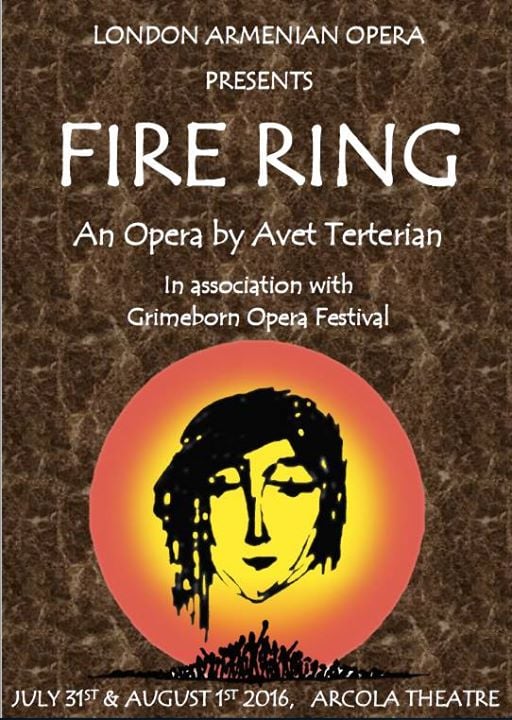
★★★ London Armenian Opera: Fire Ring at Grimeborn Festival 2016

The Armenian opera Fire Ring came with crimson power and Avet Terterian’s musical imagination at the Arcola Theatre for its annual Grimeborn Festival. It was the first time many theatregoers had seen or heard an authentic Armenian Opera, which left many thoroughly enlightened. It was in the main studio that a diverse range of artistic types made their mark on director Seta White’s stage: tragic opera, harmonic and atonal music with translucent dance performances to balance out the hard tension intended by its composer.

The London Armenian Opera (LAO) presented Armenian mysticism and creative flair, encapsulating its influence from the story by B. Lavrenev Forty First, a tale of love, war and revolution, and they weren’t alone. Akhtamar Performance Group and a small ensemble, conducted by music director Richard Harker, thrilled audiences which had them hanging off the edge of their seats.  

Not many are familiar with the Armenian composer Terterian (1929-1994), yet he produced several works including symphonies and chamber works from behind the Iron Curtain and was praised by Russian composer, Dmitri Shostakovitch. His opera Fire Ring demonstrates the composer’s creative spark for the eclectic: modern experimentalism and Armenian motifs with atonality. This is completely justified for an opera that goes as far back as 1967 which found familiar footing in LAO’s 2016 staging. 
Grimeborn has co-produced the work with LAO which expresses the bittersweet torment of a brave girl stuck on an island with the enemy. The opera captures the unsettling and internal struggles of the girl performed by Tereza Gevorgyan who sang with authority and confidence. She provided no sign of vulnerability but pure strength and loyalty to her comrades in the battle. Gevorgyan was vocally charged with passion, yet it was hard to find a sense of affection in her voice, which was also the case for Aris Nadirian, the officer from the other side. Nadirian is a talented performer who also has a gift for the stage, yet the union between these lovers seems invisible, which, unfortunately, cut out a vital part of the story.   

Sami Tammilehto made tough swings on the drums and cymbals, Brant Tilds performed with a fiery trumpet while Kristina Arakelyan provided dissonant chords on the piano, seizing the range of Terterian’s musical mastery. Yu-Wei Hu, on the other hand, hummed the songs of a lilting flute which was accompanied by the instrument of voices from a talented cast of young opera singers, underlining the intimacy between the rival lovers. 

Bass-baritone Benjamin Beurklian-Carter and tenor Stephen Mills sung from the back on the right side while mezzo Anaïs Heghoyan and soprano Tanya Hurst were on the left. Together they created penetrative sounds that revealed the web of destruction stuck on the island. ‘Da da da da da’, ‘da dum, du dum’ and high-pitched notes from the mezzo and soprano, although uncomfortable in the beginning act, were performed on repeat with tense music which was best explored in the second act.

Dancers: Arpi Kojayan, Maria Khorozyan and Asya Ghalchyan were a visual splendour to the show. Dressed in white, they lightened the mood by bringing down the tension with soft, synchronised choreographies, reminding the audience of the romantic narrative, and the moon and the mountains that surrounded the girl and the officer. 

In studio one, the performance became alive by the second half while the first didn't waste time and headed straight into a midst of fierce instruments and violent voices, which may put off some audiences. That being said, those who are up for a challenge may enjoy it, this one isn’t for the faint-hearted though. Fire Ring has a lot of firepower and emotion, which requires mental preparation, yet there’s a satisfactory ending with an unexpected conclusion.  Hold on if you can. 

Grimeborn Festival is still taking place for the next coming weeks with more opera performances including The Marriage of Figaro and Mozart and Salieri. Click here for more information and purchase tickets. 

Tuesday, 26 July 2016

BBC Proms: Glydebourne: The Barber of Seville ★★★★


Taylor Stayton as Count Almaviva and Alessandro Corbelli as Dr Bartolo in Rossini’s The Barber of Seville at the BBC Proms 2016
Copyright: BBC/Chris Christodoulou
Glyndebourne has returned to the Proms for Rossini’s mad opera of disguises and shaved beards, where the smiles and double entendres never seem to end. It is the first time that the BBC Proms have added The Barber of Seville to its programme, performed as a semi-stage presentation, and as last night highlighted it proved to be a spectacular night of giddiness, charming music and theatrical comedy.

The opera, based on the first of a triology of plays by Beaumarchais, follows the journey of the Count (Taylor Stayton) as he seeks means to claim his love Rosina (Danielle de Niese), yet her brutish bore of a guardian Bartolo (Alessandro Corbelli) intends to marry her, and keep her for himself. But then, there is Figaro (Björn Bürger) – he’s the fixer. Together with the Count, Figaro assists him in his mission for love whilst getting themselves into numerous silly mishaps.

Both lead characters Figaro and the count, performed by Bürger and Stayton, are confident and animated - they play off well together. Vocally and theatrically they make a good duo, like jumping into each other’s laps, and harmonise with poise and lyricism. Corbelli gave a mighty and hilarious performance as the curmudgeon Bartolo, and was a great sport at it. In certain parts Corbelli had to sing fast and his vocal skills and timbre may have been compromised, but there’s an edge to his talents which makes him completely likable and amusing to watch.
Danielle de Niese as Rosina and Alessandro Corbelli as Dr Bartolo in Rossini’s The Barber of Seville at the BBC Proms 2016
Copyright: BBC/Chris Christodoulou
Niese, the wife of Glyndebourne’s chairman’s grandson, envisions Rosina to be a strong-willed cheeky flirt with eyes only for one man Lindoro, who the Count disguises himself as. Although her Rosina may bat her eyelids and appear tied to Bartolo's chambers, Niese assures the audience that Rosina has a spirit that wants to run free, away from a restricted married life with Bartolo's crankiness. Her Una voce poco fa was dynamic and entertaining; it called for a huge round of applauses as her voice was loud enough for the Royal Albert Hall to hear, yet I’ve heard stronger performers of Rosina’s pinnacle aria elsewhere. As she specified in an interview with Rebecca Franks, she is aware that Rossini wrote some parts of the opera for ‘super-high ranges’ and as she is a lyric, not coloratura, soprano, who sticks with the mezzo-soprano range, this inevitably causes some challenges for her.  Nonetheless her performance was an impressive one, which enthralled prommers, including the male prommer who she ran to – she gave him a quick kiss on the cheek and jumped back on the stage again (well, that’s what I gathered from my seat).

Italian conductor Enrique Mazzola provided Rossini’s sweet scented score with a dash of stage pizazz. This was light-heartedly performed by the London Philharmonic Orchestra demonstrated through delightful harps, graceful clarinets and lively strings which enchanted prommers. Mazzola and the LPO also played a part in the storyline frolics too, by breaking the fourth wall; passing Rosina’s love letter to the Count and Mazzola having fun with the grumpy Bartolo who seemed to think he knew more about music than the maestro.
Conductor Enrique Mazzola and Alessandro Corbelli as Dr Bartolo in Rossini’s The Barber of Seville at the BBC Proms 2016
Copyright: BBC/Chris Christodoulou
Joanna Parker’s costume designs seemed to set our opera somewhere in Seville in the 17th century, with vivacious and handsome colours yet there were slices of the modern shown through Stayton’s cool full-length jacket and Niese tightly fitted, glamorous dresses. 

Director Sinéad O’Neil's staging is a simple yet effective one. The performance at the Royal Albert Hall was clean, witty and infectiously fun. To think that the premier of the opera was a sham in 1816 baffles me as performances like last night, where there's a joke hidden in every corner of the staging, verify why The Barber of Seville is a popular masterpiece  - not only composed to entertain opera newbies. 
Danielle de Niese as Rosina, Björn Bürger as Figaro, Taylor Stayton as Count Almaviva and Janis Kelly as Berta in Rossini’s The Barber of Seville at the BBC Proms 2016
Copyright: BBC/Chris Christodoulou
If you would like more information about the BBC Proms and future events, please click here: http://www.bbc.co.uk/proms

Wednesday, 6 July 2016

ROH: Il trovatore ★★★★

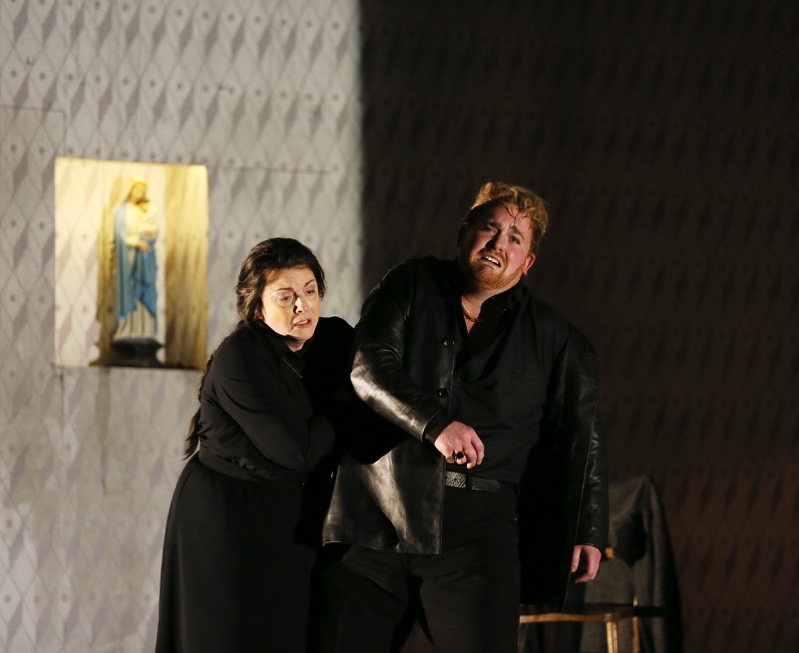
Left to Right: Christopher Maltman (Count di Luna), Anna Pirozzi (Leonora), Conductor Gianandrea Noseda, Gregory Kunde (Manrico) and Marina Prudenskaya (Azucena).
The Covent Garden stage is dark, covered with barb wire and full of flames for director David Bösch’s new production of Verdi’s great epic Il trovatore. Back in the 19th century, when it was first staged, many critics respected the work for its composition and the musical mastery of Verdi, however, there were many reservations over the horrifying and perplexing nature of its storyline. This entails child death (similar to what’s showing down the road at the ENO's production of Jenufa), vengeful gypsy mothers, family feuds and war. Of course, the tragic opera isn't complete without lovers caught in the fire, set back by impossible circumstances. 
Lead cast with Maurizio Muraro (Ferrando), Lauren Fagan (Ines), and David Junghoon Kim (Ruiz). 
Revenge, anger, hatred and determination, to right the wrongs of the past, are the core pillars of this opera classic, which makes Il trovatore a passionate and engrossing work of art. The troubadour Manrico steals the heart of Leonora who is also loved by Manrico’s rival Count di Luna. Manrico’s mother Azucena seeks revenge on those who murdered her own mother, while Count di Luna vows to find his lost brother Garzia, believed to have been murdered by Azucena. 
View from the box.
These tormented and blood-lusting characters in Verdi's and librettist Salvardore Cammarano’s masterpiece are full of fiery emotions, and include many arias and music pieces, often, used in popular commercials, from the Anvil Chorus and Manrico’s ‘Di quella pira.’ Here it is brought together by neatly measured and impassioned conducting by Italian maestro Gianandrea Noseda, as well as sophisticated playing by the ROH orchestra - sweet and tender in Leonora and Manrico’s duet ‘Miserere’, and feverishly intense for Azucena’s 'Stride la vampa’. There's also glorious singing from the ROH chorus at the highly dramatic parts including 'Or co' dadi ma fra poco' in act three.

The glowing music and brilliant vocal talents of the production's cast is a marvel in itself.  Naples-born soprano Anna Pirozzi - certainly - brings the house down for instilling a tenacious Leonora with impressive top notes and vocal skill. Marina Prudenskaya also makes her Royal Opera House debut as the relentless Azucena. She’s the tour de force in this staging and presents a deeply tainted mother, tarnished by the child and mother she's lost. 

American tenor Gregory Kunde also charms the audience with a moving rendition of 'Di quella pira', which is a reminder of how difficult Verdi made the role of Manrico. And baritone Christopher Maltman returns to the Royal Opera House singing ‘Il balen del suo sorriso’ beautifully as the Count di Luna. 

Bösch’s red-hot production, however, is slightly troubled by its drab staging. The production is saved by Verdi’s music and a great cast of performers, yet the visual projections, coordinated by video designer Patrick Bannwart, are weak links. Animated butterflies fly on to the stage screen, during various scene changes, without any meaning, and it felt as if no visual life was offered elsewhere. Yet an army tank and a heart made out of barb wire and sticks, burning at the most crucial moment of the entire opera, are some of the production's saving graces. 

It is Verdi’s music that will make one go and see this opera, and nothing else. For any first-timer to Il trovatore, this opera is a pleasure to watch, which Covent Garden frames as a musical triumphant. My feelings for the opera are renewed - from a Verdi opera I haven't heard of before to an opera I've learnt to cherish.


There are two casts for this production, so please check the website for further details here.  
Showing until July 17th. 


Wednesday, 29 June 2016

ENO: Tristan and Isolde ★★★★

Many opera lovers know that there is much luscious music to discover with Wagner’s Tristan and Isolde. The climactic love-death song that is Liebestod (otherwise known as Isolde’s Verklärung), the glorious intensity of the score alongside the romantic verse written by the German composer himself are a few reasons, out of many, as to why it is considered a landmark opera which has influenced music history. Not forgetting the tragic story where two lovers down a love potion which leaves them stuck in a world they cannot exist together in.

The English National Opera (ENO) last staged Wagner’s visceral opera twenty years ago, yet its newly appointed artistic director Daniel Kramer has introduced a new production with grand designs by award-winning contemporary artist Anish Kapoor – the man who designed the Orbital Tower at the heart of the Olympic Park and controversial sculptures for the French palace of Versailles. 


The inspiration behind Wagner’s four-hour opera includes his admiration for Arthur Schopenhauer and his metaphysical ideas of the annihilation of the self, as well as his keen interest in medieval literature and another love; a love that is revealed through various letters he wrote to the wife of his benefactor, Mathilde Wesendonch.


Although Wagner was already married, living in exile in Switzerland for his part in the Dresden Uprising of 1894, he felt compelled to write the ‘most full-blooded musical conception’. One could describe Wagner’s reasons for composing his monumental opera as a way of hammering out a message to Mathilde or releasing his own frustrations on such a sensitive situation. Regardless of his motivations, one thing that cannot be negated is the biopic nature the opera had on Wagner, where ‘words, stage setting, visible action, and music come together in closest harmony towards the central dramatic purpose.’


The ENO’s previous musical director Edward Gardner returns to his former residence, and in this case for Wagner’s Tristan and Isolde, which he performs with warmth and vitality from start to finish. The ENO Orchestra also presents Wagner’s Gesamtkunstwerk (total artwork) exquisitely - the prelude and lovely ‘Tristan chord’, which lingers throughout the opera are a wonder to hear. 

Following the nihilistic notions of Schopenhauer; the yearning for the dark, escape from the realities of the day in exchange for an existence beyond the physical, light plays a huge part of the production's staging and this is executed by Paul Anderson’s light designs, which assists Kapoor’s large scale artworks. However, some audience members may feel a bit left behind with what they see before them.

A golden stage divided by three, a huge ball sliced in half with our lovers hiding in its inner cave, and a ripped out hole, which releases blood, are the artist’s ‘vision for a complete artistic experience’, yet these abstract works can appear ambiguous unless one is familiar with Kapoor’s work. Much praise goes to the visual lighting effects that take place on stage, but a visually stimulating stage isn’t necessary for a grand opera that is already a musical masterpiece in its own right.


The production’s costumes, designed by Christina Cunningham, are filled with characteristics from a Star Wars movie, which also seem weak in relevance to the opera or Kapoor's complex staging despite their craft and sophistication.


Nonetheless, justice can be found from outstanding performances including Stuart Skelton as Tristan. His robust and silvery voice makes his Tristan a triumphant performance which is no surprise for a tenor who received positive reviews for his role as Peter Grimes at the ENO. Karen Cargill, as Brangäne, and Craig Colclough, as Kurwenal, sing effectively and energetically while Matthew Rose deeply impresses and charms the audiences as elderly King Marke. 


Making her debut at the ENO is Heidi Melton. Many members of the audience sob as she closes the opera with her version of Liebstod. Singing the role of Isolde is a tough challenge, bestowing a devoted and headstrong princess but Melton doesn't falter. She is solid in the beginning scenes, but performs best at its conclusion, rendering the auditorium speechless. It is a touching sight seeing Isolde sing romantic words, similar to a sonnet, as she holds Tristan's face - an image that will stay with me for a long time. 


Tristan and Isolde is playing at the London Coliseum until July 9. Click here to book tickets. 

Thursday, 16 June 2016

The Curious Incident of the Dog in the Night-time, West End ★★★★★


Just like three years ago, when I first saw the National Theatre’s production of The Curious Incident of the Dog in the Night-time, I had a warm fuzzy feeling as I left the Gielgud Theatre last night. It was just as inquisitive, visually stimulating and theatrical as I recall. Back then it was staged at West End’s Apollo Theatre and suffered from its stage ceiling collapsing which meant that the show was absent from the West End for a few months, yet it soon returned, in a new location.

Since 2013, the production has gained international recognition and continues to pull in new audiences. Writer, Simon Stephen adapted Mark Haddon’s acclaimed novel for the stage (now used in the classroom as a children’s textbook), which blew both West End and Broadway away; last year it won five Tony Awards including Best Play and Best Director.

The show itself has so many things to love about it. Firstly, its lead character - the socially awkward 15-year-old with behavioral issues - Christopher Boone is something out of the ordinary and I don’t mean that to highlight his mental disability, in this case Asperger Syndrome, but that it pinpoints the difficulty endured by those who can't interact or engage with others, who detest human touch and physically lash out when stuck in an uncomfortable situation. Often the actor who plays Christopher has a tough challenge, remembering line after line of theorems and algebraic formulas whilst pacing fast up and around the stage (literally!) – it takes real courage and skill to play the role.

I’ve had the pleasure of seeing the original Christopher played by Luke Treadaway. He was a wonder to watch and truly encapsulated the attributes of Christopher’s peculiar personality and wild imagination. Sîon Daniel Young is the most current version of Christopher who also provides a memorable performance, bringing the human story much closer to the audience. Both brilliant actors, there is no set way of showcasing the traits of a person with Asperger Syndrome, and I doubt this was their intention, nor the director’s, Marianne Eliott.

The second reason I love this production is that the staging is utilised to the T. It lights up like stars, beams at you in emergency red and has layers of hidden cupboards and doors filled with LEGO models and other surprises. Given the logical and systematic mind of Christopher, the stage is fashioned as a place to see Christopher’s thought process as he identifies who killed Wellington, the neighbour’s pet dog. With dreams of becoming a scientist, and - perhaps - travelling up to space and in it, Christopher’s mathematical ability is explored - it is a mirror of today’s university departments that have a high concentration of mathematicians with Asperger’s; it is associated with their brain's capacity to focus on a problem and cancel everything else out.

Adrian Sutton’s music – a whiff of electronica and moving themes – also sets the tone for a play not solely based on a dog murder mystery. Stephens is known for writing stage works of a macabre and realistic nature, as I've seen in his other work, Wastwater (click here to read the review), and in Christopher's case it’s a slightly abusive, jilted father and a depressed mother who left him as a result of the hardship of raising him. Without giving any spoilers away, it’s a real human story that has its poignant moments that are lifted with some dark humour, smart stagecraft, and ambient lighting.

My third reason for admiring the show is the ensemble, of up to nine cast members. On top of being skillful and energetic, they are a significant force that pushes Christopher through his mathematical adventures and dog investigation. Together they play over thirty characters whilst physically carrying Christopher on their backs, holding him up to the wall and turning him around in mid-air. Overall, it’s a fast-paced, intelligent and entertaining show that will remind audiences' of the chaotic journey commuters have to take on the TFL, and somehow come out alive once they have reached their destination.


To book tickets, please click here for Box Office.co.uk. - It is showing until February 2017.

For more information on the production, please click here http://www.curiousonstage.com


Monday, 6 June 2016

ENO: Jenůfa ★★★★

Photo by Donald Cooper.
Despite how musically rich and sensitive Janáček’s opera Jenůfa is, its grotesque storyline, which includes the murdering of a child, is not. It captures a sample of small-town life in Moravian Slovakia during the mid-1850s, which first influenced Gabriela Preissová to write Její Pastorkyňa (“The Stepdaughter”), which inspired Janáček to compose his opera.
Photo by Alistair Muir
It took 10 years to complete and during that time Janáček’s work took an autobiographical turn as his daughter, also caught up in an unhappy affair and a similar fate to Jenůfa, died from typhoid fever. Janáček takes us to a sound world of grief, shame and guilt in a society where tragic consequences, prejudice, and hypocrisy took place for a woman who bore a child out of wedlock – it was considered a mortal sin.
Janáček’s musical achievements are often neglected, unfortunately, and underperformed, though in the last couple of years there has been a surge of his great works programmed at some the UK’s top concert halls; The Cunning Little Vixen and Jenůfa is one of them. David Alden’s 2006 production, of the latter, has returned to the London Coliseum in luminous and triumphant form.
Photo by Donald Cooper
Back then the production won an Olivier Award for Best New Production, and if the 2006 production was as good as it was last night, then much credit is due to the intense focus of its outlandish characters, dramatic and minimal staging as well as its refined and impassioned melodies.
An empty run-down Eastern bloc of a factory yard, plucked from a Communist system, is how Charles Edwards’ displays Janáček’s Moravian Slovakian community. Jon Morrell presents simple costumes for the cast, drawn from a closed off society, while the lyrical score is welded together by the unwavering prowess of the ENO chorus and the finesse of the ENO’s most recent music director, accomplished Mark Wigglesworth. (He resigned from the position over controversial disputes with ENO’s senior management this year.) 
Stage and vocal performances from the lead cast are courageous too. Nicky Spence provides a vivid picture of Jenůfa’s lover Steva; he’s an obnoxious alcoholic and reckless womanizer, yet he sings with a rich and fluid voice. His brash character is so superficial that he leaves Jenůfa after his jealous half-brother Laca, sung impressively by Peter Hoare, slashes her cheek with a knife, out of frustrated love for her.
Laura Wilde offers a true and honest depiction of a troubled woman starved of love, childless, and left bitterly disillusioned. Although Wilde’s vocal lines brim with empathy and sentimental force as Jenůfa, it isn’t as powerful as I would like. Hopefully, this is insight based on the first night only and her performance enhances as the production goes on.
Michaela Martens, on the other hand, took charge of the stage as Jenůfa’s paranoid and concerned stepmother Kostelnicka – her voice is utterly spellbinding. Her character is the catalyst in the opera, and Martens encapsulates the trauma of a mother consumed by a community controlled by religious and social pressures.
Rarely performed, David Alden’s production at the ENO is worth the watch even if it is almost three hours long. Any die hard Janáček fan should make it their mission to see it.

This production is showing until the 8th of July. Click here to see the ENO website and purchase tickets.