|
| Nicole Car (Tatyana) and Dmitri Hvorostovsky (Eugene Onegin) by Alastair Muir |
Last week director of Opera, Kasper
Holten announced his departure from his position at Covent Garden and return to
Copenhagen in March 2017. The news
caused mixed reaction. Some relieved while others, like myself, upset yet, still,
praising him for the impact he has made on the opera landscape since his appointment.
The Royal Opera house’s final opera for 2015 ends with Holten’s production of Eugene Onegin, which premiered in 2013 that was apparently unimpressive, founded on excessive symbolic and theatrical devices far removed from the original ‘seven lyric scenes’ written by Tchaikovsky.
The Royal Opera house’s final opera for 2015 ends with Holten’s production of Eugene Onegin, which premiered in 2013 that was apparently unimpressive, founded on excessive symbolic and theatrical devices far removed from the original ‘seven lyric scenes’ written by Tchaikovsky.
Although I didn’t see the 2013 production, I was thoroughly satisfied by the opening performance last night. I found myself fully engrossed in the nostalgic and sentimental scenery and crafty directorship - undoubtedly Holten’s ideas. Perhaps some technical changes have been made since the first outing but the application of memory and knowledge through experience was effectively poignant, more so for the tragic tale from the verse novel of 19th century Russian author, Alexander Pushkin.
Semyon Bychkov conducts the piece and he is no stranger to Eugene Onegin; it was the first opera he ever conducted in Leningrad when he was only 20 years old. The opera has sentimental value to him, deeming it as one of 'operatic loves', alongside Carmen and La Traviata.
Familiar with the music he paces his baton with subtlety and fine, light tempo. Last night he refrained from conducting loudly too soon and only unleashed this when necessary, such as the death of Lensky, the letter scene and the doomed ending for Onegin.
 |
| Hvorosktrovsky (Onegin) and Michael Fabiano as his best friend, Lensky by Bill Cooper |
The ROH orchestra perform the famous Polonaise
fruitfully, and I found that the brass didn’t fall short on causing chills in the
auditorium in the opening bars of Lensky's aria in the duel scene. Bychkov allows for a long pause between the last two
scenes to differentiate the music and change in tone from the rest
of the opera.
The opening scene is an echo of how the story will end. Anyone familiar with the ending of Eugene Onegin may see this is a mental test - to see whether the production delivers on building up to such a climactic and bitter conclusion.
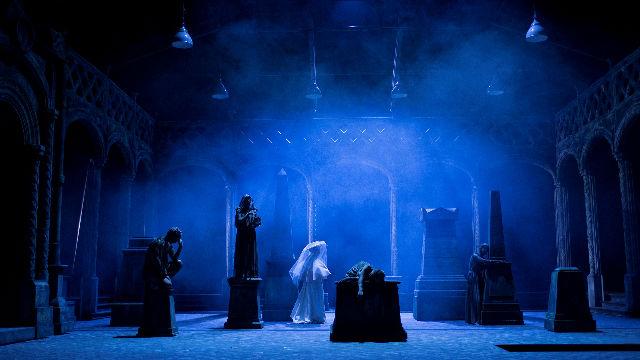
Set in late 19th century Russian high society, Mia Stensgaard colours the set with autumn hues. Katrina Lindsay dress the lead cast and ROH chorus, who sing gloriously, in handsome period costumes.
The staging is set in a country estate seen from the inside. Large doors open and close to reveal various backdrops from autumn meadows and stormy winters just before the tense duel scene between two best friends. Faint visual images of written words are projected onto the stage for the letter scene where Tantyana shares her feelings to the oafish Onegin.
The opening scene is an echo of how the story will end. Anyone familiar with the ending of Eugene Onegin may see this is a mental test - to see whether the production delivers on building up to such a climactic and bitter conclusion.
Set in late 19th century Russian high society, Mia Stensgaard colours the set with autumn hues. Katrina Lindsay dress the lead cast and ROH chorus, who sing gloriously, in handsome period costumes.
The staging is set in a country estate seen from the inside. Large doors open and close to reveal various backdrops from autumn meadows and stormy winters just before the tense duel scene between two best friends. Faint visual images of written words are projected onto the stage for the letter scene where Tantyana shares her feelings to the oafish Onegin.
 |
| Emily Ranford as the young Tatyana and the glorious ROH Chorus by Bill Cooper |
Tatyana spends the entire night writing a love letter to Onegin and once delivered to him, her crush becomes gossip amongst society. He lectures and rejects her. To evoke Tatyana’s anxiety and misery, Tchaikovsky writes her music in a peculiar and complex fashion, different from Onegin’s dressed-down composition.
Bright and excited young tenor Michael Fabiano portrays the charming poet, Lensky. Making his debut at the ROH, Fabiano wins the audience with his convincing performance as an honest romantic that turns into a hothead when he sees his lover, Olga flirting with Onegin. By the end of scene 4, audience are blown away by Fabiano as he leaves the stage in a rage, singing of his betrayal from his lover and best friend. (Someone behind me was so touched by his performance that she burst into tears.)
Russian's much-loved baritone, Dmitri Hvorostovsky returns to the Covent Garden after being diagnosed with a brain tumour and poor health this year, which led to cancellations of all pre-planned events through to August. Thankfully he responded positively to his treatment and returned back to the stage in September at the Met in their production of Il Trovatore. Similarly, he received much praise at the curtain call last night.
In good health he sung potently and dark-voiced as ever to project the Byronic Onegin. We got to see the best of Hvorostovsky in the final scenes where he begs for Tatyana to forgive him and love him again. Tchaikovsky cleverly changes up the music and gives Onegin more emotional intelligence in this tableaux in a passionate and alluring duet with Tatyana. Hvorostovsky lets loose and unleashes heavy passions as he kneels to Tatyana's feet, embracing her, unwilling to let her go.
Australian soprano, Nicole Car had sung the role of Tatyana at Opera Australia last year. She makes her debut at the Covent Garden where she also shines, showcasing her understanding of Tatyana's innocent tenderness and delicate predicament.
During the opening scene, a younger version of Tatyana tip toes around with her head in books. Yet by the end of the opera, Car's soaring lyricism shimmers and reveals the inner feelings that had been tapped by Onegin. In the Letter Scene she gives the audience a moving performance with hushed expressions. However, in the closing scenes she presents a bolder and grown-up version of Tatyana with full-throated bursts, telling Onegin to leave her alone for ever. Here you can see one of the most momentous parts of the production - seeing Car and Hvorostovsky singing the words, ‘Happiness was within our grasp. So close. So close.’
 |
| Nicole Car (Tatyana) and Dmitri Hvorosktrovsky (Eugene Onegin) in the final scene by Bill Cooper |
Italian bass, Ferruccio Furlanetto sings brilliantly as Tatyana's husband. His performance is exceptionally precious in Prince Gremin’s aria.
There's smart ideas at work in Holten’s production, even though I felt the first scene was quite slow and visually uninspiring. The use of doubling characters with younger versions of Tatyana and Onegin cunningly highlight the nostalgia of youth and its simplicity. While the remainder of Tatyana’s teared books, a tree branch from the death scene of Lensky and the corpse of his body, where Fabiano lies on stage for the remaining scene, are reminders of the scar of past experience, lessons learnt and the sacrifices made in this heart-breaking opera.
There's smart ideas at work in Holten’s production, even though I felt the first scene was quite slow and visually uninspiring. The use of doubling characters with younger versions of Tatyana and Onegin cunningly highlight the nostalgia of youth and its simplicity. While the remainder of Tatyana’s teared books, a tree branch from the death scene of Lensky and the corpse of his body, where Fabiano lies on stage for the remaining scene, are reminders of the scar of past experience, lessons learnt and the sacrifices made in this heart-breaking opera.
Sung in Russian, the opera meant a lot to Tchaikovsky's personal life. The Royal Opera House is simultanously performing a sold out production of Tchaikovsky's family festive ballet, Nutcracker. Yet life was not as rosy for Tchaikovsky, and this work definitely demonstrates that. To truly understand the composer, one must see Onegin.
Currently showing until the 7th of January - Click here to check dates and purchase tickets. (Alternatively, you can queue up for day tickets. Doors open at 10am.)
More opera reviews:
Many bits of symbolic pieces to unpack in this production. Loved the seducer's dance scene and the doubling of characters #ROHeugeneonegin
— Mary Grace Nguyen (@MaryGNguyen) December 19, 2015
100% Russian!CongratsS.Bychkov,chorus, @kasperholten @Hvorostovsky @NicoleCar_Opera @MichaelFabiano #ROHeugeneonegin pic.twitter.com/QSZFU3sW5U
— Mary Grace Nguyen (@MaryGNguyen) December 19, 2015
The superfluous male #rohonegin. "Oh, you should restrain yourself, oh, marriage would be tortuous.." Blah, blah...Typical commitment phobe!
— Mary Grace Nguyen (@MaryGNguyen) December 19, 2015
Slow start bt really getting into it nw.Was thinking Olga was going to get away with it. Glad Lensky called her out as the devil. #rohonegin
— Mary Grace Nguyen (@MaryGNguyen) December 19, 2015
Omg! @MichaelFabiano totally smashed it just now.Someone behind me is crying because of his betrayal.Poor Lensky!Big applause from theamphi!
— Mary Grace Nguyen (@MaryGNguyen) December 19, 2015
Tremendously excited about seeing @Hvorostovsky strong and healthy as he returns to the stage as the lead for #ROHeugeneonegin tonight.
— Mary Grace Nguyen (@MaryGNguyen) December 19, 2015
This is what queuing up for day tickets looks like. Totally worth it. @RoyalOperaHouse #ROHeugeneonegin pic.twitter.com/ezhUmInhjp
— Mary Grace Nguyen (@MaryGNguyen) December 19, 2015


%20ROH.%20PHOTOGRAPHER%20CATHERINE%20ASHMORE.jpg)
%20ROH.%20PHOTOGRAPHER%20CATHERINE%20ASHMORE.jpg)