Showing posts with label the magic flute. Show all posts

Wednesday, 11 May 2016

The Magic Flute: Budapest Festival Orchestra and Iván Fischer ☆☆☆☆

Last night saw the fabulous Budapest Festival Orchestra and its characterful conductor, Iván Fischer present The Magic Flute at the Royal Festival Hall. The evening was an enjoyable one, and the 'staged concert', the maestro had called it, brought to light what can – really - be recreated at the Royal Festival Hall. Most operas and concerts at the Royal Festival Hall involve soloists with scores read from a music stand and the orchestra behind them, yet this event was a special one - a proper stage for Mozart's action to take place, with the orchestra delightfully performing below in the pit.

The Budapest Festival Orchestra, known as one of the top orchestras in the world and winner of various accolades (including New York Magazine's 2013 list of the city's top classical music events and numerous Gramophone Awards for their orchestral albums), is currently on an international tour amid funding cuts decided by its city's General Assembly - cuts from 260 million forints (US$938,000) to 60 million forints (US$217,000). That being said, the performance last night proved how solid and defiant the orchestra and its maestro were at such a crucial time; only last Saturday they protested in Vörösmarty Square, central Budapest.

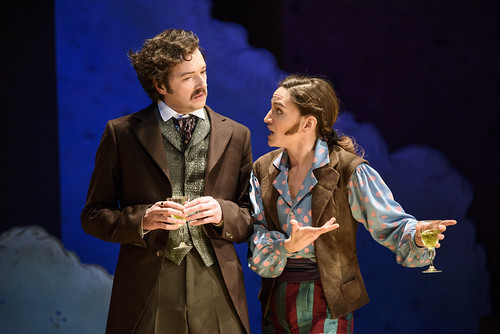
Last night, Fischer displayed his inner child as both conductor and director of the production, with singspiel successfully presented by English actors, (though I must admit, I wasn’t privy to this and thought Mr. Fischer actually needed real audience members to play a role in the opera. Damn it!) Originally performed in German as Mozart’s librettist Emanuel Schikaneder wrote it in the 18th century, Fischer had adults, teenagers, and children enjoy an evening of German singing and English dialogue, with large visual projections of pages plucked out of a children’s storybook.

This crafty technique meant fewer issues with moving around props or set designs, which hardly happens at the Royal Festival Hall, and, therefore, more visual stimulation and absorbing imagery for the audience. Actors and singers worked in sync with one another – Scott Brooksbank would translate the words and feelings of Tamino just before Bernard Richter projected Tamino’s deeper emotions and love for Pamina with his beautiful voice. The same can be said for actor, Bart Van Der Schaaf who’d bring the English crowd back to London, out of the dream-like fantasy, as lonely bird-catcher, Papageno. He released some light humour here and there, which was tidied up by bass-baritone Hanno Müller-Brachmann’s impressive voice.

The conceptual and creative imagery deserve attention too. Much scholarship has been invested into the hidden meanings in Mozart’s ‘grand opera’, most of which has alluded to the overtly Masonic nature of the piece, coinciding with 18th century Enlightenment, and in this production images of the sun and moon were prominent throughout. Though the opera is perfectly accessible for children, there are elements of opera-seria cleverly implemented with the symbolism of the Queen of Night, which was performed by Mandy Fredrich last night. Her voice hit the royal high-Fs but, from my rear stalls, it would have been nice to hear her sing a little louder, otherwise she gave a good enough performance of ‘Der Hölle Rache’, which kept the younger audiences happy. Particularly memorable was Hanna-Elisabeth Müller as the captured princess, Pamina. She has a distinctive colouring and sung with particular control and composure, which made her voice shine in ‘Ach Ich fühl’s’.


Krisztián Cser, Norma Nahoun and Rodolphe Briand gave confident and reassuring performances as Sarastro, Papagena and Monostatos. The three ladies in purple and blue wigs, sung by Eleonore Marguerre, Olivia Vermeulen, Barbara Kozelj also gave brilliant performances. And not forgetting the three boys, also dressed up as little lions, from The Hungarian State Opera Children’s Choir. They were squeaky clean on stage, and a delight to see and hear.

There were some unique moments to remember including an English speaking, and older version of, Papagena attempting to communicate with a German speaking Papageno, desperately trying to wake up his English counterpart. And towards the very end, when Papagena and Papageno come together to sing their duet, ‘Pa Pa Pa Pa, their puppy love is expressed by mushy imagery of children sprouting in the background. Yet mushy pantomime aside, Fischer seemed excited and pleased to be performing this night. The Budapest Festival Orchestra performed with flair yet they weren’t on fire - they honed in their enthusiasm enough to perform the opera in a light-hearted and leisurely pace. That’s not to say the opera was slow, but indeed, a playful and fun production, safe enough for children. Yet, it would have been nice had Papageno been a little bit wittier with his jokes - nevertheless a fun night at the staged concert. 

For information on classical events at the Southbank, click here http://www.southbankcentre.co.uk/.

For more about the Budapest Festival Orchestra, click here http://www.bfz.hu/.


Sunday, 21 February 2016

One week, many operas: L'Étoile, The Magic Flute, Norma and The Rinse Cycle


Five operas in a space of seven days may seem like a tall order but somehow I managed to do all of them. The range included works by Fringe companies like Opera Vera (read review here) and Unexpected Opera as well as those at the Covent Garden and English National Opera (ENO). To my delight it was an even spread that pretty much captured the kind of operas happening in London - and my, (oh, my) there are plenty! 

Royal Opera House: L'Étoile, Covent Garden ★★★★
(Photograph from the ROH website)
L'Étoile was composed by Emmanuel Chabrier and premiered at Offenbach's Théâtre des Bouffes in 1977. Parisians absolutely loved it back then and now, at the Royal Opera House, with some commendable additions - British comedian Chris Addison, breaking of the fourth wall with maestro Mark Elder and add-on slapstick dialogue - it is a fun-packed, entertaining production that I'd happily recommend anyone to see. Yet if you like your opera serious, sans kinkiness and completely covered with passionate and I-am-going-to-die-tragically singing, then this one may not be for you.

However I must admit that the music glows and is highly addictive. The ROH Chorus sing wittingly to Couplets du Pal as they celebrate King Ouf's execution by impalement (yeah, I know - it's very weird!) By the end of it, I was humming a few catchy songs I hadn't heard before including Le chartreuse verte. The opera is performed entirely in French, which is a good way to re-cap on your beginner's French (which you probably left behind after GCSEs), and like a Shakespeare, Mozart or Strauss narrative, there's a master of disguise, a trouser role, multiple plots going on and ridiculous love triangles. 

Addison and Jean-Luc Vincent, as Dupont, are the two comedy commentaries who interject throughout and sporadically, but I favoured this - I thought Addison was actually funny, especially when he points at the surtitles and realises he's in a real opera! Elder conducts jubilantly (and happily), and it's not hard to see why with Chabrier's highly spirited music. Hélène Guilmette (Princess Laoula) melted my heart with some scintillating singing, and mezzo-singer Kate Lindsey, as Lazuli, was a great match to her as the wandering pedlar who falls in love. In Lazuli’s solo aria (in Act 2) Lindsey's voice truly blooms.

Much hilarity is maintained by exceptional performances through Samuel Sakker (Patacha), Samuel Dale Johnson (Zalzal), Christopher Mortagne (King Ouf), Simon Bailey (Siroco), Julie Boulianne (Aloès) and Aimery Lefèvre (Tapioca). And the flamboyant and freshly coloured set designs shouldn't go unnoticed - thanks to Julia Hansen for the crazy anachronistic satire of the 19th century and Arabian Night styles. Sadly, this one isn't PC enough for the kids as it is pretty saucy. No - it's very sexy! Unless they've past puberty then, of course - by all means, bring them! 


English National Opera: The Magic Flute  ★★★★
(Photo from the Guardian website)
Things are not getting better for our opera house at the London Coliseum. More negative news keeps coming in and the most recent is the livelihood of its Chorus which has been stated to reduce, including the number of opera productions taking place next year by ENO CEO, Cressida Polluck. With many internationally known musicians, performers, conductors, directors and classical music journalists signing a petition via @SaveEno (here), it is only a matter of time before the ENO's management has to face up to the inevitable and give the people (audiences, singers, performers, musicians and tax-payers), an answer to their financial dilemma.


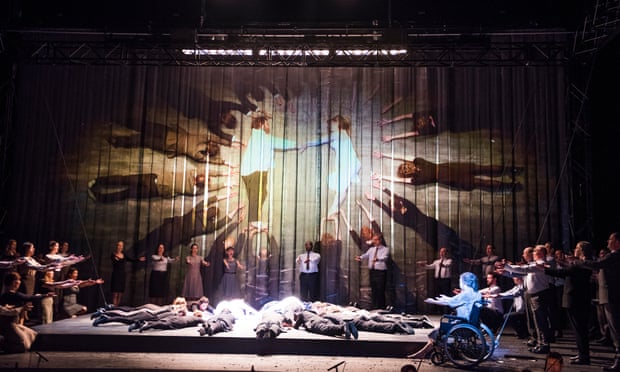
Yet in the face of such crisis, the show must go on and the nation's supposed opera house has introduced a revival production of Complicite artistic director Simon McBurney, The Magic Flute, which was first shown in 2013. Admittedly I didn't enjoy that production; I re-read my review (here), which seemed like I was in agony by the end of it. Influenced by social media, however, with rave reviews of the revival's opening night, I got myself a ticket hoping that they were right and luckily I wasn't disappointed - phew!


The set hadn't changed much in three years - the ENO orchestra was elevated from the pit and a simple platform moved in mid-air. The staging was recycled from the last production but this time round the opera was executed to a better standard. Here's my reasons why.

Firstly, it seemed much more together; there was no fuss on stage among the performers and they seemed on top of what they were doing. Secondly, the voices of its brilliant cast were stronger. This was enhanced by stimulating conducting from ENO’s resident maestro, Mark Wigglesworth. The grand overture, The vengeance of Hell by the Queen of the night and blissful duets such as Pa … pa … pa ... were performed to a hugely satisfied mixed audience of children and adults. And thirdly, there were Finn Ross's video projections which were previously implemented, but here introduced with some extra additions, making it more imaginative and mythical (I won't spoil it by telling you what - visually - happens.) Overall, though, there was a real sense that the performers and singers believed in the production, making it a far more gratifying production. 

Allan Clayton and Lucy Crowe performed convincingly as star-struck lovers and although they were not the comedy starlets, they were able to stay in character while their zany companion creatures, Papageno (Peter Coleman-Wright), Monostrato (John Graham-Hall) and Papagena (Soroya Malfi) kept the childish humour of Mozart at bay. I had seen Crowe perform at the ROH in L'elisir d'amore, so I wasn't surprised she gave an impressively delicate and sweet sounding Pamina, particularly in her solo aria in the final act. 
 
Ambur Braid performed courageously as the wheelchair-stricken OAP version of the Queen. The ENO Chorus was tremendous in voice and played a pertinent part with McBurney's tacky paper birds. Coleman-Wright's Papageno, however, was much more friend-down-the-pub and had other handy gimmicks compared to the last production's bird catcher, Roland Woods. Though with saying that, they played a version of Papageno that was entirely their own. Woods was much more sharper in voice for Mozart's harmonious and witty music while Coleman-Wright wanted to make the audience laugh – and that’s exactly what he did! James Creswell is the voice of authority, Sarastro and there was a moment when he looked on to the audience, as well as his political cronies, and said, 'we are in a crisis!' I thought he was referring to the ENO crisis but then I remembered this was the bit that they worry over Tamino's dedication to love and truth - BLAUGH! 


English National Opera: Norma
★★★★
Alastair Muir
[From Review first published at CultureVulture.net]
The English National Opera (ENO) first performed Bellini’s 1831 bel canto opera, Norma this month. Christopher Alden's production was first presented by Opera North in 2012, which is a co-production with Die Theatre Chemnitz and has toured to Bordeaux ever since. Bellini put down on paper, 'Carve in your head in adamantine letters: Opera must make people weak, feel horrified, die through singing' and to many composers, artists and philosophers they were heavily affected by the composer's artistry.


Conducted by Stephen Lord, who demonstrates his aptitude for bel canto repertory, the production was dramatic in narrative and the music's sublimity that could only come together from a solid hand (and baton) to guide the roaring and heartfelt score. The opening night permitted its ENO Chorus to take to the curtain call twice, which was well-deserved for this chorus-heavy opera. They give a phenomenal performance as excellent actors and singers. Unforgettable scenes come in the final act where Norma reveals her treachery to them, and in their pain, they fall to the ground, then abandon her. It stressed the significance of the ENO Chorus’s role at the opera house at a time where their status is being compromised and negotiated by the ENO's management. 

Due to a word count I have to follow, I wasn’t able to put down a couple of things to be wary of with watching ENO’s Norma in my CultureVulture.net review. To put it bluntly, it is one of those operas that you are really going to love or really hate, and for me I found that I truly loved the music.

Listening to an opera where you can completely lose yourself in the music is one of the reasons  I love opera – and Norma is one of those operas, yet the production is, as I said, dry and woody as the staging, and the only beings capable of moving you are the cast, ENO Chorus and the gracious music, which has the ability to make you cry and feel vulnerable.

Another thing to note is that towards the last act, which was the most musically interesting, it took a long time to end and in some ways dragged. It was almost approaching 10.30pm and yes, I was tired (having had a long week at work already) but, surely, there must have been other ways that the production could have more appealing?

Should you go and see Norma, stick with it or at least go with the knowledge that there is nothing visually sophisticated to see and you must take the narrative and magnitude of the voices as they are.


Unexpected Opera: The Rinse Cycle, Charing Cross Theatre ★★★★★
Photograph by Robert Workman
I am an advocate of the fringe scene, a place where young and aspiring musicians and performers can reveal their trained voice and talent to an audience new to opera. Yet opera aficionados also like to check out small-scale productions too. Who knows if they might be seeing the next Maria Callas or Placido Domingo? (Honestly, who knows?) Some fringe opera companies are based locally while others go on tour, and this week I had the pleasure of seeing The Rinse Cycle by Unexpected Opera. It may sound rather cliché but I truly didn't know what to expect. The programme booklet reads, 'Wagner's Ring Cycle Conditioned with comedy and shrunk to 2 hours' and on analysis it did just that but in an inventive and intelligent way. 

Unexpected Opera's artistic director, Lynn Binstock is on a mission to bring opera to those who think it's not for them as well as those who are devout operagoers through engaging and hilarious productions, and I've seen some funny operas but this one took comedy to another level. From the very beginning scenes I wasn't sure when Wagner's Rhinemaidens were going to fly in but it really didn't matter at this point as I got stuck in to the bizarre laundry stage and odd props: Patisserie Valkyrie sign post, mermaid aprons, disputed leitmotifs, an ironed out sword, Norfolk accents and oven gloves for Wotan’s giants.  Somehow Top Gun's Tom Cruise, with a phony American accent, also seemed relevant.

What's smart about this show is that it eases the audience in with its own light-hearted story. Ronnie (Simon Thorpe) and ex-opera singer Edith (Harriet Williams) are the married couple with son, Tim (Edward Hughes) while Hilda (Mari Wyn Williams) and Robin (Anna Gregory) are like the waitresses from BBC Comedy 'Allo 'Allo, who go through the trouble of delivering the Ring cycle in a shrunken down version for the audience sat in front of them. However Tim didn't hear his dad properly and thought he said Rinse - not ring, hence, the hypnotic washing machines on stage.

Though jokes aside, it is only by the end of the first half that you begin to get to the core of Wagner's music and all of that powerful Wagnerian singing. So while you may have spend the first hour doing stomach crunches in your seat, you'll be enlightened by real music drama, and the transition is, pretty much, seamless through the conviction of its passionate cast. 
 
There are two casts for this production and on the opening night Thorpe sung both baritone roles, as Wotan and Alberich, yet he also played other characters with strange accents, including Sean Connery, on his knees and standing up. He gave a sensitive performance for the audience by the second half. The same can be said for Williams who sung as Fricka and her voice was intense, bold and alluring - my favourite voice of the night! 
Photograph by Robert Workman
Mari Wyn Williams sung the prelude of Die Walküre almost effortlessly with utter assurance and she had multiple roles to go on including Sieglinde and Ronnie's secret flirt. I also enjoyed tenor Edward Hughes who was marvellous as Siegmund and Siegfried - poor Tim kept getting confused playing both roles, but Hughes rose to the occasion and hit all those brave notes!
 
Gregory has the vocal prowess for her roles as well ranging from Gutrune and Tim's knocked up girlfriend. Music director Kevin Lim had a shaky start on the piano but that was quickly forgotten when it came to performing the pithy and heartfelt songs sung by the cast.
 
Some may only prefer their Wagner operas to be heard as the composer wrote it, or wanted it to be performed in Bayreuth, but that would be elitist, wouldn't it? For veteran operagoers who don't mind letting their hair down, having a beer and watching a cheerful and slightly cheesy opera that speeds through Wagner's 16-hour opera and neatly trims it down to 2 (with a break in between), then this is a perfect antidote. This is mutually beneficial for opera newbies, too, who will still get a taste of Wagner's profoundly dramatic music straight up from a versatile cast. Hats off to Unexpected Opera for ending my week on a high and making me sing Hoyotoho with the crowd - honestly, no one predicted that would happen and I love surprises.


L'Étoile ends 24th February, 2016. (Click here for more information)

The Magic Flute ends 19th March, 2016. (Click here for the ENO website.) 

Norma ends 11th March, 2016 (Click here for more information) 


Thursday, 27 November 2014

Royal College of Music: Mozart's Die Zauberflöte/The Magic Flute (RCMIOS) ***


Mozart’s Die Zauberflöte (The Magic Flute) is an opera journey about two lovers and their mystical struggle to be together with numerous fantasia-esque characters who help them, while others obstruct them, on their way. It is one of the few operas that is performed just before (and during) the festive season as it encapsulates prevalent fantasy and mystical themes. Some would content that this derived from Mozart’s personal engagement with the freemasonry; yet the opera’s significance is not simply due to its mysticism or status as Mozart’s penultimate operatic work but from its stunning and uniquely written musical composition which evoke the musical wizardry and emotions that produced the splendour of Mozart's overture in The Marriage of Figaro (and possibly Così fan tutte.) 
The Royal College of Music International Opera School (RCMIOS) is currently performing Die Zauberflöte under the directorship of Jean-Claude Auvay at the Britten Theatre. This opera production is one of the many opportunities to showcase the school's new and fresh talent. Some of the biggest names in opera trained at RCMIOS including Dame Joan Sutherland, Sarah Connolly and Gerald Finley. Elizabeth Watts, Alfie Boe and Sophie Bevan also made their mark through the opera school. Maestro Michael Rosewell, director of opera at the RCM, had the RCM Opera Orchestra at the helm. He embraces the natural and earthy hues of Mozart’s masterpiece and allowed the exuberant overture to flourish with heavy double basses, abrasive cellos and lusciously played oboes, reminding the audience that life is sweet, just like the opera’s endings.
Galina Averina as Pamina (Photograph from stjohns-hydepark)
As the opera begins, the audience watch how Sarastro's masked men kidnap innocent Pamina (Galina Averina). We are then left guessing what a projected image of cartoon furniture has to do with a magic flute; yet this is quickly swiped under the carpet as Tamino (Gyula Rab) attempts to spiral his way out from being attacked by a giant snake, which we unfortunately never see.
A toy snake however is bragged about by our deviant three ladies lavishly sung by Natasha Day, Rose Setten and Amy Williamson. They are presented as purple dressed fashionistas and practice some saucy acts on unconscious Tamino.
Tamino sung by Gyula Rab - (Photograph from fidelio.hu)
Our comic relief and lonely Papageno was sung by the talented Timonthy Nelson. Both him and Rab made the songspiel feature of the opera amusing through their clear Germanic diction. Our Queen of the Night was sung by Marie Jaermann and, during the evening, it seemed as if she had sung the role several times before. She gave the patient audience what they wanted to hear in "Der Hölle Rache kocht in meinem Herzen" but also showed hints of humility in her vocal agility as well.
Our three child spirits (Louise Fuller, Katie Coventry, Polly Leach) complimented the opera's share of fun and games. Their synchronised vocals paid off and heightened their spiritual and harmonious characterisations. Simon Shibambu sung as an authoritative Saratsto with his corporate suits working below him; yet I would have liked to have heard more of his voice as there were moments when there wasn't enough zeal to convey the paternal side of Sarastro.
Pamina, sung by Averina, was the most taut, sorrowful and beguiling particularly when she sung "Ach, ich fühl's, es ist verschwunden" in the final scenes. And Gyula Rab sung as the bounty tenor visually matching Pamina on stage, but lacked a tiny spark of pathos. Still, a decently sung Tamino.
Timonthy Nelson - (Photograph from Oxford Leider website)
In Act 2 scene 7, when the elements scene takes hold, neon lights with the words ‘wasser’ in blue and ‘fueue’ in red manage to impress the audience, but only for a few moments. The overall stage was designed by Ruari Murchison, which is a mix of semi-stage with a large folded and concealed room at its centre. Often the cast were left having to pull and push open the doors for the room which seemed like a physical hassle, but once these doors were open the wonder was demystified; this is due to Mark Doubleday’s own lighting techniques.
The production's ending is slightly unexpected and ambiguous. Both Tamino and Pamina are romantically united but dressed in suits with a book (they reveal) as if they had just published it, or as proof they had triumphantly graduated from a business school, perhaps. Audiences will interpret this to mean many things. One of these ideas could be the success after a hard journey, whether personal or profession; it’s all driven by passion; an inherent notion Mozart undoubtedly wanted to convey in the opera.
The RCMIOS's production is a very German experience with both the intrigue of Mozart’s enchanting opera muzzled in with light humour. It is also a springboard for the diverse talent at the RCMIOS. One rarely feels miserable after seeing Die Zauberflöte and being exposed to Mozart's operatic power.

Die Zauberflöte is showing until the 29th November 2014. Click here for more information. Please note the change in cast depending on the night.

Thursday, 20 February 2014

The Magic Flute: Review English National Opera Coliseum, London - December 2013


The Magic Flute: Review English National Opera Coliseum, London7 November - 7 December 2013Director: Simon McBurney


Last night at the ENO’s Coliseum theatre, the staging was unconventional where an elevated orchestra was raised from the pit. The protagonist, Tamino (Ben Johnson,) walks up to the flautist, Katie Bedford, while our clown king, Papageno (Roland Wood,) approaches Soojeong Joo, who plays the glockenspiel, to prove that these musicians are playing their magical instruments. With Simon McBurney, artistic director of ‘Complicite,’ his version of Mozart’s ‘The Magic Flute’ is not what you would expect.  His aim for the audience was to  “see and hear,” much like 1791, two years after the French Revolution, when it premiered at the Theatre auf der Wieden, in Vienna. This integrated orchestra was the vision McBurney wanted to emulate, where music and action could interact - yet, this might have been an oversight, as those sat in the front paid extra, but they could only see half the stage. 
In its original creation, the musical genius had many things to consider - the era it bore, the Enlightenment, and not forgetting, his participation in Freemasonry. This had influenced opera convert, McBurney, to spur him on to re-create a version just as radical as Mozart’s. 
In McBurney’s production, before the lights had gone down, an enthusiastic Gergely Madaras plunges straight into conducting the orchestra. By the stage, in a glass booth, an artist makes visible movements chalking up the words,  ’Act 1, Scene 1’ at a snail’s pace, projected for the audience’s entertainment, during a long overture. This tedious gimmick was best left out.

‘The Magic Flute’ is famous for Mozart’s grand musical wizardry and, more importantly, the Queen of the Night’s famous aria,  ’the vengeance of hell boils in my heart.’  As a frequent operagoer, I was looking forward to hearing the hard-to-sing coloratura music being sung by a mystical and revengeful mother as a defining point of the performance. Instead we received the soprano (Cornelia Götz,) dressed down as an old cripple who struggled to hit those money-making notes and get off her own seat or in this case, an actual wheel chair. Götz had sung as the Queen of the Night many times, internationally, and tonight was not her best performance, but she wasn’t alone. Bestial and filthy looking, Monostratos, (Brian Galliford) was out of tune too, and not reaching his peak.
Heavenly cherubic delights came to the rescue, nonetheless, from the three boys dressed like wrinkled Benjamin Buttons, (Alessio D'Andrea, Finlay A'Court, and Alex Karlsson) as wise guides to Tamino. They deserved applause, but it may have been past their bedtime, as they were not seen at the grand finale. James Creswell, our voice of justice and principle, through Sarastro, was the antithesis of Götz and, whose caliber of voice was an astounding presence, hitting those basal tones well.
Johnson, a Ricky Gervais look-a-like, had distinctive vocals most representative when expressing love for Pamina, (Devon Guthrie) ‘this enchantingly beautiful effigy,’ a stranger that he gathers from a projection of her face on a collection of white A4 sheets, is the girl of his dreams. 
Unfortunately Gutherie’s voice was merely adequate, lacking the sparks needed for a lead role. Still, the performance managed to redeem itself with the cheeky couple, Papageno (Wood) and Papagena (Mary Bevan,) who proved to be best-suited. Bevan had unravelled from a covered up elder to a young cute minx, whose talented voice, in a duet with Wood, celebrated the idea of making babies in their song, “Pa,  Pa,  Pa…”  Wood had an uncanny resemblance to the TV bird catcher, Bill Oddie, who brought depth to his developed baritone role. His northern accent and woeful loneliness added a fine comedic pantomime attribute required to balance out a serious storyline.
Finn Ross, the video designer, and set designer, Michael Levine, should be mentioned for their exaggerated paper birds, unorthodox sets and technological visuals of immersing water and fire images against a suspended cast in the air. 
McBurney is an actor, writer and director, which explains his theatrical canon for ‘Complicite.’  Yet, at first, he did not like opera, and said, it was,  “obscure” and  “pointless,” until he was encouraged to by Pierre Audi, artistic director of London's Almeida. Having done his due diligence for ‘The Magic Flute’ beforehand, in an interview on Radio 4, he said he examined Mozart’s thought processes such as, “how is humanity going to evolve?  We have just had the French Revolution and there’s buckets of blood everywhere.”  Luckily, there was no bloodshed tonight, but a multiplicity of theatrical intrigue piled onto a delightful ensemble of high spirited music, engaging visual effects, and a diversity of animated cast members. Regrettably, there was nothing awe-inspiring to praise here. ‘The Magic Flute’ requires electrifying operatic voices and it seems that someone forgot to tell McBurney this, which is a big shame.