Showing posts with label mozart. Show all posts

Sunday, 23 October 2016

Met HD: Don Giovanni with the return of Simon Keenlyside ★★★★★

Simon Keenlyside as Don Giovanni © Marty Sohl/ Met Opera photography.
It was Simon Keenlyside himself who told Michael Cooper of the New York Times, “I felt a tick, and I knew it had gone” when recounting the night in Vienna, where he had to leave mid-opera. (I reported the event here.) It was thereafter that the British baritone underwent intense thyroid surgery, which the singer recalled as ‘a bad job.’ Just under two years later, he is - now - back on New York’s Metropolitan stage to perform one of his favourite opera roles, Don Giovanni. 

His much-anticipated performance for many of his fans, including myself, was a simulcast, broadcasted to all around the globe. It is not the first time Keenlyside has had to sing as the Don in Michael Grandage’s dark and, often considered, lifeless staging. 

Set in Spain in the early 18th century, a first-class cast including Hibla Gerzmava, Malin Byström, Serena Malfi, Adam Plachetka, Paul Appleby and Matthew Rose, gave way to a musically hypnotising and exciting work of scandalous drama - betrayal, deceit, and revenge. And let’s not forget – there’s plenty of womanizing from Giovanni. 


© Marty Sohl/ Met Opera photography.
The Met HD event was hosted by esteemed soprano Joyce Didonato who managed to catch up with some of the soloists during the interval. This included Keenlyside himself. Within seconds of the curtain going down at the end of the first act, Didonato was spoken to about revolution, liberty and the history of humanity by Simon, enthusiastically thanking the Zoology department of Cambridge University, a subject which he studied there. Seeming like much more than one had bargained for a Saturday night viewing, I couldn’t see the relevance these academic references had to the opera or Mozart, yet given the limited time, it was a testament to Keenlyside’s in-depth understanding, passion, and respect for Mozart’s work. Didonato hardly got the chance to ask him a second question.

Last night Keenlyside proved that he had mastered the role of Giovanni. He has the ability to display both a vulgar and licentious Giovanni to his servant Leporello whilst presenting a more polished Spanish gentlemen to others, including the noblemen and ladies he intends on wooing. 

Many love the opera, Don Giovanni, for various reasons. Some believe that Mozart wrote it grieving the death of his father, which happened a year before the premiere of the opera. According to them, this generated his creative urge, making it a touch more personal to him. Other sources say he completed the overture the night before it premiered. 

Despite the grey and unimaginative background, there’s much to enjoy in this Met production including the harmonious key structure and the musical symmetries which are tightly executed by the Met Orchestra under the baton of versatile conductor Fabio Luisi (well, at least from what I heard from the screens of Wimbledon’s Curzon cinema.) Luisi commanded a lyrical and yet powerful introduction to this performance, and the Met Orchestra performed with precision, paying particular attention to tempi and retaining full force for pivotal moments. The D minor chords from the overture and the supper scene, distinctively highlighting the Commendatore and the authority of moral justice, is just an example of one of these crucial moments. 


Paul Appleby and Hibla Gerzmava as Don Ottavio and Donna Anna © Marty Sohl/ Met Opera photography.
Alongside the music, there’s the introspective viewpoint from all of the main characters. Mozart and his librettist, Lorenzo Da Ponte deliberately imposed this as it gave the audience the opportunity to see these characters voice their deeper thoughts, concerns, and worries, serving to make the story more relatable to the audience. With Met HD, cinema audiences got an enhanced experience with cameras focusing on the character’s facial expressions when they were singing solo, or in a duet. 

Plachetka did a tremendous job as Giovanni’s desperate servant. He seemed particularly at home singing the catalogue aria where he tells Don Elvira of the 1,003 Spanish, 640 Italians, 231 Germans, 100 French and 91 Turkish women he had seduced. Plachetka’s characterisation is inward thinking, constantly questioning the lack of morality of his employer, and at one point seeks to quit and leave, yet he’s won over by the four coins of gold which Keenlyside drops on the floor like crumbs of bread. A rotten scoundrel and deceiver Giovanni is, he points the finger at Leporello when he doesn’t succeed in getting his way with country, newbie bride Zerlina. Keenlyside’s Giovanni is cold, he has no merci for those that try to get in the way of what he desires. 

Malin Byström deserves a salute for her challenging role as Giovanni’s former conquest Don Elvira. Her singing reflected the heartbreak and disappointment of Giovanni, so there was sheer gusto to her performance with vocal fluidity, which shined throughout the night. 
Adam Plachetka and Malin Byström  as Leporello and Donna Elvira. © Marty Sohl/ Met Opera photography.
Serena Malfi’s Zerlina was completely likable, enough to calm down Matthew Rose’s Masetto when he had been physically crushed by the Don. Little effort was required from Malfi to sing Batti, batti bel Masetto, and both her and Rose worked comfortably together, even though the woman considered leaving him on their wedding day. Rose also stood out as a fantastic singer as vengeful Masetto, playing the role of a duped lover, angry and frustrated to be sidelined by his love.

Donna Anna was gorgeously sung by Hibla Germzmava. She was absolutely astonishing. It was the first time I had seen her perform, and I’d love to her again in another coloratura role - she’d definitely hit the mark. You could sympathize with her Donna Anna who had not only been subjected to a horrifying rape attempt but saw her father’s blood drip to the ground. 

Her fiancé Don Ottavio was performed by Paul Appleby, and he gave an entirely unique act. Don Ottavio’s character is usually written to be wet and weedy as he swears revenge to Donna Anna. Don Ottavio sings 'if she sighs, I too must sigh', and is usually conceived as a bore, yet Appleby revolutionizes Ottavio and makes him stronger and almost alpha-like. Mozart gave him beautiful music, which is the direct opposite to the lustful music of Giovanni, and Appleby more than complements this. When he sang Il mio Tesoro, he was a joy to listen to – I felt musically seduced.

Singing was pretty seamless last night, yet the camera work was poor, I’m afraid. There were several tweets from cinema viewers complaining there was a lack of surtitles and sound. For me, the serenading song to Don Elvira's maid can easily capture the heart of anyone, however, for those sat in front of a cinema screen, the camera director decided to focus the singing on Keenlyside as oppose to the discreet and curious maid behind the curtain, which would have produced a much more lustrous and sensitive touch to the scene. Shame on them! 

Other favourite scenes include the astonishing scene where there were two different dances happening at the end of the first act. The music is distinctive, and you can tell the difference between the peasants' dance versus the noble. All characters are on stage, from country dancing to a waltz and a minuet. There's also the sextet in act II which reaches a climax and everyone admits to being confused as to who the man is in front of them is. We know it is Leporello, but he is dressed as the Don. Disguised or not, in the face of god, we are all judged for our moral and immoral behaviour. Viva la liberty!

More information about the HD Cinema showing is here. In New York it is still available at the Metropolitan until May 11th 2017. The next showing is on November 4th. Click here to purchase tickets. Next viewing of Met HD is L'Amour de Loin on December 10th. More information here.

This blog post continues from a post I wrote about Keenlyside in December 2014. Click here to acces it. 

Friday, 14 October 2016

Amadeus LIVE : The Royal Albert Hall


Friday was a special occasion for many who had waited for the live orchestra event to the Oscar-winning film, Amadeus (1984). The Royal Albert Hall was full to the brim of spectators seeking a Friday night thrill with Mozart's grand music, taking them back to 17th century Vienna through the ears and eyes of maestro Ludwig Wicki, pianist extraordinaire Patricia Ulrich and the fascinating orchestra who recorded the soundtrack of the film, the Academy of St. Martin in the Field.

The screenplay, originally written for the stage, by Peter Shaffer, saw success on London's West End and New York's Broadway during the height of the 80s. It was here that the production caught the attention of producers Saul Zaentz and director Milos Forman as casual audience members who decided to reinvent the show into a film.

Fleshing out the complicated and often curiously-studied relationship between the two composers, Salieri and Mozart, Amadeus shows a wittier and child-like side to Mozart, which moves off from the original play. Moreover, it was a phenomenal opportunity to piece together the music of Mozart which made him the legendary composer and devoted music-maker as we know him today. 

History provides proof suggesting that a 35-year-old Mozart died of Miliary Fever and that both composers had a healthy rivalry. Yet there are myths surrounding a supposed jealousy and disdain for Mozart by Salieri, who poisoned him to death.

In the film, Shaffer takes an interesting turn with this myth and takes the murdering of Mozart to an abstract level, through a third character, arguably the most important character in this feature film - his music. 


In 1984, Amadeus became a box office success and won eight Oscars, and a Golden Globe, after its premiere in Los Angeles including 'Best Picture', 'Best Director', and Best Actor in a Leading Role' (F. Murray Abraham). The stunning pictures and scenery goes back to Prague, and given the then communist rule at the time of shooting, the center of the old Czechoslovakia seemed an ideal location to depict old Vienna; there wasn't the slightest sight of modernity, the only things needed included gas lights and snow.

Back at The Royal Albert Hall, this evening's event was dedicated to the orchestra's founder Sir Neville Marriner who sadly passed away this year. He conducted and performed the original soundtrack of Amadeus back in the 1980s, and Wicki did an exceptional job, tonight, keeping the music fresh and alive for an excited audience. Wicki has conducted many live performances of various blockbusters, such as Fantasia, Pirates of the Caribbean, and the Fellowship of the Ring, internationally, including the Royal Albert Hall and Radio city Hall in NYC. 

Sir Neville Marriner once described Tom Hulce (Mozart) as being note perfect in every scene as both he and Abraham's (Salieri) had to learn how to play the piano whilst filming. The soundtrack altogether plays an emotional and impactful part in the film, adding to the drama between the composers, the festering anger within Salieri and the conflicts developing in Mozart's  personal life, with his father (Roy Dotrice) and his wife, Constanze (Elizabeth Kerridge).


The recurring motifs performed throughout the movie derive from the ominous chords from the Overture and finale Commendatory scene from Mozart's opera, Don Giovanni, which is commonly associated with Mozart's father and the masked messenger who requested he write a Mass Requiem. There's also a grand scene to his magical and mythical opera, The Magic Flute, which saw a younger Simon Callow singing as Papageno, in English, in a Vaudeville theatre. 

Throughout the evening, the hall's audience laughed and giggled to the charming dialogue between the Emperor Joseph II and Mozart, and the rest of his court composers and music directors by his side, also misjudging the Salzburg-born maestro. The winning words, however, go to Abraham for depicting a disgruntled and unsatisfied Salieri, gone mad. 

The audience were completely blown away by the careful instrumental and passages shown through the Academy of St. Martin in the Field and the Philharmonia Chorus who steadily presented Mozart and Salieri composing roles in the mighty Requiem Mass. Watching the tenors, altos, basses, clarinet, oboe, strings, and timpani work singularly to then progress into a masterful harmonious collaboration was a true reminder of what they had been waiting for. It was a heroic moment for those performing at the pit to show what Shaffer wanted the audience to understand about Mozart's love for music, and if not necessarily the truest way he composed his Requiem Mass, it proved the intricacies of Mozart's musical mind and how he had developed a beautiful relationship with musical notes, ever since he had learnt them as a three-year-old boy. 


This event has ended, more information can be found here. The Royal Albert Hall will be presenting Michael Morpurgo's War Horse on October 27th and E.T. The Extra-Terrestrial with live Orchestra on December 28th. Hover for more information and to purchase tickets.

Tuesday, 22 March 2016

King's Head Theatre: Così fan tutte ★★★★


There are those who can enjoy La Traviata and La bohème multiple times in a year, but I’m one of those operagoers that can see Così fan tutte again and again. Why? Admittedly Don Giovanni, another of Mozart’s tremendous works, is one of my favourite operas and a lot of that has to do with the highly memorable and addictive music, as well as the hilarious narrative that caused a bit of a stir when it was first shown in 1790 at the Burgtheater in Vienna.

Considering it was written and performed in the late 1700s, some may argue that Mozart’s Così was ahead of its time, depicting would-be fiancées falling for new lovers on the same day their fiancés had been called away to war. It would be fair to say that today, where so-called freedom of speech and supposed gender equality exists, current directors wouldn’t be fazed about the way that women are depicted in this opera.

Così fan tutte translated from Italian means both 'School for lovers' or 'women are like that'. It would be unfair to suppose that ‘women are like that’ and, of course, Mozart or his librettist Da Ponte didn’t compose the opera to voice such opinion but some sources suggest that the young composer was writing against the backdrop of the French Revolution, in the final years of the Enlightenment era where rational and liberal thoughts were motivating creative minds, leading to vast new artistic innovations, including this one.


I’ve seen a variety of productions of Così - from the circus-styled extravaganza at the ENO, the Met Opera’s traditional staging and Opera Vera’s modern-day setting with a cameraman recording Don Alfonso charming a TV audience – and I’ve realised how fun, easily adaptable and versatile Così can be performed today.

Now, the King’s Head Theatre have concocted something far more original, which includes both Così as the opera and the play by Louis Nowra, an Australian comedy, as well. Sadly, due to time constraints, I wasn’t able to see the play but I can tell you that I was, more than, pleased with what I took from the opera alone.

Music director, Elspeth Wilkes plays Mozart's reduced score vividly on the piano. Director Paul Higgins sets his opera in a TV studio with digital screens, diary rooms, a security guard and a talk show host to propel the story forward. This hilarious opera follows the male lovers as they get into the cab laughing away outside the King’s Head Theatre Pub, having sealed a deal with the TV presenter, then the audience watch as their women cry. As they pretend to drive away to a false destination, the fiancés return secretly disguised as trendy, preppy types. Yet, the TV show is more of a reality show that is geared towards tearing up relationships for better entertainment value, false drama and cat fights like a typical Jerry Springer show. 


Baritone Steven East is rich in tone as the philosopher Don Alfonso, dressed in a tacky presenter’s suit, and he comes across as a manipulative TV star than a wise Socrates attempting to teach something new. The reality show tries to prove these male contestants wrong - that their fiancées aren't as loyal as they originally thought - at the expense of ruining their relationship and providing better TV ratings.

Caroline Kennedy recently sang the role of Despina in Opera Vera (click here), a few weeks before I had seen this production, where she gave a supremely confident performance. However, her depiction of Despina here is very different. Kennedy retains the same independent and liberal attitude compared to Dorabella and Fiordiligi, but she shows signs of previously being hurt by a loved one and is forced by the sleazy Don Alfonso to take part in the trickery game. Nonetheless, her different accents and singularly talented and silky smooth voice shouldn’t go unnoticed.


The other soloists also deserve credit. Laurence Panter as Ferrando is bright and enthusiastic, Jevan Mcauley as Guglielmo was incredibly impressive, having a way with charming the audience with his warm, deep voice. Ailsa Mainwaring is a skilled actress too and sung well, yet there were times where she sounded weaker than others.

And then there's Stephanie Edwards as Fiordligi. Not only does she exhibit a tenacious character, she has a stunning, sweet-toned voice and acting prowess that I haven’t seen in a young soprano at an early stage in her career before - she is a soloist I hope to see and hear again! So, if laughing, giggles, TV gimmicks and opera is what you're looking for, then here is it.


Così is showing on the 23rd, 25th, 27th, 29th, 31st March and the 2nd and 3rd of April. For more information and to purchase tickets please click here. http://www.kingsheadtheatre.com/

Sunday, 21 February 2016

One week, many operas: L'Étoile, The Magic Flute, Norma and The Rinse Cycle


Five operas in a space of seven days may seem like a tall order but somehow I managed to do all of them. The range included works by Fringe companies like Opera Vera (read review here) and Unexpected Opera as well as those at the Covent Garden and English National Opera (ENO). To my delight it was an even spread that pretty much captured the kind of operas happening in London - and my, (oh, my) there are plenty! 

Royal Opera House: L'Étoile, Covent Garden ★★★★
(Photograph from the ROH website)
L'Étoile was composed by Emmanuel Chabrier and premiered at Offenbach's Théâtre des Bouffes in 1977. Parisians absolutely loved it back then and now, at the Royal Opera House, with some commendable additions - British comedian Chris Addison, breaking of the fourth wall with maestro Mark Elder and add-on slapstick dialogue - it is a fun-packed, entertaining production that I'd happily recommend anyone to see. Yet if you like your opera serious, sans kinkiness and completely covered with passionate and I-am-going-to-die-tragically singing, then this one may not be for you.

However I must admit that the music glows and is highly addictive. The ROH Chorus sing wittingly to Couplets du Pal as they celebrate King Ouf's execution by impalement (yeah, I know - it's very weird!) By the end of it, I was humming a few catchy songs I hadn't heard before including Le chartreuse verte. The opera is performed entirely in French, which is a good way to re-cap on your beginner's French (which you probably left behind after GCSEs), and like a Shakespeare, Mozart or Strauss narrative, there's a master of disguise, a trouser role, multiple plots going on and ridiculous love triangles. 

Addison and Jean-Luc Vincent, as Dupont, are the two comedy commentaries who interject throughout and sporadically, but I favoured this - I thought Addison was actually funny, especially when he points at the surtitles and realises he's in a real opera! Elder conducts jubilantly (and happily), and it's not hard to see why with Chabrier's highly spirited music. Hélène Guilmette (Princess Laoula) melted my heart with some scintillating singing, and mezzo-singer Kate Lindsey, as Lazuli, was a great match to her as the wandering pedlar who falls in love. In Lazuli’s solo aria (in Act 2) Lindsey's voice truly blooms.

Much hilarity is maintained by exceptional performances through Samuel Sakker (Patacha), Samuel Dale Johnson (Zalzal), Christopher Mortagne (King Ouf), Simon Bailey (Siroco), Julie Boulianne (Aloès) and Aimery Lefèvre (Tapioca). And the flamboyant and freshly coloured set designs shouldn't go unnoticed - thanks to Julia Hansen for the crazy anachronistic satire of the 19th century and Arabian Night styles. Sadly, this one isn't PC enough for the kids as it is pretty saucy. No - it's very sexy! Unless they've past puberty then, of course - by all means, bring them! 


English National Opera: The Magic Flute  ★★★★
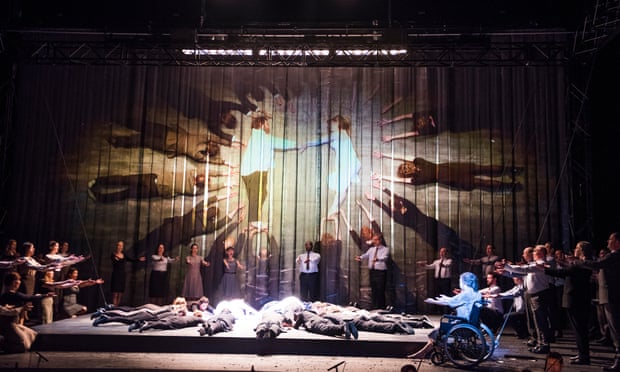
(Photo from the Guardian website)
Things are not getting better for our opera house at the London Coliseum. More negative news keeps coming in and the most recent is the livelihood of its Chorus which has been stated to reduce, including the number of opera productions taking place next year by ENO CEO, Cressida Polluck. With many internationally known musicians, performers, conductors, directors and classical music journalists signing a petition via @SaveEno (here), it is only a matter of time before the ENO's management has to face up to the inevitable and give the people (audiences, singers, performers, musicians and tax-payers), an answer to their financial dilemma.


Yet in the face of such crisis, the show must go on and the nation's supposed opera house has introduced a revival production of Complicite artistic director Simon McBurney, The Magic Flute, which was first shown in 2013. Admittedly I didn't enjoy that production; I re-read my review (here), which seemed like I was in agony by the end of it. Influenced by social media, however, with rave reviews of the revival's opening night, I got myself a ticket hoping that they were right and luckily I wasn't disappointed - phew!


The set hadn't changed much in three years - the ENO orchestra was elevated from the pit and a simple platform moved in mid-air. The staging was recycled from the last production but this time round the opera was executed to a better standard. Here's my reasons why.

Firstly, it seemed much more together; there was no fuss on stage among the performers and they seemed on top of what they were doing. Secondly, the voices of its brilliant cast were stronger. This was enhanced by stimulating conducting from ENO’s resident maestro, Mark Wigglesworth. The grand overture, The vengeance of Hell by the Queen of the night and blissful duets such as Pa … pa … pa ... were performed to a hugely satisfied mixed audience of children and adults. And thirdly, there were Finn Ross's video projections which were previously implemented, but here introduced with some extra additions, making it more imaginative and mythical (I won't spoil it by telling you what - visually - happens.) Overall, though, there was a real sense that the performers and singers believed in the production, making it a far more gratifying production. 

Allan Clayton and Lucy Crowe performed convincingly as star-struck lovers and although they were not the comedy starlets, they were able to stay in character while their zany companion creatures, Papageno (Peter Coleman-Wright), Monostrato (John Graham-Hall) and Papagena (Soroya Malfi) kept the childish humour of Mozart at bay. I had seen Crowe perform at the ROH in L'elisir d'amore, so I wasn't surprised she gave an impressively delicate and sweet sounding Pamina, particularly in her solo aria in the final act. 
 
Ambur Braid performed courageously as the wheelchair-stricken OAP version of the Queen. The ENO Chorus was tremendous in voice and played a pertinent part with McBurney's tacky paper birds. Coleman-Wright's Papageno, however, was much more friend-down-the-pub and had other handy gimmicks compared to the last production's bird catcher, Roland Woods. Though with saying that, they played a version of Papageno that was entirely their own. Woods was much more sharper in voice for Mozart's harmonious and witty music while Coleman-Wright wanted to make the audience laugh – and that’s exactly what he did! James Creswell is the voice of authority, Sarastro and there was a moment when he looked on to the audience, as well as his political cronies, and said, 'we are in a crisis!' I thought he was referring to the ENO crisis but then I remembered this was the bit that they worry over Tamino's dedication to love and truth - BLAUGH! 


English National Opera: Norma
★★★★
Alastair Muir
[From Review first published at CultureVulture.net]
The English National Opera (ENO) first performed Bellini’s 1831 bel canto opera, Norma this month. Christopher Alden's production was first presented by Opera North in 2012, which is a co-production with Die Theatre Chemnitz and has toured to Bordeaux ever since. Bellini put down on paper, 'Carve in your head in adamantine letters: Opera must make people weak, feel horrified, die through singing' and to many composers, artists and philosophers they were heavily affected by the composer's artistry.


Conducted by Stephen Lord, who demonstrates his aptitude for bel canto repertory, the production was dramatic in narrative and the music's sublimity that could only come together from a solid hand (and baton) to guide the roaring and heartfelt score. The opening night permitted its ENO Chorus to take to the curtain call twice, which was well-deserved for this chorus-heavy opera. They give a phenomenal performance as excellent actors and singers. Unforgettable scenes come in the final act where Norma reveals her treachery to them, and in their pain, they fall to the ground, then abandon her. It stressed the significance of the ENO Chorus’s role at the opera house at a time where their status is being compromised and negotiated by the ENO's management. 

Due to a word count I have to follow, I wasn’t able to put down a couple of things to be wary of with watching ENO’s Norma in my CultureVulture.net review. To put it bluntly, it is one of those operas that you are really going to love or really hate, and for me I found that I truly loved the music.

Listening to an opera where you can completely lose yourself in the music is one of the reasons  I love opera – and Norma is one of those operas, yet the production is, as I said, dry and woody as the staging, and the only beings capable of moving you are the cast, ENO Chorus and the gracious music, which has the ability to make you cry and feel vulnerable.

Another thing to note is that towards the last act, which was the most musically interesting, it took a long time to end and in some ways dragged. It was almost approaching 10.30pm and yes, I was tired (having had a long week at work already) but, surely, there must have been other ways that the production could have more appealing?

Should you go and see Norma, stick with it or at least go with the knowledge that there is nothing visually sophisticated to see and you must take the narrative and magnitude of the voices as they are.


Unexpected Opera: The Rinse Cycle, Charing Cross Theatre ★★★★★
Photograph by Robert Workman
I am an advocate of the fringe scene, a place where young and aspiring musicians and performers can reveal their trained voice and talent to an audience new to opera. Yet opera aficionados also like to check out small-scale productions too. Who knows if they might be seeing the next Maria Callas or Placido Domingo? (Honestly, who knows?) Some fringe opera companies are based locally while others go on tour, and this week I had the pleasure of seeing The Rinse Cycle by Unexpected Opera. It may sound rather cliché but I truly didn't know what to expect. The programme booklet reads, 'Wagner's Ring Cycle Conditioned with comedy and shrunk to 2 hours' and on analysis it did just that but in an inventive and intelligent way. 

Unexpected Opera's artistic director, Lynn Binstock is on a mission to bring opera to those who think it's not for them as well as those who are devout operagoers through engaging and hilarious productions, and I've seen some funny operas but this one took comedy to another level. From the very beginning scenes I wasn't sure when Wagner's Rhinemaidens were going to fly in but it really didn't matter at this point as I got stuck in to the bizarre laundry stage and odd props: Patisserie Valkyrie sign post, mermaid aprons, disputed leitmotifs, an ironed out sword, Norfolk accents and oven gloves for Wotan’s giants.  Somehow Top Gun's Tom Cruise, with a phony American accent, also seemed relevant.

What's smart about this show is that it eases the audience in with its own light-hearted story. Ronnie (Simon Thorpe) and ex-opera singer Edith (Harriet Williams) are the married couple with son, Tim (Edward Hughes) while Hilda (Mari Wyn Williams) and Robin (Anna Gregory) are like the waitresses from BBC Comedy 'Allo 'Allo, who go through the trouble of delivering the Ring cycle in a shrunken down version for the audience sat in front of them. However Tim didn't hear his dad properly and thought he said Rinse - not ring, hence, the hypnotic washing machines on stage.

Though jokes aside, it is only by the end of the first half that you begin to get to the core of Wagner's music and all of that powerful Wagnerian singing. So while you may have spend the first hour doing stomach crunches in your seat, you'll be enlightened by real music drama, and the transition is, pretty much, seamless through the conviction of its passionate cast. 
 
There are two casts for this production and on the opening night Thorpe sung both baritone roles, as Wotan and Alberich, yet he also played other characters with strange accents, including Sean Connery, on his knees and standing up. He gave a sensitive performance for the audience by the second half. The same can be said for Williams who sung as Fricka and her voice was intense, bold and alluring - my favourite voice of the night! 
Photograph by Robert Workman
Mari Wyn Williams sung the prelude of Die Walküre almost effortlessly with utter assurance and she had multiple roles to go on including Sieglinde and Ronnie's secret flirt. I also enjoyed tenor Edward Hughes who was marvellous as Siegmund and Siegfried - poor Tim kept getting confused playing both roles, but Hughes rose to the occasion and hit all those brave notes!
 
Gregory has the vocal prowess for her roles as well ranging from Gutrune and Tim's knocked up girlfriend. Music director Kevin Lim had a shaky start on the piano but that was quickly forgotten when it came to performing the pithy and heartfelt songs sung by the cast.
 
Some may only prefer their Wagner operas to be heard as the composer wrote it, or wanted it to be performed in Bayreuth, but that would be elitist, wouldn't it? For veteran operagoers who don't mind letting their hair down, having a beer and watching a cheerful and slightly cheesy opera that speeds through Wagner's 16-hour opera and neatly trims it down to 2 (with a break in between), then this is a perfect antidote. This is mutually beneficial for opera newbies, too, who will still get a taste of Wagner's profoundly dramatic music straight up from a versatile cast. Hats off to Unexpected Opera for ending my week on a high and making me sing Hoyotoho with the crowd - honestly, no one predicted that would happen and I love surprises.


L'Étoile ends 24th February, 2016. (Click here for more information)

The Magic Flute ends 19th March, 2016. (Click here for the ENO website.) 

Norma ends 11th March, 2016 (Click here for more information) 


Saturday, 20 February 2016

Opera Vera: Così fan tutte

(Photo from www.operavera.co.uk)
Whenever you're in the piazza of Covent Garden you pass a church that tends to be ignored, mostly due to the hustle and bustle of Central London, but Actors' Church is, in fact, a unique space for small-stage productions like Opera Vera's Così fan tutte which I was delighted to see on the Valentine's weekend. Not only did conductor, Philip Hesketh and the 10 musicians of the Opera Vera Players give an imaginative and sharp-witted performance, they managed to present the fine subtleties and characteristics inhabited by its hilarious fiancée-swapping plot in what was regarded as Mozart's most controversial opera.

For Opera Vera, they set their comedy in today’s cannot-live-without-my-smartphone world, by the coastal lines of the Italian sea. In the background, a scrolled down screen pans images of the Italian mountains alongside the beautiful coast, then on the left a cameraman sets up his gear for what could be a reality TV show. Queue camera! The charming philosopher, Don Alfonso (Håkan Vramsmo) glares into focus, quickly sorts out his hair and gives a cheeky smile that everyone in the audience can see on screen.

Ferrando (Tom Morss) and Guiglelmo (Peter Brooke) are our optimistic and adamant fiancés assured that their other halves Dorabella (Camilla Bull) and Fiordiligi (Susan Jiwey) would never stray into another man's arms, and so they bargain with Don Alfonso to their defence. This is where the camera came in and acted as a portal for these men to speak freely about their love gamble. Yet in this yoga, selfie laden, strawberry and creams, barbeques-at-the-ready universe, men dressed as if they had walked off a Middle-Eastern desert can still turn the righteous heads of fiancées.

With many excuses to laugh and giggle, there were a fabulously polished cast that revealed hidden talents I hadn't heard before. Tom Morss and Peter Brooke gave a comical performance as the strange men who pretended to poison themselves, in the name of love – of course! Morss firmly executed some serious singing, particularly when his character realises he might have been wrong about his lover, while Brooke gave a refined and terrific performance as an overly complacent Guiglielmo.

Susan Jiwey, as Fiordiligi, is a hidden gem whose voice shined throughout the halls. Clear and gracious, her voice rose high and had a dimension of sophistication that I hope to hear again in the near future. Camilla Bull's Dorabella likes to smash things on the food table and create a big mess. She also met the challenges of her role singing beautifully with Jiwey and Vramsmo in “Soave sia il vento". (It sounded so good, I had to close my eyes!)

And Caroline Kennedy was the feline Despina dressed like the ladies' PA, with a realistic outlook of men and women and of the belief that women should be as naughty as the opposite sex. I'm no stranger to Kennedy's voice and found it a pleasure to see and hear her again as the multilinguist witch doctor and clumsy notary.

James McOran-Campbell and Alexander Anderson-Hall's Così is a brilliant illustration of how classical operas framed in a modern settings can really work, and, indeed, be very relevant. Gender stereotypes aside, Mozart's opera eventually became popular by the 20th century and today - where both men and women can be mutually 'stupid' and it, really, isn't a big deal.


This production has ended. To find out more about Opera Vera, please go to their website (here), and follow them on Twitter on: @operavera (here).