Showing posts with label national theatre live. Show all posts

Thursday, 10 December 2015

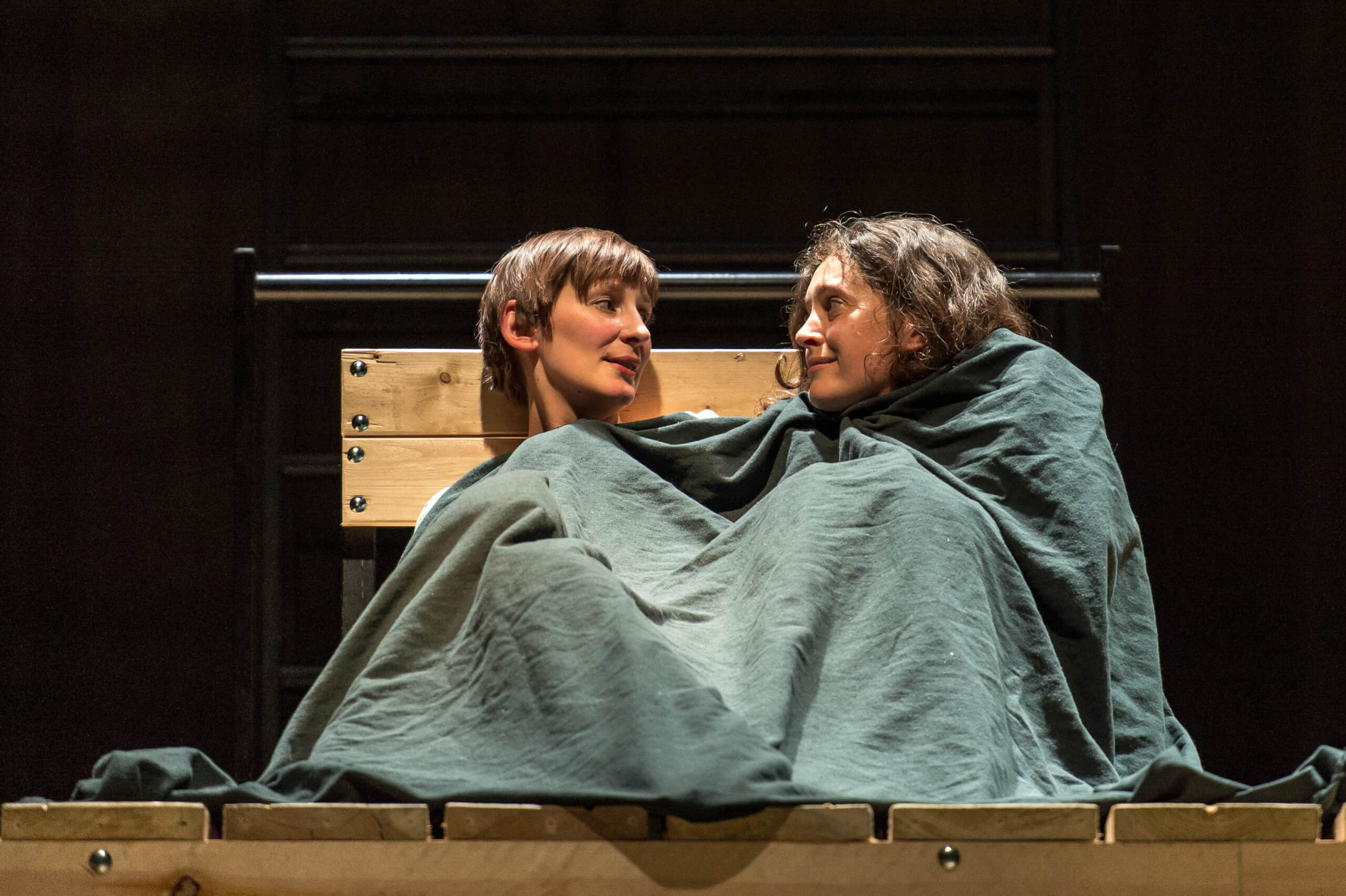
⭐⭐⭐ National Theatre Live: Eyre at the Gate Picture House (Notting Hill)


Charlotte Bronte's eponymous novel of the life of Jane Eyre is considered avant-garde, ahead of its time, dabbling with gender roles, sexuality and religion during the 19th century. Yet through Bronte, Eyre was given an individual voice that went against social whims, and was arguably one of the first examples of proto-feminism, of the century.

Now, still, showing at the National Theatre is Sally Cookson's ensemble adaptation, which was first shown last year at the Bristol Old Vic, as part of a hugely successful two-part show. Presented as a single show, this 210-minute drama begins with Jane (Madeleine Worrall) crying like a first born child, with atmospheric music performed by a impassioned band who prepares the audience for the psychological ordeals that this would-be child later endures. With Cookson, however, it's abundantly clear that she studies Eyre's cruel and desperate upbringing, rather than hone in, so much, at the troublesome and confusing relationship she develops with Rochester. 


Stage designer, Michael Vale offers a rustic, wooden maze of ladders and platforms for the complex characters to dance, run and hide away.  The jazz ensemble (piano, drums and brass) is stationed centre stage throughout; either they are singing and banging to the beat of Eyre's feet, or buzzing to a stagecoach charade, running on the spot to signify Eyre's journey to a new country estate or the draconian Thornfield Hall School.

Cookson's play instills the neglect and abandonment of various family members in Eyre's life, from her parents, her kindly uncle and best friend, Helen Burns (Laura Elphinstone), who were lost to the widespread diseases of the time. This follows her hardship under the verbally abusive Aunt Reed (Maggie Tagney) and over-zealous Mr Brocklehurst (Craig Edwards). Aideen Malone's exquisite display of light and Benji Bower's howling score represent the fragility of Thornfield Hall and the chilling depression of Lowood.


Worrall's sensitive and tender portrayal of Eyre has crafty nuances of childishness, which appeals to Felix Hayes's aggressive and Byronic Rochester. Hayes retains an assured and bold Rochester whose overt superiority exudes rough-around-the-edges masculinity. Craig Edwards
animatedly performs as his giddy and curious dog, Pilot and Melanie Marshall gives a gracious and heart-felt performance singing as Rochester's insane wife, Bertha.

This original production puts a musical twang to Bronte’s 19th century tale and brings to life the internal voices that haunted Eyre. The performance is visceral and the music is, almost, unforgettable. 


For more information on Jane Eyre, please click here.

Click here for NT Live's performance of A View from the Bridge with Mark Strong. 

NT Live Review of Everyman, click here.

Click here for NT Live Review of Tom Stoppard's The Hard Problem.

Monday, 20 July 2015

★★★★ NT LIVE: Everyman


For Rufus Norris’s debut production as the new artistic director at the National Theatre Everyman deserves to be classed as big, bold, eclectic and entirely relevant. For a start its lead character, Everyman is performed by Award Winning Actor, Chiwetel Ejiofor who yanked our heartstrings in the Oscar Winning film, 12 Years A Slave. Secondly, the contemporary and electric coloured set is actually a backdrop for a morality play originally written in the 15th century. And, on top of that, you have poet laureate, Carol Ann Duffy writing reams of poetry and script for this adapted production. (Norris stated that Duffy began with twenty pages of script, which ended with seventy-two pages for the show.)
I wasn’t there at the National Theatre. Tonight [July 16], I was at the Gate Cinema in Notting Hill with cinema audiences who also enjoy watching live theatre from the comfort of their local cinema. This was the first time I had seen the production and whilst viewing it on the big screen, it seemed to work really well considering the versatility of Ian MacNeil’s brilliant staging and visual elements, not to mention Ejiofor who, we know, looks good on film.
As we see NT audiences get settled in the auditorium, we watch as a cleaning lady sweeps the Olivier theatre stage, yet even before the show has began, we’re unsure if she’s part of the show or a NT staff member. All is confirmed when she turns around, projects her voice and speaks at the audience. Actress, Kate Duchêne, says ‘Enjoy it while it lasts!’ Before we know it’s actually God ranting about the falsehood of man in a dirty apron simultaneously brushing dust off the floor. Yet the quiet is instantly destroyed by an ambush of electro, dub step and high intensity club music.
Everyman celebrates his 40th birthday with coke, alcohol, debauchery and sin, and whilst this is happening the entire stage looks like a visually intensifying (and amusing) music video. Choreographer and Movement Director, Javier De Frutos adds in the intimate slow-mo, vitality and dynamics to this corrupt scene with a neatly casted team (up-to 22 supporting actors and actresses). 
Courtesy of The Stage/National Theatre
With a pair of rubber gloves and a plastic carrier bag, Irish actor Dermot Crowley makes his entrance as Death, yet don't let the humour and sarcasm fool you - there’s still a glimmer of evil in his eyes. There’s no dark cloak or nightmarish hood to identify him – just a snappy and scary persona that forces Everyman to look back at his life for a meaningful act he had committed. The rest of the show is the hair raising journey Everyman takes.
Everyman goes back to his mother, father, sister, so-called clubbing pals and a load of abstract characters (Vanity, Knowledge and Goods, etc.,) in search of a good deed yet nothing is redeemable, nor attainable. He has a reflective moment when he meets his younger self, Everyboy (played by Jeshaiah Murray) and says to him, ‘You’re so lucky!’’ Through Everyman’s desperation Ejiofor convinces us that we’ve had a few moments asking ourselves similar questions: ‘What have I done?’ or ‘What is my good deed?’ That once, we have doubted ourselves and regretted a thing, or two. 
Yet, with all such brilliant staging and acting, there are scenes that move super fast, from one abstract character to another, that it's hard to keep up with the pace, including the toing and froing from old English and casual slang. In one scene, Everyman is in prayer talking about the Act of Contrition and in another has a revelatory dialogue in plain verse with Vanity about his secular love for credit cards and bling bling. But these tiny blips didn't change how together the message of the play was cleverly delivered.
Duffy, naturally, has a way with words, which shaped the story exquisitely. Paul Arditti also deserves his due as sound designer as well as the ensemble of musicians directed by Williams Lyons. This included interesting instrumentation from a hurdy gurdy, racket, crumhorn, recorder, bagpipes, gittern and many more.

Photo by Richard Hubert Smith


Monday, 20 April 2015

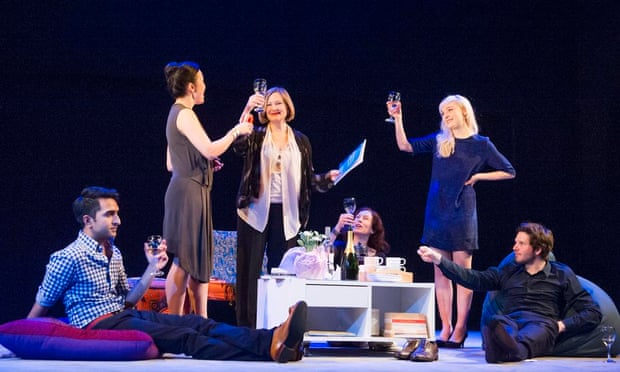
NT Live: Tom Stoppard's The Hard Problem ⭐⭐⭐⭐


Back in the Gate cinema on April 16, a crowded audience gathered for the NT Live screening of The Hard Problem, directed by Sir Nicolas Hytner. It is his last production at the National Theatre as he bids farewell to his post as the artistic director of the National after a 12-year stint.  
Tom Stoppard’s first play in nine years is a mean feat of critical theorising about consciousness and everything connected to it: philosophy; evolution; biochemistry; neurology; and much more. Even religion gets a mention and plays a part in this head scratching performance. The Hard Problem speaks for itself. It is a question that has been bugging intellectuals since the 4th century in classical Greek philosophy (and even earlier for Eastern philosophers.) For those who are a novice to critical theory or have never stepped into a philosophy a-level class, they might be in trouble here though.
This isn’t the first of its kind for Stoppard. He is known for writing brilliant theatrical works that include themes of political freedom, linguistics and the meaning of life, and for this The Hard Problem shoves audiences into a dialectic much like the way Plato and Socrates challenged each other five hundred years ago. 
By comparison, many who expect the wittiness and cleverness of Stoppard’s 1993 play Arcadia will be let down. That is not to say that The Hard Problem is not as witty or as clever as Acadia. No, in fact the play is both these things but in a different way. Arcadia combines the manifestations of pre-19th century Romanticism idealism with nature. While Arcadia brushes upon some interesting thought provoking ideas, The Hard Problem gets deep, so deep it hits the academic books and looses the audiences’ attention unless they are familiar with the terminology and theoretical notions e.g. the Prisoner’s dilemma, which crops up almost twenty times in the play.
Between the young psychology student Hilary and Spike, played convincingly by Damien Molony as Hilary’s university mentor, cinema viewers can see the dynamic movement in their heated debates as camera focus onto one another. Camera 1 focuses on Hilary. Immediately after, camera 2 moves into Spike who aggressively rebukes her with a brutal and gutless definition on altruism, the ‘selfish gene’, if you will, and so on. Their intellectual frustrations are set aside while they maintain an odd,  attachment-free relationship. 
Olivia Vinall gives an electrifying performance of Hilary not only in seasoned application of verbal assaults but with Hilary's deep-seated passion as a young mother who gave up her child for adoption at the age of 15. After gaining a position at the Krohl Institute for Brain Science Hilary delivers a paper hypothesising God as the answer to all things including consciousness, which isn’t good; it won’t fund the institute’s research facilities. 
This is other side of Stoppard’s play that he highlights through the character of Jerry, who is wickedly acted by Anthony Calf. He exhibits a hedge-fund millionaire who swears and shouts down at his employees whilst portraying a genuine and caring father. There’s an emotional twist to the story that ends the play in a hopeful fashion, but I shan't share any spoilers here.
Vera Chok, Jonathan Coy, Rosie Hilal, Parth Thakerar, Lucy Robinson and little Daisy Jacob come on top as playing small parts of this mind-boggling 'abstract' of a play, yet not much depth is offered about their characters. The emphasis is ultimately on Hilary’s journey who tries to find herself, understand her conscience and grapple with her own hard problem. 
With Bach’s enthusiastic piano solos that are lightly and lyrically played by Benjamin Powell and Bob Crowley and Mark Henderson set design of colourful light rods and wires; that light up like brain neurons or brain currents, Hytner ensures audiences gain a sense of the profound and complex mindset of its protagonist.

NT Live Encore of The Hard Problem on the April 21 in Gate Cinema at 12pm. The Encore is also available throughout the week in London cinemas including Picture Houses on the 24th. Check your local cinema.
(Photo courtesy of National Theatre)
Also showing at the National Theatre until May 27th. Check their website.

Sunday, 18 May 2014

National Theatre Live's showing of 'Sam Mendes' King Lear ****


National Theatre Live has provided live broadcasts of their stage productions since 2009 to over 500 cinema venues internationally. 250 venues of which are in the UK alone.  May 2nd was the live presentation of Sam Mendes, director of James Bond: Sky fall and American Beauty, suspense driven production of ‘King Lear.’ The re-broadcast shows shall take place on the 15th and19th of May and considering that ‘King Lear’ has sold out at the theatre, itself, it is perhaps worthwhile grabbing cinema tickets for one of Shakespeare’s most notable tragedies; which although loses the frills of a theatrical experience allows viewers to see the action from closer angles, which can be equally beneficial.

Mendes relationship with Simon Russell Beale, who plays Lear, has been longstanding since 2000. Russell Beale’s Lear descends from an officious authoritarian leader, (who, although, is a short man has a powerful presence that speaks volumes beyond his height,) to an insane naked hospital patient who wears a straw hat and carries a bag of flowers; he suffering from dementia.


The beginning scene is a stately affair, in the presence of military men, where Lear divides his kingdom amongst his three daughters, yet Cordelia (Olivia Vinall) defies her father’s request for praise and love which drives him into a tantrum frenzy as he stomps across the stage. Vinall, however, plays an outspoken and unwavering Cordelia quite different to docile and self-effacing versions of Cordelia often portrayed, yet his parading of her on top of a chair to embarrass her is early signs of his sanity soon-to-be doomed.
Anthony Ward’s injection of digital grey cloud screens made the ominous tone of the play even scarier and his use of an elevated platform, which brought Lear and the fool towards the turbulent thunderous skies, was an innovative device necessary in any version of ‘King Lear.’

Goneril (Kate Fleetwood) and Regan (Anna Maxwell Martin) play the catty, evil sisters, similarly dressed in colour, sexiness and skintight wear to enchant and bewitch the men of power; Lear, their husbands, and their own half brother, Edmund, who they both – unknowingly – have affairs with to get their way. Yet there are other sinister and darker hues of immorality which pervade Mendes stage such as an incestuous relationship between Lear and Regan, as he often smack her bottom, and her husband, the Duke of Cornwall (Michael Nardone) use of a cork screw to pluck out the eyes of loyal and merciful Gloucester (Stephen Boxer) which left viewers gasping from the, somewhat realistic, blood as they hid behind their hands. A unique touch of Mendes was added when Lear killed his fool (Adrian Scarborough,) with an iron bar who delivered woeful singing to his Shakespearean lines of half-truths as he subtly warned Lear to be, ‘not have been old before thou hadst been wise.’ It is a unexpectedly shocking scene to see the innocent fool dead in a bath tub by the hands of the one he had most concern for, yet Russell Beale’s Lear is full of contradictions; he looks back at the bloodied body and whimpers as he had forgotten that he taken his fool’s life.

Sam Troughton as the bastard son, Edmund, plays an erudite half brother, but a hypocrite (no less,) whose charismatic monologues make him a great fit for the role. Yet Tom Brooke’s Edgar only becomes convincing towards the end of Act 2 with the accompaniment of his blind father, Gloucester. From the moment Brooke enters the stage, he presents a naive and uncertain Edgar; unsure of himself and, possibly, his own place in the play which is, sadly, felt by the audience. Gloucester and Edgar’s relationship is a parody of the lack of familial love shared with Lear and his daughters, and it is perhaps Brooke’s mistake to emphasise this as oppose to focusing, a little more, on the deeper elements of Edgar’s character.

The last scene where, like, most Shakespeare plays many anti-heroes are suicidal and bloodied, is rather unchoreographed and half-heartedly done. A much-anticipated brawl would have come in handy for such a taut and forlorn play. Nonetheless, the show’s sell-out status is thoroughly justified thanks to Mendes’ wickedly presented production.