Showing posts with label Gate Cinema. Show all posts

Tuesday, 26 January 2016

☆ ☆ ☆ ☆ MetOpera: Live in HD: Les Pecheurs de Perles (The Pearl Fishers) at the Gate Cinema


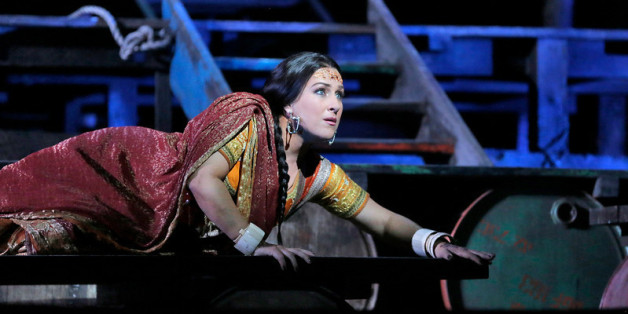
Picture from the Huffington Post
Firstly, it should be said that this is an original production from the English National Opera (ENO) in London. Whilst sitting at the Gate cinema in Notting Hill, I noticed there was barely any mention of it, and although it may have seemed like a brand new revival for New York, it certainly wasn't for London audiences. On top of the so-called novelty was the performance of Bizet's Ceylon romantic opera, which hadn't been staged at the Metropolitan Opera for 100 years. In 1919, Enrico Caruso and Giuseppe De Luca sung as the two best friends who fell in love with the same Hindu priestess (Frieda Hempel), which was, sadly, only performed three times in the run.

Back in my mind I recalled some of my concerns I had about the ENO production I saw in 2014. Director Penny Woolcock, set designer Dick Bird and lightening designer Jen Schriever were here again to regal their 'traditional', silky, smooth Eastern pearl-diving village, with its aquatic, ocean shimmer. The French words, the romantic libretto, and steaming story line of secret lovers hiding behind society - ultimately taboo - is why many opera lovers adore the opera so much. Second to Carmen, Les Pecheurs de Perles is another operatic success composed by Bizet.
The chorus and soloists were dressed in autumn coloured sarongs and saris, and compared to the static London production there was more magnetism and energy from the performers here. Perhaps that was due to the pressures of HD Live: some performers chose to improvise their acting for the camera, for those close up shots.

As a cinema viewer, I was under the powers of Live in HD director, Matthew Diamond and his camera men who were directing my eyes away from any tetchy scene changes going on in the background, which the Met audience were privy to. (There were no laddish conversations going onbackstage like the ENO production. Phew!) Undoubtedly with a larger budget, the Met managed to get 59 Productions to coordinate their projection designs, which, with aeroplane machinery, allowed dancers and acrobats to swim in the air with animated bubbles following their tracks.

Diana Damrau sung as the pure and scared protector of the village Leïla - not allowed to give into temptation. Yet she had already fallen in love with Nadir (Matthew Polenzani) whose best friend, Zurga (Mariusz Kwiecien) was the leader of the town. He too is in love with Leïla. Both Zurga and Nadir promise to make friends and put their fight over Leïla behind them, yet Nadir doesn't abide. 
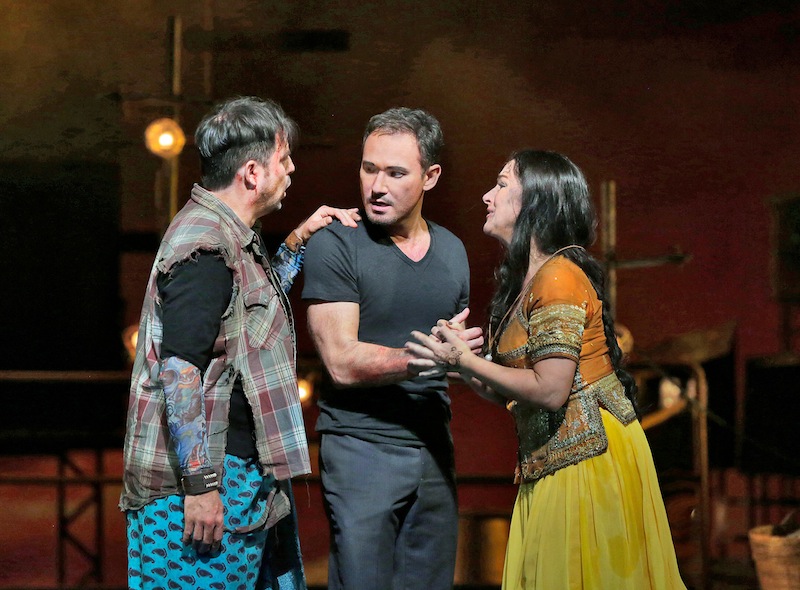
Picture by Ken Howard
Polenzani sung 'Je crois entrendre encore' with supreme confidence as the starry-eyed Nadir. There's a hopeful, wanderer's quality about his singing, which is, arguably, one of the most memorable parts of the entire production. Damrau's vocals displayed relative ease in the colouratura sections. She gave a convincing performance as the Hindu priestess lost to love's ways, though Damrau seemed to get carried away with too much delicate vibrato; I wasn't sure if she was simply showing off or deliberately singing like this to prove how fragile and naive her character was. With her partner, Polenzani, their voices blended with interesting colouring and phrasing, though, looking back, they didn't seem to make their clandestine relationship look especially romantic. I'd rather give the credit to the Met orchestra, maestro Gianandrea Noseda and Bizet for keeping the theatrical atmosphere sweet and dreamy.

The town is under the control of Zurga, performed by baritone Kwiecien. He's the good guy. He hands out money to the community and considers what is best for their livelihood. Yet, he loses out on the girl of his dreams and loses his best friend's loyalty on the way. Kwiecien's Zurga is like a captain - controlled, calm and subdued. With Polenzani, the best friend's duet is performed with panache and is another sparkling gem in the production. Standing on different ends of the stage, they sing 'Au fond du temple saint' walking slowly, closer and closer together, breaking the social boundaries that once separated them. 
Picture by Sara Krulwich
In the second half of the opera, Kwiecien and Damrau sung emphatically about love, but for different people. The dynamic is entirely different; kindness and innocence has been destroyed.  Zurga no longer respects his best friend for betraying him and he denounces Leïla, condemning both of them to death. With a cigarette, a clean washed shirt and swig of alcohol Kwiecien's Zurga tries to calm himself down, but is riled up by Leïla's presence, begging him to let Nadir live. Back at the Gate Cinema, it's an aggressive and scary sight. Damrau's singing is passionate, while Kwiecien is red in the face; jealous and angered, and, just, about, manages to sing his lines, clearly and fluidly.

In the pit, the Met Orchestra were tremendous, taking fine direction from conductor Noseda. Simultaneously the prelude was tender and powerful . Together they brought out the luscious lyricism of Bizet's gorgeous opera. I find it difficult to comment about the music in detail given that I was depending on the Gate Cinema's speakers. Overall, I can say it gets a thumbs up from me. Let's just hope the Metropolitan Opera doesn't wait another 100 years to show another performance of The Pearl Fishers.

For more information on this production at the Met Opera, please see http://www.metopera.org/Season/2015-16-Season/pecheurs-de-perles-bizet-tickets/ 

Click here to check out full showings and listening at the Picture House, Gate cinema.  

Click here for my review of the ENO's production of The Pearl Fishers, 2014 

Click here for my review of Live in HD production of Berg's Lulu, 2015 at Curzon Cinema, Chelsea

Click here for my review of Live in HD production of Othello, 2015  at Curzon Cinema, Chelsea


Thursday, 10 December 2015

⭐⭐⭐ National Theatre Live: Eyre at the Gate Picture House (Notting Hill)


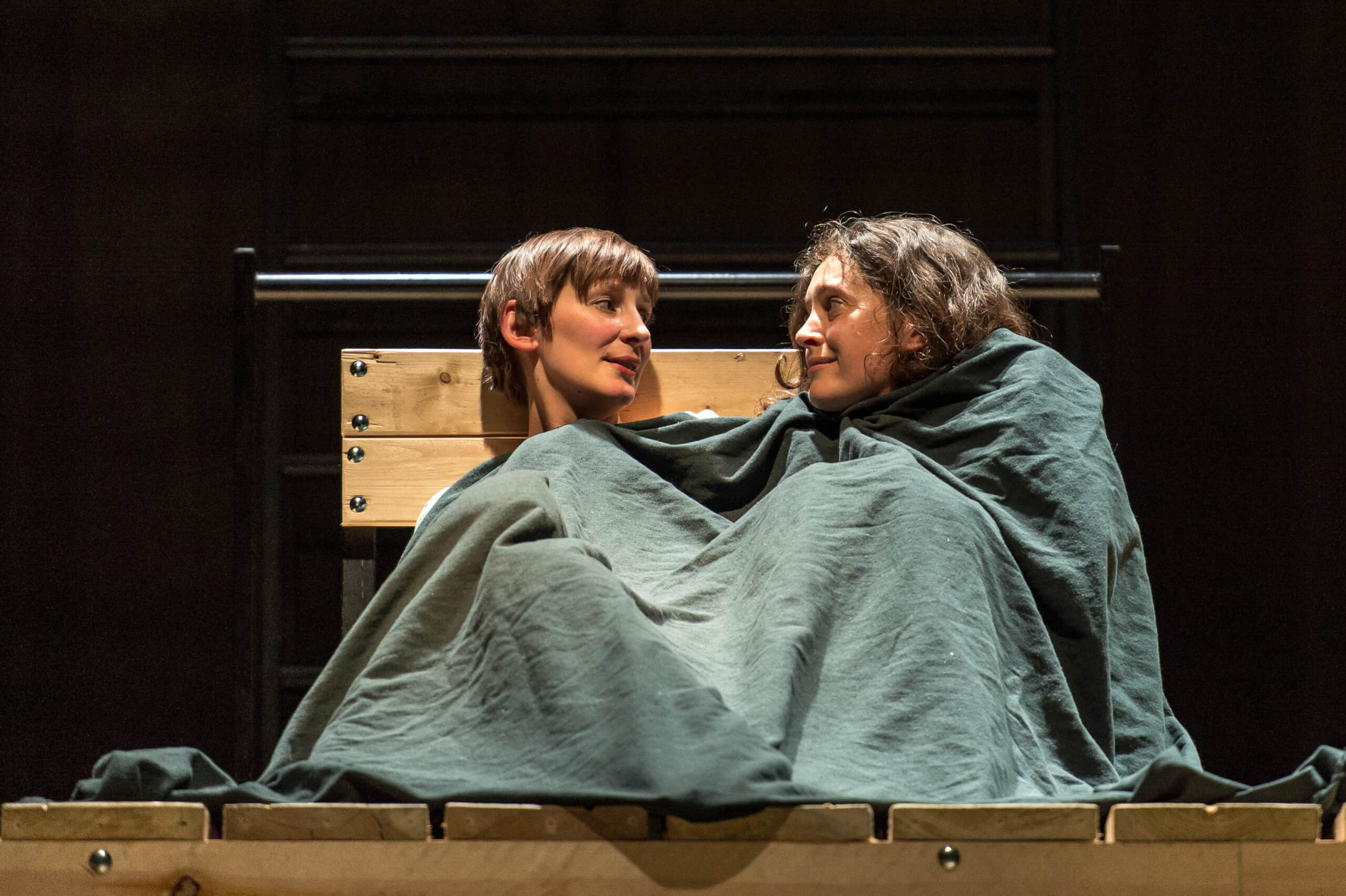
Charlotte Bronte's eponymous novel of the life of Jane Eyre is considered avant-garde, ahead of its time, dabbling with gender roles, sexuality and religion during the 19th century. Yet through Bronte, Eyre was given an individual voice that went against social whims, and was arguably one of the first examples of proto-feminism, of the century.

Now, still, showing at the National Theatre is Sally Cookson's ensemble adaptation, which was first shown last year at the Bristol Old Vic, as part of a hugely successful two-part show. Presented as a single show, this 210-minute drama begins with Jane (Madeleine Worrall) crying like a first born child, with atmospheric music performed by a impassioned band who prepares the audience for the psychological ordeals that this would-be child later endures. With Cookson, however, it's abundantly clear that she studies Eyre's cruel and desperate upbringing, rather than hone in, so much, at the troublesome and confusing relationship she develops with Rochester. 


Stage designer, Michael Vale offers a rustic, wooden maze of ladders and platforms for the complex characters to dance, run and hide away.  The jazz ensemble (piano, drums and brass) is stationed centre stage throughout; either they are singing and banging to the beat of Eyre's feet, or buzzing to a stagecoach charade, running on the spot to signify Eyre's journey to a new country estate or the draconian Thornfield Hall School.

Cookson's play instills the neglect and abandonment of various family members in Eyre's life, from her parents, her kindly uncle and best friend, Helen Burns (Laura Elphinstone), who were lost to the widespread diseases of the time. This follows her hardship under the verbally abusive Aunt Reed (Maggie Tagney) and over-zealous Mr Brocklehurst (Craig Edwards). Aideen Malone's exquisite display of light and Benji Bower's howling score represent the fragility of Thornfield Hall and the chilling depression of Lowood.


Worrall's sensitive and tender portrayal of Eyre has crafty nuances of childishness, which appeals to Felix Hayes's aggressive and Byronic Rochester. Hayes retains an assured and bold Rochester whose overt superiority exudes rough-around-the-edges masculinity. Craig Edwards
animatedly performs as his giddy and curious dog, Pilot and Melanie Marshall gives a gracious and heart-felt performance singing as Rochester's insane wife, Bertha.

This original production puts a musical twang to Bronte’s 19th century tale and brings to life the internal voices that haunted Eyre. The performance is visceral and the music is, almost, unforgettable. 


For more information on Jane Eyre, please click here.

Click here for NT Live's performance of A View from the Bridge with Mark Strong. 

NT Live Review of Everyman, click here.

Click here for NT Live Review of Tom Stoppard's The Hard Problem.

Tuesday, 28 July 2015

Glyndebourne Live Broadcast: Mozart's Die Entführung aus dem Serail ★★★★

Photo by
Die Entführung aus dem Serail (The Abduction from the Seraglio) (1782) reawakens audiences of Mozart’s genius with some heart-felt arias and a throbbing whirlpool of an overture. He was only 26-years-old when he composed the opera.

Die Entführung is famously known for being criticised by Mozart’s then commissioner, Emperor Joseph II for having ‘too many notes’, and although a comedy opera, its subject isn’t so innocent. Much like Die Zauberflöte (The Magic Flute), there are misogynistic and racial slurs honing in on Eastern and Western values, particularly the Ottoman Empire so, it’s always interesting to see how directors choose to stage a production.

This year, Glyndebourne has David McVicar directing the opera for their summer programme, which was broadcasted live at cinemas [July 19 ]. At the Gate cinema, Notting Hill, older audiences familiar with the work attended, yet some of them were a little too impatient to see its ending. McVicar’s instruction to include the full singspiel may have been the cause of this, which produced a half play, half opera concoction. One cinema viewer shouted, ‘hurry up!’ during a dialogue between Belmonte and Pedrillo in act I.

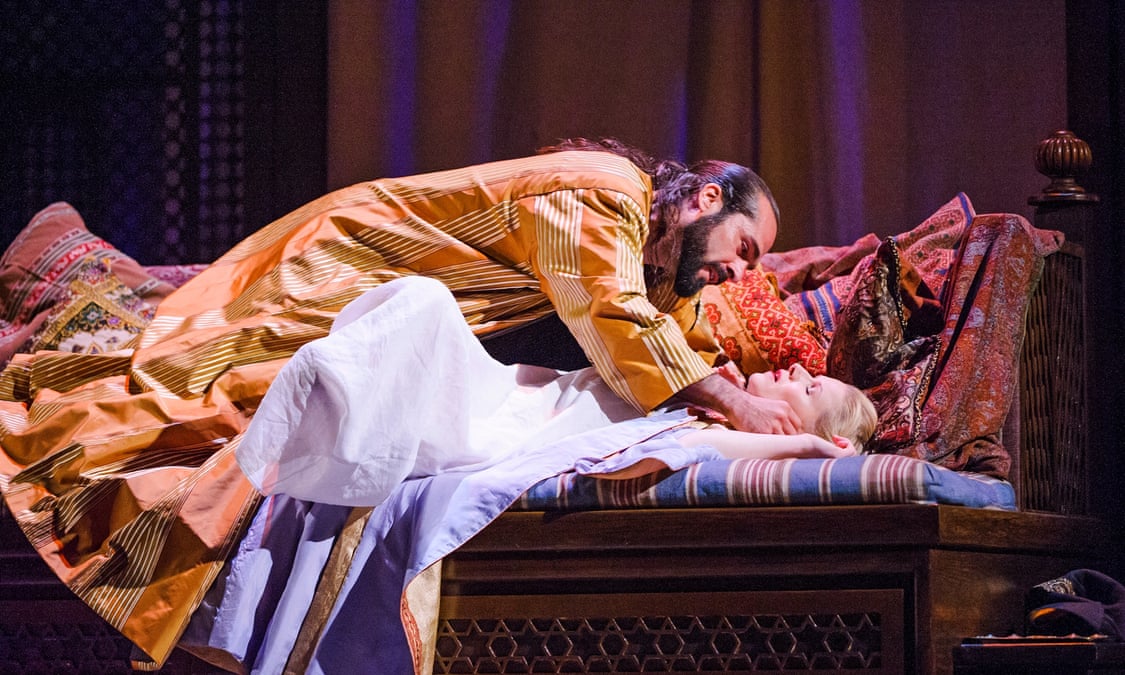
In spite of how long the opera was the singspiel didn’t spoil my experience, which, surprisingly, was refreshing. The fine German diction and frivolity between the oafish Osmin (Tobias Kehrer), artful Pedrillo (Brenden Gunnell) and noblemen Belmonte (Edgaras Montvidas) were things to relish about the opera. The merciful efforts from heart-broken Pasha (Franck Saurel) to claim Konstanze’s love (Sally Matthews) were also significant parts of the production.
Photo by Tristram Kenton for The Guardian
 McVicar’s traditional and safe staging seemed to go well with the beautiful score. The overall set was visually pleasing with period costume, green gardens and Ottoman Empire-inspired, lavish interiors for Pasha’s harem, designed by Vicki Mortimer. The Orchestra of the Age of Enlightenment and their period-specific instruments appropriately added a unique touch to the decadent opera with Glyndebourne’s music director Robin Ticciati at the helm. The overture was gutsy and Ticciati conducted with aplomb.

Undoubtedly radiant and sensual was Matthews as our trapped heroine who says one thing but does the other - she allows Pasha to kiss her one second but rejects him in another. Her ability to reach stratospheric notes seemed effortless though it had me thinking, at times, how cruel Mozart was to make sopranos sing such top notes so often and between one another. And because of this, I could hear her straining in ‘Martern aller Arten’, but, resilient as she was, she kept singing until the end.
Montvidas was lyrical as his character’s virtuosity and bass singer, Kehrer sang as an awesome, but nasty Osmin. He soon became a favourite amongst the audience, even though he displayed an evil ogre and less of a comedian. His scene with Mari Eriksmoen, as Blonde, throwing pans and dishes at each other was one of the funniest moments of the opera.

Eriksmoen performed as a crafty and cheeky Blonde, and with Gunnell’s speedy Pedrillo made a cute and hilarious couple on stage, cleverly depicting the social divide with Belmonte and Konstanze’s relationship. 

Despite not having to sing Franck Saurel was a thrill to watch too as the sensitive Pasha. With saucy scenes of a sexual violence, teary eyes, passionately said words and a half naked torso, Saurel was the stuff of great acting.

Thanks to Live broadcast of Glyndebourne audiences can gain insight of Glyndebourne performances, minus the dinner jacket and fascinator.

Die Entführung aus dem Serail is still showing at Glyndebourne until the 10 August. Click her to purchase tickets. They are also going on Tour this autumn so there’ll be another chance to see it at other venues in England – book early to see the production on Tour.

The next cinema Glyndebourne showing is Fiona Shaw’s Rape of Lucretia on the 9th of August also showing at Gate Cinema, Notting Hill. Click here for Gate Cinema website or here, for other UK cinemas.

Monday, 20 July 2015

★★★★ NT LIVE: Everyman


For Rufus Norris’s debut production as the new artistic director at the National Theatre Everyman deserves to be classed as big, bold, eclectic and entirely relevant. For a start its lead character, Everyman is performed by Award Winning Actor, Chiwetel Ejiofor who yanked our heartstrings in the Oscar Winning film, 12 Years A Slave. Secondly, the contemporary and electric coloured set is actually a backdrop for a morality play originally written in the 15th century. And, on top of that, you have poet laureate, Carol Ann Duffy writing reams of poetry and script for this adapted production. (Norris stated that Duffy began with twenty pages of script, which ended with seventy-two pages for the show.)
I wasn’t there at the National Theatre. Tonight [July 16], I was at the Gate Cinema in Notting Hill with cinema audiences who also enjoy watching live theatre from the comfort of their local cinema. This was the first time I had seen the production and whilst viewing it on the big screen, it seemed to work really well considering the versatility of Ian MacNeil’s brilliant staging and visual elements, not to mention Ejiofor who, we know, looks good on film.
As we see NT audiences get settled in the auditorium, we watch as a cleaning lady sweeps the Olivier theatre stage, yet even before the show has began, we’re unsure if she’s part of the show or a NT staff member. All is confirmed when she turns around, projects her voice and speaks at the audience. Actress, Kate Duchêne, says ‘Enjoy it while it lasts!’ Before we know it’s actually God ranting about the falsehood of man in a dirty apron simultaneously brushing dust off the floor. Yet the quiet is instantly destroyed by an ambush of electro, dub step and high intensity club music.
Everyman celebrates his 40th birthday with coke, alcohol, debauchery and sin, and whilst this is happening the entire stage looks like a visually intensifying (and amusing) music video. Choreographer and Movement Director, Javier De Frutos adds in the intimate slow-mo, vitality and dynamics to this corrupt scene with a neatly casted team (up-to 22 supporting actors and actresses). 
Courtesy of The Stage/National Theatre
With a pair of rubber gloves and a plastic carrier bag, Irish actor Dermot Crowley makes his entrance as Death, yet don't let the humour and sarcasm fool you - there’s still a glimmer of evil in his eyes. There’s no dark cloak or nightmarish hood to identify him – just a snappy and scary persona that forces Everyman to look back at his life for a meaningful act he had committed. The rest of the show is the hair raising journey Everyman takes.
Everyman goes back to his mother, father, sister, so-called clubbing pals and a load of abstract characters (Vanity, Knowledge and Goods, etc.,) in search of a good deed yet nothing is redeemable, nor attainable. He has a reflective moment when he meets his younger self, Everyboy (played by Jeshaiah Murray) and says to him, ‘You’re so lucky!’’ Through Everyman’s desperation Ejiofor convinces us that we’ve had a few moments asking ourselves similar questions: ‘What have I done?’ or ‘What is my good deed?’ That once, we have doubted ourselves and regretted a thing, or two. 
Yet, with all such brilliant staging and acting, there are scenes that move super fast, from one abstract character to another, that it's hard to keep up with the pace, including the toing and froing from old English and casual slang. In one scene, Everyman is in prayer talking about the Act of Contrition and in another has a revelatory dialogue in plain verse with Vanity about his secular love for credit cards and bling bling. But these tiny blips didn't change how together the message of the play was cleverly delivered.
Duffy, naturally, has a way with words, which shaped the story exquisitely. Paul Arditti also deserves his due as sound designer as well as the ensemble of musicians directed by Williams Lyons. This included interesting instrumentation from a hurdy gurdy, racket, crumhorn, recorder, bagpipes, gittern and many more.

Photo by Richard Hubert Smith