


 |
| Picture from the Huffington Post |
Firstly, it should be said that this is an original production from the
English National Opera (ENO) in London. Whilst sitting at the Gate cinema in Notting
Hill, I noticed there was barely any mention of it, and although it may have
seemed like a brand new revival for New York, it certainly wasn't for London
audiences. On top of the so-called novelty was the
performance of Bizet's Ceylon romantic opera, which hadn't been staged at
the Metropolitan Opera for 100 years. In 1919, Enrico Caruso and Giuseppe De
Luca sung as the two best friends who fell in love with the same Hindu
priestess (Frieda Hempel), which was, sadly, only performed three times in the run.
Back in my mind I recalled some of my concerns I had about the ENO production I saw in 2014. Director Penny Woolcock, set designer Dick Bird and lightening designer Jen Schriever were here again to regal their 'traditional', silky, smooth Eastern pearl-diving village, with its aquatic, ocean shimmer. The French words, the romantic libretto, and steaming story line of secret lovers hiding behind society - ultimately taboo - is why many opera lovers adore the opera so much. Second to Carmen, Les Pecheurs de Perles is another operatic success composed by Bizet.
Back in my mind I recalled some of my concerns I had about the ENO production I saw in 2014. Director Penny Woolcock, set designer Dick Bird and lightening designer Jen Schriever were here again to regal their 'traditional', silky, smooth Eastern pearl-diving village, with its aquatic, ocean shimmer. The French words, the romantic libretto, and steaming story line of secret lovers hiding behind society - ultimately taboo - is why many opera lovers adore the opera so much. Second to Carmen, Les Pecheurs de Perles is another operatic success composed by Bizet.

The chorus and soloists were dressed in autumn coloured sarongs and
saris, and compared to the static London production there was more magnetism
and energy from the performers here. Perhaps that was due to the pressures of HD
Live: some performers chose to improvise their acting for the camera, for those close
up shots.
As a cinema viewer, I was under the powers of Live in HD director, Matthew Diamond and his camera men who were directing my eyes away from any tetchy scene changes going on in the background, which the Met audience were privy to. (There were no laddish conversations going onbackstage like the ENO production. Phew!) Undoubtedly with a larger budget, the Met managed to get 59 Productions to coordinate their projection designs, which, with aeroplane machinery, allowed dancers and acrobats to swim in the air with animated bubbles following their tracks.
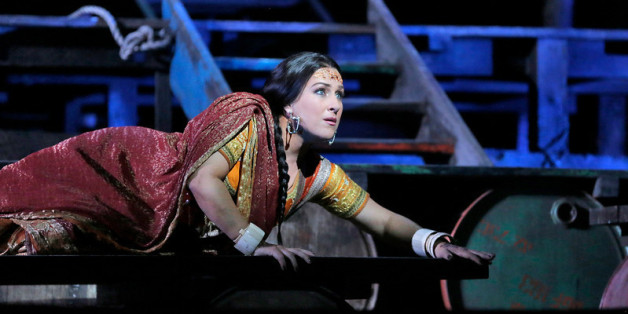
Diana Damrau sung as the pure and scared protector of the village Leïla - not allowed to give into temptation. Yet she had already fallen in love with Nadir (Matthew Polenzani) whose best friend, Zurga (Mariusz Kwiecien) was the leader of the town. He too is in love with Leïla. Both Zurga and Nadir promise to make friends and put their fight over Leïla behind them, yet Nadir doesn't abide.
As a cinema viewer, I was under the powers of Live in HD director, Matthew Diamond and his camera men who were directing my eyes away from any tetchy scene changes going on in the background, which the Met audience were privy to. (There were no laddish conversations going onbackstage like the ENO production. Phew!) Undoubtedly with a larger budget, the Met managed to get 59 Productions to coordinate their projection designs, which, with aeroplane machinery, allowed dancers and acrobats to swim in the air with animated bubbles following their tracks.
Diana Damrau sung as the pure and scared protector of the village Leïla - not allowed to give into temptation. Yet she had already fallen in love with Nadir (Matthew Polenzani) whose best friend, Zurga (Mariusz Kwiecien) was the leader of the town. He too is in love with Leïla. Both Zurga and Nadir promise to make friends and put their fight over Leïla behind them, yet Nadir doesn't abide.
 |
| Picture by Ken Howard |
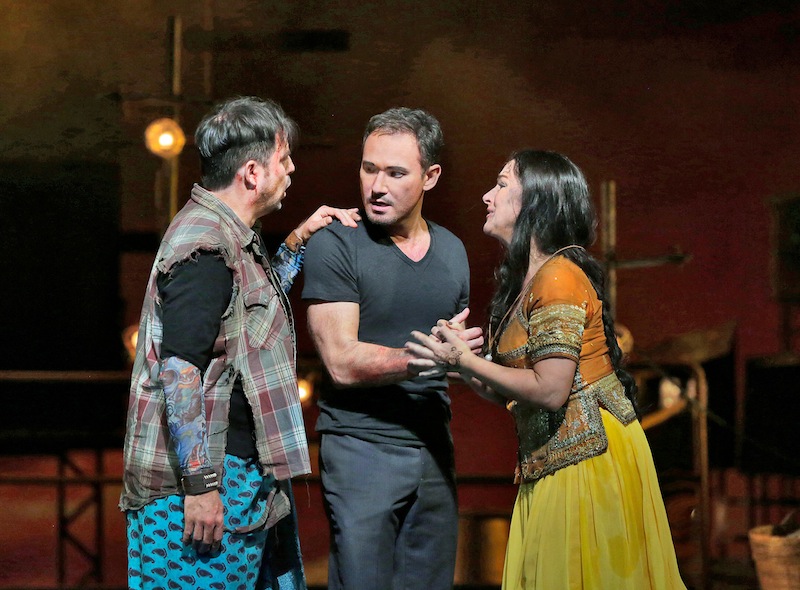
The town is under the control of Zurga, performed by baritone Kwiecien. He's the good guy. He hands out money to the community and considers what is best for their livelihood. Yet, he loses out on the girl of his dreams and loses his best friend's loyalty on the way. Kwiecien's Zurga is like a captain - controlled, calm and subdued. With Polenzani, the best friend's duet is performed with panache and is another sparkling gem in the production. Standing on different ends of the stage, they sing 'Au fond du temple saint' walking slowly, closer and closer together, breaking the social boundaries that once separated them.
 |
| Picture by Sara Krulwich |
In the second half of the opera, Kwiecien and Damrau sung emphatically about love, but
for different people. The dynamic is entirely different; kindness and innocence
has been destroyed. Zurga no longer respects his best friend for
betraying him and he denounces Leïla, condemning both of them to death. With a
cigarette, a clean washed shirt and swig of alcohol Kwiecien's Zurga tries
to calm himself down, but is riled up by Leïla's presence, begging him to let
Nadir live. Back at the Gate Cinema, it's an aggressive and scary sight.
Damrau's singing is passionate, while Kwiecien is red in the face; jealous and
angered, and, just, about, manages to sing his lines, clearly and fluidly.
In the pit, the Met Orchestra were tremendous, taking fine direction from conductor Noseda. Simultaneously the prelude was tender and powerful . Together they brought out the luscious lyricism of Bizet's gorgeous opera. I find it difficult to comment about the music in detail given that I was depending on the Gate Cinema's speakers. Overall, I can say it gets a thumbs up from me. Let's just hope the Metropolitan Opera doesn't wait another 100 years to show another performance of The Pearl Fishers.
For more information on this production at the Met Opera, please see http://www.metopera.org/Season/2015-16-Season/pecheurs-de-perles-bizet-tickets/
Click here to check out full showings and listening at the Picture House, Gate cinema.
Click here for my review of the ENO's production of The Pearl Fishers, 2014
Click here for my review of Live in HD production of Berg's Lulu, 2015 at Curzon Cinema, Chelsea
Click here for my review of Live in HD production of Othello, 2015 at Curzon Cinema, Chelsea
In the pit, the Met Orchestra were tremendous, taking fine direction from conductor Noseda. Simultaneously the prelude was tender and powerful . Together they brought out the luscious lyricism of Bizet's gorgeous opera. I find it difficult to comment about the music in detail given that I was depending on the Gate Cinema's speakers. Overall, I can say it gets a thumbs up from me. Let's just hope the Metropolitan Opera doesn't wait another 100 years to show another performance of The Pearl Fishers.
For more information on this production at the Met Opera, please see http://www.metopera.org/Season/2015-16-Season/pecheurs-de-perles-bizet-tickets/
Click here to check out full showings and listening at the Picture House, Gate cinema.
Click here for my review of the ENO's production of The Pearl Fishers, 2014
Click here for my review of Live in HD production of Berg's Lulu, 2015 at Curzon Cinema, Chelsea
Click here for my review of Live in HD production of Othello, 2015 at Curzon Cinema, Chelsea
Matthew Polenzani's Nadir is the best I've seen. It was his first opera role at 17. @MetOpera #hdlive #PearlFishers pic.twitter.com/Kr714FvMcr
— Mary Grace Nguyen (@MaryGNguyen) January 16, 2016
Mariusz Kwiecien's Zurga sacrifices his 💓,his best friend's life& takes his top off, again. #PearlFishers @MetOpera pic.twitter.com/l0yonIEyz7
— Mary Grace Nguyen (@MaryGNguyen) January 16, 2016
Enjoyed @DianaDamrau's performance of the hopeful and "naughty" heroine, Leïla. @MetOpera #hdlive #PearlFishers pic.twitter.com/8XHjQrf8Kf
— Mary Grace Nguyen (@MaryGNguyen) January 16, 2016


