Showing posts with label wagner. Show all posts

Wednesday, 29 June 2016

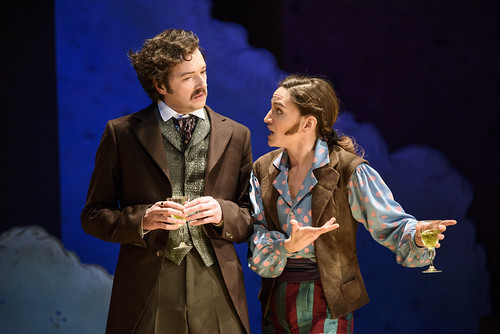
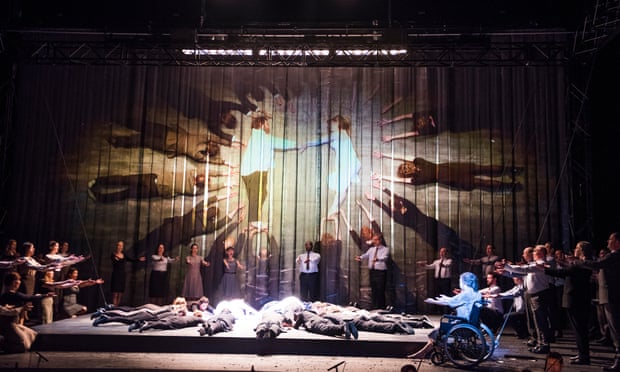
ENO: Tristan and Isolde ★★★★

Many opera lovers know that there is much luscious music to discover with Wagner’s Tristan and Isolde. The climactic love-death song that is Liebestod (otherwise known as Isolde’s Verklärung), the glorious intensity of the score alongside the romantic verse written by the German composer himself are a few reasons, out of many, as to why it is considered a landmark opera which has influenced music history. Not forgetting the tragic story where two lovers down a love potion which leaves them stuck in a world they cannot exist together in.

The English National Opera (ENO) last staged Wagner’s visceral opera twenty years ago, yet its newly appointed artistic director Daniel Kramer has introduced a new production with grand designs by award-winning contemporary artist Anish Kapoor – the man who designed the Orbital Tower at the heart of the Olympic Park and controversial sculptures for the French palace of Versailles. 


The inspiration behind Wagner’s four-hour opera includes his admiration for Arthur Schopenhauer and his metaphysical ideas of the annihilation of the self, as well as his keen interest in medieval literature and another love; a love that is revealed through various letters he wrote to the wife of his benefactor, Mathilde Wesendonch.


Although Wagner was already married, living in exile in Switzerland for his part in the Dresden Uprising of 1894, he felt compelled to write the ‘most full-blooded musical conception’. One could describe Wagner’s reasons for composing his monumental opera as a way of hammering out a message to Mathilde or releasing his own frustrations on such a sensitive situation. Regardless of his motivations, one thing that cannot be negated is the biopic nature the opera had on Wagner, where ‘words, stage setting, visible action, and music come together in closest harmony towards the central dramatic purpose.’


The ENO’s previous musical director Edward Gardner returns to his former residence, and in this case for Wagner’s Tristan and Isolde, which he performs with warmth and vitality from start to finish. The ENO Orchestra also presents Wagner’s Gesamtkunstwerk (total artwork) exquisitely - the prelude and lovely ‘Tristan chord’, which lingers throughout the opera are a wonder to hear. 

Following the nihilistic notions of Schopenhauer; the yearning for the dark, escape from the realities of the day in exchange for an existence beyond the physical, light plays a huge part of the production's staging and this is executed by Paul Anderson’s light designs, which assists Kapoor’s large scale artworks. However, some audience members may feel a bit left behind with what they see before them.

A golden stage divided by three, a huge ball sliced in half with our lovers hiding in its inner cave, and a ripped out hole, which releases blood, are the artist’s ‘vision for a complete artistic experience’, yet these abstract works can appear ambiguous unless one is familiar with Kapoor’s work. Much praise goes to the visual lighting effects that take place on stage, but a visually stimulating stage isn’t necessary for a grand opera that is already a musical masterpiece in its own right.


The production’s costumes, designed by Christina Cunningham, are filled with characteristics from a Star Wars movie, which also seem weak in relevance to the opera or Kapoor's complex staging despite their craft and sophistication.


Nonetheless, justice can be found from outstanding performances including Stuart Skelton as Tristan. His robust and silvery voice makes his Tristan a triumphant performance which is no surprise for a tenor who received positive reviews for his role as Peter Grimes at the ENO. Karen Cargill, as Brangäne, and Craig Colclough, as Kurwenal, sing effectively and energetically while Matthew Rose deeply impresses and charms the audiences as elderly King Marke. 


Making her debut at the ENO is Heidi Melton. Many members of the audience sob as she closes the opera with her version of Liebstod. Singing the role of Isolde is a tough challenge, bestowing a devoted and headstrong princess but Melton doesn't falter. She is solid in the beginning scenes, but performs best at its conclusion, rendering the auditorium speechless. It is a touching sight seeing Isolde sing romantic words, similar to a sonnet, as she holds Tristan's face - an image that will stay with me for a long time. 


Tristan and Isolde is playing at the London Coliseum until July 9. Click here to book tickets. 

Sunday, 21 February 2016

One week, many operas: L'Étoile, The Magic Flute, Norma and The Rinse Cycle


Five operas in a space of seven days may seem like a tall order but somehow I managed to do all of them. The range included works by Fringe companies like Opera Vera (read review here) and Unexpected Opera as well as those at the Covent Garden and English National Opera (ENO). To my delight it was an even spread that pretty much captured the kind of operas happening in London - and my, (oh, my) there are plenty! 

Royal Opera House: L'Étoile, Covent Garden ★★★★
(Photograph from the ROH website)
L'Étoile was composed by Emmanuel Chabrier and premiered at Offenbach's Théâtre des Bouffes in 1977. Parisians absolutely loved it back then and now, at the Royal Opera House, with some commendable additions - British comedian Chris Addison, breaking of the fourth wall with maestro Mark Elder and add-on slapstick dialogue - it is a fun-packed, entertaining production that I'd happily recommend anyone to see. Yet if you like your opera serious, sans kinkiness and completely covered with passionate and I-am-going-to-die-tragically singing, then this one may not be for you.

However I must admit that the music glows and is highly addictive. The ROH Chorus sing wittingly to Couplets du Pal as they celebrate King Ouf's execution by impalement (yeah, I know - it's very weird!) By the end of it, I was humming a few catchy songs I hadn't heard before including Le chartreuse verte. The opera is performed entirely in French, which is a good way to re-cap on your beginner's French (which you probably left behind after GCSEs), and like a Shakespeare, Mozart or Strauss narrative, there's a master of disguise, a trouser role, multiple plots going on and ridiculous love triangles. 

Addison and Jean-Luc Vincent, as Dupont, are the two comedy commentaries who interject throughout and sporadically, but I favoured this - I thought Addison was actually funny, especially when he points at the surtitles and realises he's in a real opera! Elder conducts jubilantly (and happily), and it's not hard to see why with Chabrier's highly spirited music. Hélène Guilmette (Princess Laoula) melted my heart with some scintillating singing, and mezzo-singer Kate Lindsey, as Lazuli, was a great match to her as the wandering pedlar who falls in love. In Lazuli’s solo aria (in Act 2) Lindsey's voice truly blooms.

Much hilarity is maintained by exceptional performances through Samuel Sakker (Patacha), Samuel Dale Johnson (Zalzal), Christopher Mortagne (King Ouf), Simon Bailey (Siroco), Julie Boulianne (Aloès) and Aimery Lefèvre (Tapioca). And the flamboyant and freshly coloured set designs shouldn't go unnoticed - thanks to Julia Hansen for the crazy anachronistic satire of the 19th century and Arabian Night styles. Sadly, this one isn't PC enough for the kids as it is pretty saucy. No - it's very sexy! Unless they've past puberty then, of course - by all means, bring them! 


English National Opera: The Magic Flute  ★★★★
(Photo from the Guardian website)
Things are not getting better for our opera house at the London Coliseum. More negative news keeps coming in and the most recent is the livelihood of its Chorus which has been stated to reduce, including the number of opera productions taking place next year by ENO CEO, Cressida Polluck. With many internationally known musicians, performers, conductors, directors and classical music journalists signing a petition via @SaveEno (here), it is only a matter of time before the ENO's management has to face up to the inevitable and give the people (audiences, singers, performers, musicians and tax-payers), an answer to their financial dilemma.


Yet in the face of such crisis, the show must go on and the nation's supposed opera house has introduced a revival production of Complicite artistic director Simon McBurney, The Magic Flute, which was first shown in 2013. Admittedly I didn't enjoy that production; I re-read my review (here), which seemed like I was in agony by the end of it. Influenced by social media, however, with rave reviews of the revival's opening night, I got myself a ticket hoping that they were right and luckily I wasn't disappointed - phew!


The set hadn't changed much in three years - the ENO orchestra was elevated from the pit and a simple platform moved in mid-air. The staging was recycled from the last production but this time round the opera was executed to a better standard. Here's my reasons why.

Firstly, it seemed much more together; there was no fuss on stage among the performers and they seemed on top of what they were doing. Secondly, the voices of its brilliant cast were stronger. This was enhanced by stimulating conducting from ENO’s resident maestro, Mark Wigglesworth. The grand overture, The vengeance of Hell by the Queen of the night and blissful duets such as Pa … pa … pa ... were performed to a hugely satisfied mixed audience of children and adults. And thirdly, there were Finn Ross's video projections which were previously implemented, but here introduced with some extra additions, making it more imaginative and mythical (I won't spoil it by telling you what - visually - happens.) Overall, though, there was a real sense that the performers and singers believed in the production, making it a far more gratifying production. 

Allan Clayton and Lucy Crowe performed convincingly as star-struck lovers and although they were not the comedy starlets, they were able to stay in character while their zany companion creatures, Papageno (Peter Coleman-Wright), Monostrato (John Graham-Hall) and Papagena (Soroya Malfi) kept the childish humour of Mozart at bay. I had seen Crowe perform at the ROH in L'elisir d'amore, so I wasn't surprised she gave an impressively delicate and sweet sounding Pamina, particularly in her solo aria in the final act. 
 
Ambur Braid performed courageously as the wheelchair-stricken OAP version of the Queen. The ENO Chorus was tremendous in voice and played a pertinent part with McBurney's tacky paper birds. Coleman-Wright's Papageno, however, was much more friend-down-the-pub and had other handy gimmicks compared to the last production's bird catcher, Roland Woods. Though with saying that, they played a version of Papageno that was entirely their own. Woods was much more sharper in voice for Mozart's harmonious and witty music while Coleman-Wright wanted to make the audience laugh – and that’s exactly what he did! James Creswell is the voice of authority, Sarastro and there was a moment when he looked on to the audience, as well as his political cronies, and said, 'we are in a crisis!' I thought he was referring to the ENO crisis but then I remembered this was the bit that they worry over Tamino's dedication to love and truth - BLAUGH! 


English National Opera: Norma
★★★★
Alastair Muir
[From Review first published at CultureVulture.net]
The English National Opera (ENO) first performed Bellini’s 1831 bel canto opera, Norma this month. Christopher Alden's production was first presented by Opera North in 2012, which is a co-production with Die Theatre Chemnitz and has toured to Bordeaux ever since. Bellini put down on paper, 'Carve in your head in adamantine letters: Opera must make people weak, feel horrified, die through singing' and to many composers, artists and philosophers they were heavily affected by the composer's artistry.


Conducted by Stephen Lord, who demonstrates his aptitude for bel canto repertory, the production was dramatic in narrative and the music's sublimity that could only come together from a solid hand (and baton) to guide the roaring and heartfelt score. The opening night permitted its ENO Chorus to take to the curtain call twice, which was well-deserved for this chorus-heavy opera. They give a phenomenal performance as excellent actors and singers. Unforgettable scenes come in the final act where Norma reveals her treachery to them, and in their pain, they fall to the ground, then abandon her. It stressed the significance of the ENO Chorus’s role at the opera house at a time where their status is being compromised and negotiated by the ENO's management. 

Due to a word count I have to follow, I wasn’t able to put down a couple of things to be wary of with watching ENO’s Norma in my CultureVulture.net review. To put it bluntly, it is one of those operas that you are really going to love or really hate, and for me I found that I truly loved the music.

Listening to an opera where you can completely lose yourself in the music is one of the reasons  I love opera – and Norma is one of those operas, yet the production is, as I said, dry and woody as the staging, and the only beings capable of moving you are the cast, ENO Chorus and the gracious music, which has the ability to make you cry and feel vulnerable.

Another thing to note is that towards the last act, which was the most musically interesting, it took a long time to end and in some ways dragged. It was almost approaching 10.30pm and yes, I was tired (having had a long week at work already) but, surely, there must have been other ways that the production could have more appealing?

Should you go and see Norma, stick with it or at least go with the knowledge that there is nothing visually sophisticated to see and you must take the narrative and magnitude of the voices as they are.


Unexpected Opera: The Rinse Cycle, Charing Cross Theatre ★★★★★
Photograph by Robert Workman
I am an advocate of the fringe scene, a place where young and aspiring musicians and performers can reveal their trained voice and talent to an audience new to opera. Yet opera aficionados also like to check out small-scale productions too. Who knows if they might be seeing the next Maria Callas or Placido Domingo? (Honestly, who knows?) Some fringe opera companies are based locally while others go on tour, and this week I had the pleasure of seeing The Rinse Cycle by Unexpected Opera. It may sound rather cliché but I truly didn't know what to expect. The programme booklet reads, 'Wagner's Ring Cycle Conditioned with comedy and shrunk to 2 hours' and on analysis it did just that but in an inventive and intelligent way. 

Unexpected Opera's artistic director, Lynn Binstock is on a mission to bring opera to those who think it's not for them as well as those who are devout operagoers through engaging and hilarious productions, and I've seen some funny operas but this one took comedy to another level. From the very beginning scenes I wasn't sure when Wagner's Rhinemaidens were going to fly in but it really didn't matter at this point as I got stuck in to the bizarre laundry stage and odd props: Patisserie Valkyrie sign post, mermaid aprons, disputed leitmotifs, an ironed out sword, Norfolk accents and oven gloves for Wotan’s giants.  Somehow Top Gun's Tom Cruise, with a phony American accent, also seemed relevant.

What's smart about this show is that it eases the audience in with its own light-hearted story. Ronnie (Simon Thorpe) and ex-opera singer Edith (Harriet Williams) are the married couple with son, Tim (Edward Hughes) while Hilda (Mari Wyn Williams) and Robin (Anna Gregory) are like the waitresses from BBC Comedy 'Allo 'Allo, who go through the trouble of delivering the Ring cycle in a shrunken down version for the audience sat in front of them. However Tim didn't hear his dad properly and thought he said Rinse - not ring, hence, the hypnotic washing machines on stage.

Though jokes aside, it is only by the end of the first half that you begin to get to the core of Wagner's music and all of that powerful Wagnerian singing. So while you may have spend the first hour doing stomach crunches in your seat, you'll be enlightened by real music drama, and the transition is, pretty much, seamless through the conviction of its passionate cast. 
 
There are two casts for this production and on the opening night Thorpe sung both baritone roles, as Wotan and Alberich, yet he also played other characters with strange accents, including Sean Connery, on his knees and standing up. He gave a sensitive performance for the audience by the second half. The same can be said for Williams who sung as Fricka and her voice was intense, bold and alluring - my favourite voice of the night! 
Photograph by Robert Workman
Mari Wyn Williams sung the prelude of Die Walküre almost effortlessly with utter assurance and she had multiple roles to go on including Sieglinde and Ronnie's secret flirt. I also enjoyed tenor Edward Hughes who was marvellous as Siegmund and Siegfried - poor Tim kept getting confused playing both roles, but Hughes rose to the occasion and hit all those brave notes!
 
Gregory has the vocal prowess for her roles as well ranging from Gutrune and Tim's knocked up girlfriend. Music director Kevin Lim had a shaky start on the piano but that was quickly forgotten when it came to performing the pithy and heartfelt songs sung by the cast.
 
Some may only prefer their Wagner operas to be heard as the composer wrote it, or wanted it to be performed in Bayreuth, but that would be elitist, wouldn't it? For veteran operagoers who don't mind letting their hair down, having a beer and watching a cheerful and slightly cheesy opera that speeds through Wagner's 16-hour opera and neatly trims it down to 2 (with a break in between), then this is a perfect antidote. This is mutually beneficial for opera newbies, too, who will still get a taste of Wagner's profoundly dramatic music straight up from a versatile cast. Hats off to Unexpected Opera for ending my week on a high and making me sing Hoyotoho with the crowd - honestly, no one predicted that would happen and I love surprises.


L'Étoile ends 24th February, 2016. (Click here for more information)

The Magic Flute ends 19th March, 2016. (Click here for the ENO website.) 

Norma ends 11th March, 2016 (Click here for more information) 


Sunday, 8 February 2015

Royal Opera House: Der fliegende Holländer **** (The Flying Dutchman)


It’s been a good week for Wagner lovers. Covent Garden had their opening night of Tom Albany’s revival: Der fliegende Holländer last Thursday and English National Opera, the nation’s opera house down the road, opened their season with The Meistersinger on Saturday. (REVIEW COMING SOON)

Shown in 2009 and 2011, Albany’s production lays bear the solitude felt from a community of sea bound sailors and forlorn women abandoned on dry land. Their grief is funneled through the voices of our lead singers the Flying Dutchman, which is sung by our nation’s favourite baritone Bryn Terfel with Senta sung by Canadian soprano Adrianne Pieczonka.
Leitmotifs are prolific in Der fliegende Holländer as expected for most operas composed by Wagner. He created fresh and memorable melodies, but not all.  With Der fliegende Holländer his leitmotifs echo emotional tension, suspense, mystery and uncertainty. A nihilistic sense of being is ubiquitous in Albany’s production from stage, music, chorus singers and leads.

Consider all of that bleakness served in an opera devoid of an interval and you might want to run for the hills, but in truth the musical subtleties and Wagnerism enchantment are worth the time and patience. The simplistic stage design, however, left me with a few unanswered questions, on the night, as it didn’t mirror the same magnitude.

For obvious reasons the stark and minimalistic set designs of Michael Levine may give audience more space to listen and become immersed with the music, yet this meant they very little for their eyes. Luckily the hot-blooded chorus singers (and there were many) and notable characterisation from the cast managed to gage our interest. Yet for audiences seated on the left including myself, we were slightly shortchanged as most lead singers, including Terfel, were directed to stay on the left. This led to bitter disappointment for many operagoers on the upper slips. Note: Don't purchase tickets located on the left amphitheatre, slips, etc. 
The conductor Andris Nelsons, positively received in Europe, waved his baton with passion and fluidity as if he had a higher understanding of the Wagerian influences and vulnerability of the opera’s characters. He managed to strike a balance between the sorrow of Terfel and Pieczonka and gusty brawniness of the chorus ensembles, particularly in the very end. Nelsons massive contribution made the production an evening of musical sublimity.

Terfel has perfected the role of the Dutchman as he has sung the role for more than a decade. He depicted all the yearning and despair of a man cursed for seven years at sea. Pieczonka took on the complicated role of Senta. She puts in all the vigour of a vocally tough role, though she didn’t blow everyone away. She aptly unifies the complexity of a woman starved of affection and intimacy, but, for a first night, she failed to bring the required excitement to her performance. Nonetheless they portrayed pathos in the unresolved situation and looked good on stage together. The supporting cast with Ed Lyons, Catherine Wyn-Rogers, Michael König and Peter Rose were also moving and lusty even if they sung through a storm. 

[----So about that 2.5-hour opera and absence of an interval - well, it didn’t help that there was small creek of water on stage, which alluded to the bathroom for many. Think about the poor orchestra as well. Some of the brass instruments got a break, but the rest - nada!]


There is also the live screening of the Der fliegende Holländer on the 24th of February. Click here for more information. Photos courtesy of the Royal Opera House. 


Saturday, 20 December 2014

Royal Opera House: Nina Stemme - Tristan and Isolde ★★★★★


My critical view of Christof Loy’s acclaimed production of Tristan und Isolde is slightly marred by where I was sitting in conjunction to the Royal Opera House's stage – literally five meters away from Wagnerian Soprano Nina Stemme who won a Laurence Olivier Award for her performance as Isolde at its premier in 2010.
Having witnessed her vocal prowess and first-class performance at this year's Proms as an audacious Salome, my expectations were only skyrocketing for an opera said to be ‘intoxicated by passion almost to the point of depravity.’ Wagner, unlike other composers, wrote the libretto and poetry to his operas where ‘words, stage setting, visible action and music all come together in closest harmony towards the central dramatic purpose’ (otherwise termed as Gesamtkunstwerk (total art-work)). And here Stemme’s role as the heroine plays as much a significant part as Antonio Pappano’s conducting of the orchestra of the Royal Opera House.
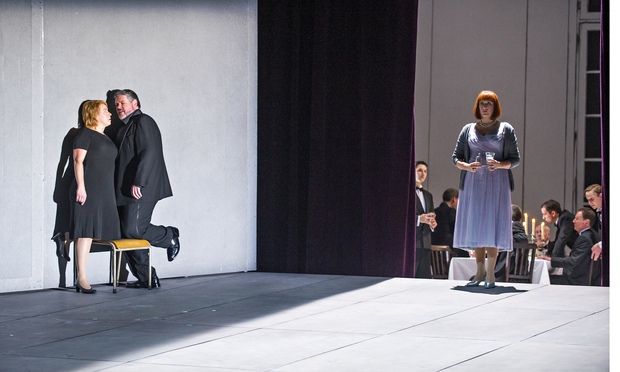
In this four hour production Loy’s minimal setting, which is limited to walls, two chairs and a table, puts the onus on Pappano, the orchestra and the cast members’ vocal craft to evoke the drama on to the opera; in the back a parallel world: banquet of debauchery, is concealed by curtains that supposedly represent Wagner’s metaphysical influences from philosopher Schopenhauer and the yearning of endless night, darkness and even death. Although known for controversial productions, Loy's effective stage decision, here, is one that I fully support.
The preclude in Act I is a moving feast and it transcends from the overture - this unsettling and uncomfortable atmosphere of natural and sharp notes magically transfix into a reassuring romantic vortex, which sensationally flows and weaves. And Pappano just captures it like a butterfly in a nest. Of course, he is no stranger of Wagnerian Leitmotif as he also conducted Puccini’s Manon Lescaut in this year’s repertory and articulated his interest for such ‘sublime’ music. Yet once the overture was over, Pappano softened his conducting and left the magnitude to, what I thought was,  one of the most crucial parts of the opera in Act II alongside Liebstod. It seemed that he was saving the ardour and luster for the climactic parts. 
This was a different case for Stemme who entered with the same energy and fire, which she ended on.  In the 80 minutes where she had to sing continuously in Act II she was unflagging and we can only thank her experience as Isolde, in multiple opera productions, for her unrelenting performance - I can’t recall a note off. Her stage act as an angry Isolde to a undivided and loving Isolde was also developed and didn’t look a mark out of place. When Stephen Gould, as Tristan, and Stemme unite in Act II, I couldn’t contain my tears – the Celtic poetry that inspired Wagner and the hopeful romance, exceled by voice and music, was stupendous – never has an opera truly make me feel this way.
Stephen Gould is no stranger to Wagner either and has played multiple international roles as Siegfried and Lohengrin. Both him and Stemme seem to understand Wagner’s musical text and the notion of Liebstod (love-death) better than many. Although Stemme comes in full thrust, and a notch higher in quality, Gould has tones of mellowness that can romantically subdue audiences. The role of Tristan is not an easy one and even if he was soft toned on the poetry he managed to balance this out with higher notes, which he sang with glory and might.
Brangäne sung by Sarah Connolly was also a vocal blessing as the contrast character to Isolde. Her strong voice, and diction was in place as well as Brangäne's woeful worries that were particularly felt by the audience. The synergy between Stemme and Connolly were remarkable. And we see Iain Paterson as a wilful Kurwenal who sings with heart and poignancy in Act III.
The wonderful production, I experienced, hit some nostalgic nerves. Liedstod, as I understand it, is a swirling symphonic piece that can be appreciated on its own; yet it needs the right soprano with the vocal integrity and depth to extract the challenging and peculiar subtleties of the music. I’ve been listening to a lot of Jessye Norman and now Stemme and although different in voice I admire how immensely important it is for there to be a strike in balance for such a cosmically daring role as Isolde.  
Last showing tomorrow - More information here.
Recommended to queue from 8.30pm tomorrow (21st Dec) for day tickets
Courtesy of Royal Opera House for photographs