Monday, 20 April 2015

NT Live: Tom Stoppard's The Hard Problem ⭐⭐⭐⭐


Back in the Gate cinema on April 16, a crowded audience gathered for the NT Live screening of The Hard Problem, directed by Sir Nicolas Hytner. It is his last production at the National Theatre as he bids farewell to his post as the artistic director of the National after a 12-year stint.  
Tom Stoppard’s first play in nine years is a mean feat of critical theorising about consciousness and everything connected to it: philosophy; evolution; biochemistry; neurology; and much more. Even religion gets a mention and plays a part in this head scratching performance. The Hard Problem speaks for itself. It is a question that has been bugging intellectuals since the 4th century in classical Greek philosophy (and even earlier for Eastern philosophers.) For those who are a novice to critical theory or have never stepped into a philosophy a-level class, they might be in trouble here though.
This isn’t the first of its kind for Stoppard. He is known for writing brilliant theatrical works that include themes of political freedom, linguistics and the meaning of life, and for this The Hard Problem shoves audiences into a dialectic much like the way Plato and Socrates challenged each other five hundred years ago. 
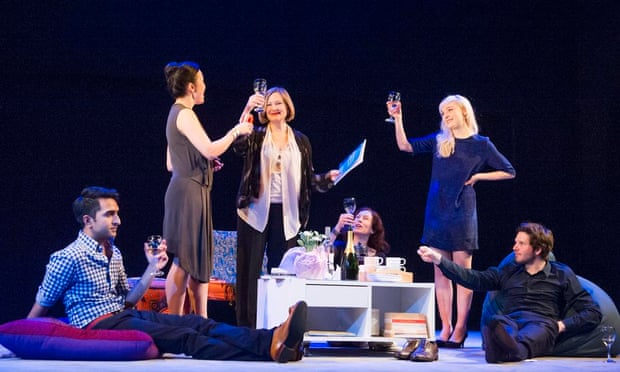
By comparison, many who expect the wittiness and cleverness of Stoppard’s 1993 play Arcadia will be let down. That is not to say that The Hard Problem is not as witty or as clever as Acadia. No, in fact the play is both these things but in a different way. Arcadia combines the manifestations of pre-19th century Romanticism idealism with nature. While Arcadia brushes upon some interesting thought provoking ideas, The Hard Problem gets deep, so deep it hits the academic books and looses the audiences’ attention unless they are familiar with the terminology and theoretical notions e.g. the Prisoner’s dilemma, which crops up almost twenty times in the play.
Between the young psychology student Hilary and Spike, played convincingly by Damien Molony as Hilary’s university mentor, cinema viewers can see the dynamic movement in their heated debates as camera focus onto one another. Camera 1 focuses on Hilary. Immediately after, camera 2 moves into Spike who aggressively rebukes her with a brutal and gutless definition on altruism, the ‘selfish gene’, if you will, and so on. Their intellectual frustrations are set aside while they maintain an odd,  attachment-free relationship. 
Olivia Vinall gives an electrifying performance of Hilary not only in seasoned application of verbal assaults but with Hilary's deep-seated passion as a young mother who gave up her child for adoption at the age of 15. After gaining a position at the Krohl Institute for Brain Science Hilary delivers a paper hypothesising God as the answer to all things including consciousness, which isn’t good; it won’t fund the institute’s research facilities. 
This is other side of Stoppard’s play that he highlights through the character of Jerry, who is wickedly acted by Anthony Calf. He exhibits a hedge-fund millionaire who swears and shouts down at his employees whilst portraying a genuine and caring father. There’s an emotional twist to the story that ends the play in a hopeful fashion, but I shan't share any spoilers here.
Vera Chok, Jonathan Coy, Rosie Hilal, Parth Thakerar, Lucy Robinson and little Daisy Jacob come on top as playing small parts of this mind-boggling 'abstract' of a play, yet not much depth is offered about their characters. The emphasis is ultimately on Hilary’s journey who tries to find herself, understand her conscience and grapple with her own hard problem. 
With Bach’s enthusiastic piano solos that are lightly and lyrically played by Benjamin Powell and Bob Crowley and Mark Henderson set design of colourful light rods and wires; that light up like brain neurons or brain currents, Hytner ensures audiences gain a sense of the profound and complex mindset of its protagonist.

NT Live Encore of The Hard Problem on the April 21 in Gate Cinema at 12pm. The Encore is also available throughout the week in London cinemas including Picture Houses on the 24th. Check your local cinema.
(Photo courtesy of National Theatre)
Also showing at the National Theatre until May 27th. Check their website.

Wednesday, 15 April 2015

Barbican and ENO's Between Worlds ⭐⭐⭐

#Review ⭐⭐⭐ @TansyDavis ' #ENOWorlds 'Original and authentic' but 'surprisingly suffocated'

Click here for my full review: http://www.ldncard.com/blog/between-worlds-barbican/0214

Monday, 6 April 2015

NT Live: Arthur Miller's A View From The Bridge ★★★★


Arthur Miller’s ‘A View From The Bridge’ strikingly visceral script lays bear the brewing tensions of a man’s obsession with his niece. Yet it’s not all about Eddie Carbone, it’s the domino effect his uncontained emotions have on the rest of his family; his wife Beatrice and Sicilian cousin Marco. 
Last year The Young Vic’s production of Miller’s play made a killing at the box office with its impressive stage direction and steadfast cast including Mark Strong, as Eddie Carbone, that it welcomed a sturdy transfer to West End’s Wyndham Theatre.
An NT Live event of the production was shown to hundreds of cinemas across the nation on March 26th, which also went down a storm, zooming into the protagonist’s harbouring instincts and ‘tunnels’ in his eyes, as described by Alfieri, the ubiquitous narrator. 
Miller wrote the play with the theatrical fixtures of a Greek tragedy following the brechtian rulebook where theatre says more the human condition than reality itself. And for this production experimental Belgium director, Ivo Van Hove, executed it right by bringing together Miller’s stage manifesto with an unexpected ending that stings like a slap in the face.

Van Hove’s production instills two blood-boiling hours of accumulative drama, yet there isn’t time for an interval for audiences to recuperate and reflect. Jan Versweyveld’s staging is white and stark, bordered with low fences mirroring the space within a boxing ring. It has the effect of telling the audience this is as far as the emotional violence and physically fighting will go. This is most prominent when Carbone invites Rodolpho (Luke Norris), a friend of his cousin, Marco (Emun Elliott) to a quick lesson on boxing. Soon it erupts into a sparring match and ends with a hard jab in Rodolpho’s stomach. 
Well-known film and television actor, Strong doesn’t mess around with Eddie’s character. Strong builds dramatic momentum with his personification of Eddie’s frustrations that is let loose when he abandons reason and gives up his cousin to the immigration bureau. 
From the outset Eddie is besotted with Catherine (Phoebe Fox.) She jumps and wraps her legs around him as if she was still a 6-year-old child, but that’s unacceptable. She’s grown into a 17-year-old teenager wearing high heels and short skirts, giving him the ‘willies.’ For this it opens up a few questions to the audience. Is he evil? Is he innocent? And, can we pity him? 
Michael Gould plays Eddie’s lawyer and Miller’s storyteller and he absorbs these roles without confusing them. As a lawyer and advisor, Gould shows the attributes of a loyal and good friend, trustworthy and logical to the point that shouting the truth at Eddie doesn't deter him. Nicola Walker plays a tenacious part as Eddie’s battle-axe and sexually neglected wife Beatrice, while Phoebe Fox is full of energy. She bestows a fast-spoken and fiery teenage beauty. 
Norris’ interpretation of Rodolpho is an interesting one. As part of the audience, I wasn’t entirely sure if Eddie’s suspicions were correct of Rodolpho, that he was using Catherine for a green card, yet Norris showcases the polar opposite of Eddie's manlihood. He can cook, dance and sing, and has a better chance with Catherine, which Eddie just cannot stand. And Emun Elliott really comes out of his humble character as Eddie’s blood cousin and shows a darker side in the pinnacle scene in the act of picking up a chair with one hand.
When pressured conversations and verbal confrontations arise, Tom Gibbon’s use of a quasi-Asian instrument, mimicking Kabuki theatre, denotes the sounds of a ticking timer, which aggravates the audience and projects them into the minds and anxieties of its characters. 
There is nothing that says 1955’s Brooklyn on Van Hove’s stage. The script moves fast causing viewers to fidget and scream for an interval, but Van Hove gives everyone the relief with a crescendo blood bath that pours with Faure's Requiem in ‘Libera me’. Some parts may be sordid (I won’t say which), but at least with NT Live you can run to the bathroom, if you, really, have to.

 The Encore screening at Gate Cinema is on the 7th April at 12pm. Check your local cinemas to confirm times. Other cinemas may have different schedules for the encore.
(Photos courtesy of National Theatre Live.)  


Sunday, 22 March 2015

Madama Butterfly: Royal Opera House 2015 ★★★★


© The Royal Opera House
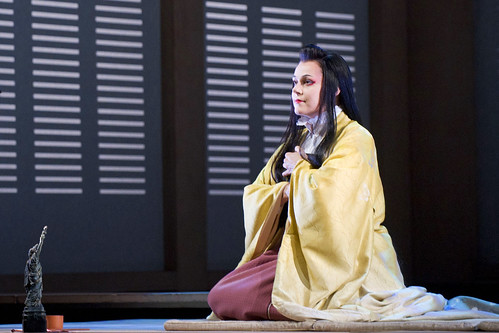
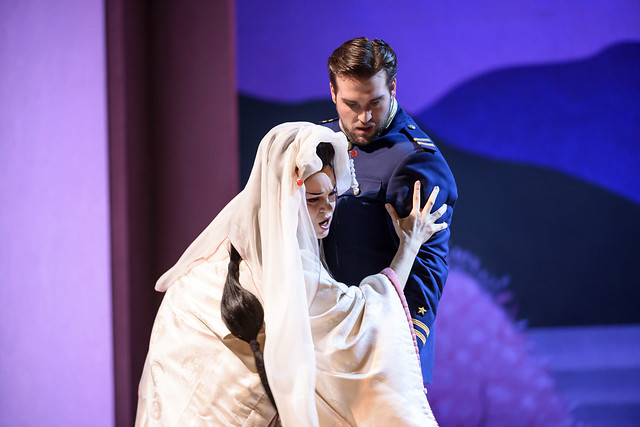
This Friday [20th March] was the opening night of Moshe Leiser and Patrice Caurier’s 2011 revival production of Madama Butterly, which brought audiences to tears. Following a tremendous portrayal of a troubled Manon in a‘tight fitted, bust improvising pink corset’ in last year’s controversialproduction of Manon Lescaut, Latvian Soprano, Kristine Opolais, gave a dramatic performance as a naïve Cio-Cio san with the vocal heft that made it one of her best nights at Covent Garden.

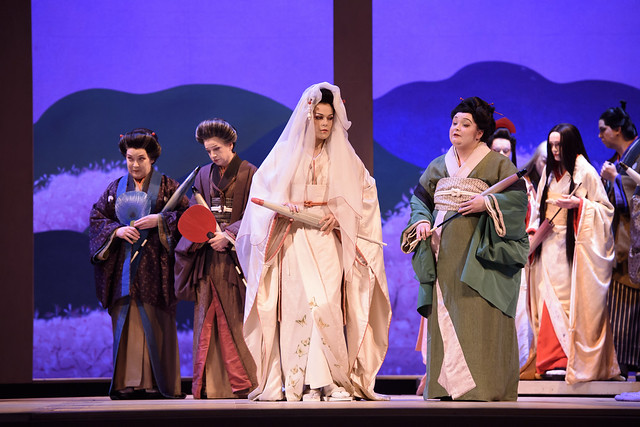
Puccini’s Madama Butterfly - based on a 15-year-old ex-geisha who falls in love with a chauvinist American, that leaves her with a love child unbeknown to him - is ranked as the 7th most popular opera in the world. According to co-director, Leiser, ‘it is a very important story to tell’ and many would agree. The revival production, directed by Justin Way, embodies the tragedy of Madama Butterfly through Japanese simple architectural design, lavishly made kimonos by Agostino Cavalca, and Japanese cultural values including patience and graciousness. 

Christian Fenouillat’s minimal set design of subtle sliding doors and large panels convey Cio-Cio san’s enclosure from the outside world: her heritage, religion and, most of all, her family. Act I reveals a picturesque backdrop of Nagasaki: a mountainous beauty, as the wedding ceremony commences. Yet as the Bonze (Jeremy White) utters his curse on Cio Cio san Nagasaki is no more. Her family, sung by the Royal Opera Chorus, walk over the image of Nagasaki as they sing in outrage, ‘Cio-Cio-san’ and abandon her for ever. 
© The Royal Opera House

For Leiser and Caurier, the opera presents a cynical ‘American imperialist view on Japanese culture’ where such characters as Pinkerton ‘do not consider Japanese culture as valid.’ It is a ‘dark work’ that captures an unfortunate situation that happens repeatedly to many women in the world. The sadness lies in the virtuousness of Cio-Cio san whose illusory beliefs depend on her apparent American husband. With an unexpected child in the mix the operatic drama is amplified, gripping the hearts of many young mothers in the audience. 

Even Opolais can empathise with this heartrending tale being a mother of a three-year-old. She stated how emotionally taxing and challenging the role of Cio-Cio san can be in an interview with Latin Post . Recently she told Rupert Christiansen, [Cio-Cio san] knows that her child is going to be taken away from her and that for me is what makes the agony of the tragedy.’ 

Under the baton of Nicola Luisotti, the music director of San Francisco Opera and the Teatro di San Carlo, the Royal Opera House Orchestra gave a resoundingly rich musical performance of Puccini’s much-loved opera. Having never seen Luisotti in action before, watching him was like watching, something out of, a movie. His delicate, classic and, almost, cinematic conducting style was a sight to marvel as was his love for Puccini, which was oozing audibly out of the pit. 
@ The Royal Opera House
Making his debut at the Royal Opera House, as bad boy Pinkerton, was ‘fresh off the boat’ American Tenor, Brian Jagde. Pinkerton only hangs around for the first act, but, for this, Jagde gave a convincing performance of a man who had fallen for an exotic creature as he sung, ‘I’m marrying Japanese style for 999 years.’ His voice has an exquisite vibrato, which is disarming even if the words he sang were not genuine. I hope we get to see him again in another production at Covent Garden.

Enkelejda Shkosa, who sang as Suzuki, added spice and a little kick to her characterisation of Cio-Cio san’s maid. She presented a tougher version of Suzuki. In the flower duet Il cannone del porto! with Opolais, her sweet vocal accompaniment seemed also deluded with hope of Pinkerton’s return, which made the audience sigh.

Gabriele Viviani sang as Sharpless after having sung the role of Pinkerton in the original production. Here, he exudes the remorse and guilt of being the go-between, but, unfortunately, did not present much luster or sheen in his voice. Carlo Bosi as Goro gave a theatrical performance of a corrupt Japanese marriage broker. Dressed in a fabulous semi-Western, semi-Japanese design, he concocted a Goro we would learn to hate and sang pleasant enough, even though he played a villain.
© The Arts Desk

The long intermission that shifts Act II to Act III, where Opolais waits motionless for her husbands’ return, sees no action on stage, and the opera may seem to drag. The audience have to depend on Luisotti’s waving arms and swaying body to gather some visual momentum. But the humming chorus is a gem in itself - it never fails to please Puccini fans whist preparing for the ultimate death scene.

Opolais triumphed on the opening night. She created an intense and emotional evening for many. As she sung Butterfly's heart breaking finale aria, Con onor muore , I was reminded of her last performance singing as the dying Manon in Sola, perduta, abbandonata. Towards the final act, many sniffles and fiddly tissues were heard from the audience. With an excellent choice of cast for the Royal Opera House’s 396th performance of Madam Butterfly, it was, perhaps, the most dramatic portrayal of Madam Pinkerton I had ever seen. 

(I had a distraught and upsetting experience at the finale. Luckily I didn’t get any tears on my pink Kimono, which, by the way, I was the only one wearing. sheesh!)
The production is showing until April 11th. Please have a look at the site as tickets are selling out fast.


Other Reviews:
Madam Butterfly at the Royal Albert Hall @LDNCARD - Currently showing (2015)
Relay Screening of Madam Butterfly by Opera Australia (2014)

Monday, 16 March 2015

V & A Museum: Savage Beauty: Alexander McQueen 2015 ★★★★★

My written review for US review site: Culture Vulture can be found here I highly recommend you look at the photographs before or whilst reading the review to get a better picture of the exhibition, Savage Beauty: Alexander McQueen. 
(Victoria and Albert Museum)
London (Photos by @MaryGNguyen)
London (Photos by @MaryGNguyen) http://culturevulture.net/art-architecture/savage-beauty/
Image of 'Lee' Alexander McQueen (changes to image of a skull) (Photos by @MaryGNguyen)


Savage Mind (Photos by @MaryGNguyen)

London (Photos by @MaryGNguyen) 
Romantic Gothic (Photos by @MaryGNguyen) http://culturevulture.net/art-architecture/savage-beauty/
Romantic Gothic (Photos by @MaryGNguyen)
Claire Wilson, curator of Savage Beauty, interviewed at press preview (Photos by @MaryGNguyen)
Romantic Gothic (Photos by @MaryGNguyen) http://culturevulture.net/art-architecture/savage-beauty/
Savage Mind (Photos by @MaryGNguyen)

Savage Mind  (Photos by @MaryGNguyen) http://culturevulture.net/art-architecture/savage-beauty/
Romantic Nationalism  (Photos by @MaryGNguyen)
Romantic Primitivism (Photos by @MaryGNguyen)
Romantic Nationalism (Photos by @MaryGNguyen) http://culturevulture.net/art-architecture/savage-beauty/
Romantic Primitivism (Photos by @MaryGNguyen)
Cabinet of Curiosities (Photos by @MaryGNguyen)
Romantic Naturalism (Photos by @MaryGNguyen)
Romantic Exoticism (Photos by @MaryGNguyen)
Cabinet of Curiosities (Photos by @MaryGNguyen) http://culturevulture.net/art-architecture/savage-beauty/
Cabinet of Curiosities (Photos by @MaryGNguyen)


Plato's Altantis (Photos by @MaryGNguyen) http://culturevulture.net/art-architecture/savage-beauty/

Tuesday, 10 March 2015

ROH: The Rise and Fall of Mahagonny ★★★★


For most operas, and contrary to popular belief, audiences are not required to read a synopsis or any literature about the creative process of the work, however, for The Rise and Fall of Mahagonny (Aufstieg und Fall der Stadt Mahagonny in German), a little bit of reading wouldn’t hurt.
The opera’s creators, the poet and librettist Bertolt Brecht, and composer Kurt Weill, collaborated during the 1930s after World War I and the collapse of the Weimar Republic. At the time, German and Austrian composers were reinventing opera having developed Zeitoper (opera in the time in German) in the 1920s, which mixed together music genres: jazz, contemporary, and cabaret, with political satire. 
Based on an opera of ‘juxtapositions’, from music to text, The Rise and Fall of Mahagonny follows the lives of criminals searching for an escape who end up in the city of Mahagonny, which breeds cash, greed, capitalism and sex. Given the opera’s unusual nature, audiences will wonder whether a production has captured the ironies and quizzical devices that Brecht and Weill implemented in the 1930s.
Last night was the opening night for the first, ever, production of The Rise and Fall of Mahagonny at the Royal Opera House. Under the direction of John Fulljames it successfully captured the complexity of the opera as delivered in the 1930s. Fulljames’ production has updated the opera to 2015 with high-tech digital trends and props, which Brecht and Weill would have, only, dreamt of. 

There are various themes (too many to mention here) that are purposefully embedded by Brecht and Weill, but Fulljames has introduced a production that allows the audience to freely figure out the complicated metaphors and allegories in an uncomplicated manner. One of these devices are the songs. Although originally written in German, there are easily memorable, and tongue-in-cheek, songs written and sung in English including the ‘Benares Song’ and the well-known ‘Alabama Song’, which has been covered by multiple artists from David Bowie to music band The Doors. 
To keep the opera fresh Fulljames has instilled a cross-pollination of digital traditions. Finn Ross’ video designs are layered on top of one another, which include an image of a hurricane, an animated weather map, footage of civilians in the middle of a hurricane and even a title screen that reads ‘Mahagonny’. This is neatly bundled up with audio recordings of inscriptions set between each scene and live broadcast footage of the singers on stage, and some members of the audience. (You’ve been warned!)
This appropriately merges in with Es Devlin’s fascinating set designs, one of the best stage designs I’ve seen at the Royal Opera House, with a versatile lorry that opens up into many things like a magician’s bag. It can be a gruelling office, a prostitutes' hub, or a bar with jazz pianist, Robert Clarke, playing away with large white palm trees sat right next to him. The use of huge colourful shipments boxes is also an industrial cabinet of curiosity that stores more than human traffic and whiskey decanters combined.
The chorus singers were enthusiastic and on excellent form on stage. They were most remarkable at the end of the opera to the song, ‘To This Day Found In Mahagonny’, which sounded almost like a quasi-sermon song. Mark Wigglesworth conducted the ROH orchestra and although, the music was full of quality, pace and energy, I felt there was a lack of volume for some songs that needed an extra punch such as the first run of the ‘Alabama song’. I also got a sense that some musicians were more confident than others given that the opera was being played here for the first time.
Yet confidence wasn’t a problem for our eclectic cast. Annie Sofie von Otter, as Begbick, was a joy to watch, but vocally she was all over the place. She started off on strong form yet by Act 2 her voice wasn't as consistent. There was confusion as to whether her accent was English or American as well. Willard W. White, as Moses, was simply authentic. He brought his vintage, signature bass-baritone voice that was a thrill to hear. And Peter Hoard was also a great act on stage but for the role of Fatty there wasn’t a good enough aria to show off his vocal talent. 
(Photo: From the Times)
But it was Kurt Streit’s Jimmy and Christine Rice’s Jenny that got the audiences' attention. Streit sang as a rebel who broke all the rules, when it wasn’t permitted, and he didn’t hold back. Streit's character was possibly the only character that showed raw emotion and he sung as if he was at the a picket line over brassy jazz and ragtime melodies. Rice, however, controlled her voice to model the mind frame and stoic mannerisms of Jenny who acknowledged her profession as a prostitute and desire for nothing but hard cash. Her pure silky voice was present but Rice managed to embrace and fine tune her vocals to remind the audience that Jenny was a prostitute who only cared about money.
Operas like this one, with sophisticated concepts, unorthodox narrative, huge set designs and a combination of artistic genres, are few and far between. The Rise and Fall of Mahagonny is a bizarre opera. At times it can be morose, realistic and too close to home, particularly with topics about the economy and society as a whole but audiences are bound to ask themselves a few thought provoking questions whilst being entertained by a pig playing an accordion. 

The opera is showing until the 4th of April. Click here for more information. 
Photographs courtesy of the Royal Opera House.