Showing posts with label Fulham Opera. Show all posts

Sunday, 20 March 2016

How to get cheap Opera Tickets in London, even if they are sold out


There seems to be two misconceptions about opera tickets. Firstly - a point which has been argued to death - that 'opera tickets are expensive' and secondly, once a show, or production, has sold out there is no way you can see it, ever!

As a reviewer and blogger, I have the advantage of seeing many operas in London through press tickets, however, this is not ALWAYS the case. With the amount of theatre and opera I see per week (which can range between two to five shows in a week), there are occasions where opera and theatre companies do not provide me with that complimentary ticket. This has encouraged me to seek alternative ways of gaining access to sold out shows and finding the cheapest tickets, which might not always offer the best view but still provides me with a means to view 90% of the opera, and hearing beautiful music and amazing voices.

Opera, theatre, even ballets and classical music concerts, are not only composed and written for the rich and affluent. Keen culture vultures can go and enjoy shows without breaking the bank! Alongside discounted theatre websites and (believe it or not) newspaper, magazine and online publications, actual opera companies offer reduced tickets and special offers as well! 

Here are two examples from newspaper, magazine and online publications:
For the 5-Star rated Akhnaten at the ENO, Time Out were offering 40% off on tickets. 
  • Dress Circles tickets on Thursdays, Fridays and Saturdays were £79 (now £47.40) and Upper Circle tickets were £39 (now £23.40).
  • Dress Circles tickets on Tuesdays were £59 (now £35.40) and Upper Circle tickets were £34 (now £20.40). (Click here to see the offer.)
The Daily Mail also, at times, offer £10 tickets to Sussex Opera House at Glyndebourne. Although they might not be available on ideal dates (or close to the stage), it's still a massive chunk from the usual £90+ to £200+ tickets, which is the going rate for most Glyndebourne operas. (Click here for article.)

Keeping a close eye on the schedules and calendars of your favourite opera companies, opera festivals (Grimeborn, Tête-à-Tête) or concert halls (Barbican, Royal Festival Hall, St John's Smith Square), is probably the most effective way of knowing what operas are being showed so you can prepare ahead and purchase the ticket(s) you want, before they get snapped up by someone else. 

Social media, particularly Twitter, is another way of keeping tabs on opera tickets (including returns) on the day. Sometimes fellow Tweeters (and opera lovers on other social media platforms) let people know if they have tickets up for grabs. I've been fortunate enough to meet some very generous operagoers and classical music aficionados who have offered me their spare ticket last minute through Twitter and Facebook.

I've provided a list of opera companies (unfortunately not all) that not only dispel the idea that opera tickets are expensive but provide ways for customers to see a sell out show on the cheap!

The English National Opera (ENO)

    • Cheap tickets: Balcony tickets, in the first and second rows, are worth £12, but they come with a restricted view e.g. a pole or safety bar is in front of you, but I've never been fazed by this as I tend to see the majority of the staging. These tickets sell out fast, so find out when the ENO release tickets for the opera and book early!
    • Cheap tickets: Opera Undressed (£25) (Click here for more info) I've managed to get stall seats from Opera Undressed, which is usually worth £100+. All you need to do is register and you will get an email that will indicate when you can purchase your Secret Seat ticket(s). At the end of the performance, you also get the chance to meet some members of the cast and a lovely drink (G & T) on the house. However, there's only one or two opportunities to take advantage of Secret Seats, so perhaps get a friend to register thereafter to ensure you can continue to use Secret Seats. It should be noted, however, that these tickets are targeted at newbies to opera, so for those that that are regular operagoers...
    • Cheap tickets: Secret Seat (£20) is probably the best option (Click here for more info.) Secret Seats are released during the priority booking period and are for stall and dress circles seats, which are usually priced at £30. First, you decide when to see the opera and then you book online, in advance! From those who have experience booking them, they suggest you book Secret Seat tickets for several operas in the season. The only catch is that if you book for a group, of say four, sitting next to all of them isn't guaranteed, but you're promised to sit next to at least one. Also, although the website says there are a limit on Secret Seat tickets, there have been occasions whereby operagoers have managed to get Secret Seat tickets on the day of the opera, so it is worthwhile keeping an eye on the ENO social media accounts in case they pop up.
    • Cheap tickets:Access All Arias - If you are aged 16-29 or a full time student, you can purchase stall tickets for £30, dress circle tickets for £20 and upper circle tickets for £10 through Access All Arias. You can also bring another adult with you for the same price, and purchase a programme booklet for half the price. Talk about convenient! (Click here for more information.)
    • Cheap tickets, and great for sell out shows: The £10 Standing ticket - I recently discovered this method for ENO's Ahknaten, which was completely sold out. Surprisingly, I felt that while I was watching the opera, I had a better view than those sitting in the row in front of me. You can only purchase them in person on the day, and sometimes you can buy an extra ticket for your friend if they are running late (which I was.) When I arrived at 6.30pm (for a show that started at 7.30pm) there were many standing tickets available, therefore there isn't a limit of them on the day. My advice is - just grab your opera glasses and ensure you wear the most comfortable shoes, then enjoy the show! Of course, I'm not recommending this to anyone who has been advised by their doctor to avoid activity that requires standing for a long period of time. 
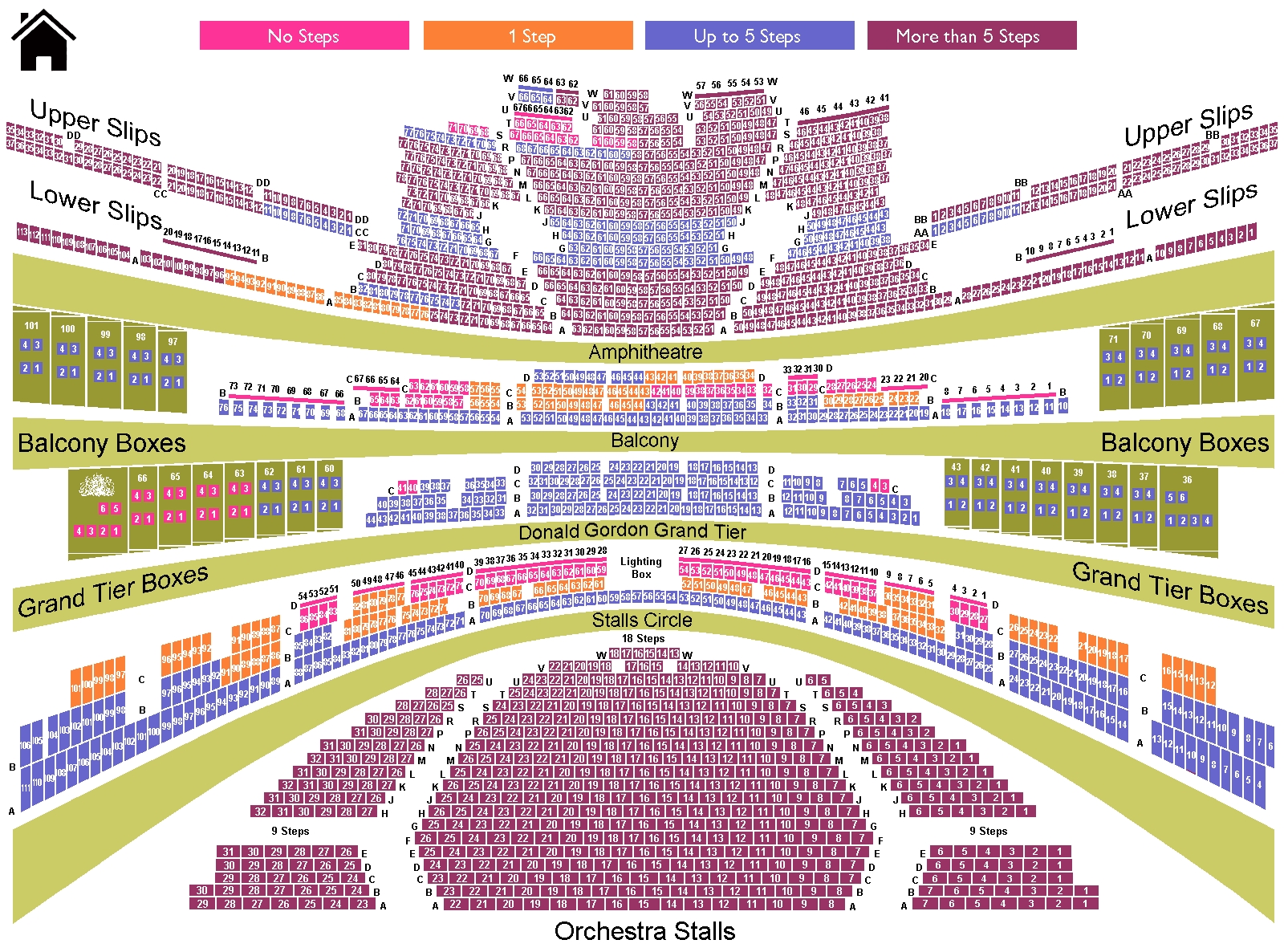

      • Cheap Tickets: Upper Slips for £4 - £18 - Last year, to my joy, I discovered £4 Upper Slip tickets to see one of Tchaikovsky's ballets. I also managed to see La Traviata with Sonya Yoncheva for £14. These seats are on the side of the stage, high up, more so than the amphitheatre level, with a restricted view, yet I was pretty satisfied with what I was paying for. It's worth mentioning that it's a game of luck when purchasing these tickets - you don't know which side has the best view. Unfortunately the ROH box office doesn't know where the best side to view the production is until a week before the first night, usually the time when dress rehearsals have taken place, so you might be out of luck on choosing the wrong side to sit if you book months in advance. But there are...
      • ... Day tickets, which range from various prices. These can be cheap tickets and are great for sell out shows: On the actual day of the opera (or ballet), the ROH offers between 60 to 70 day tickets, so you can physically queue up to get a ticket of a sold-out performance. For your information, it's one ticket per person and the box office doesn't open until 10am! However, depending on the cast, conductor or popularity of the opera, you might have to get there very early. For the in-demand Tristan und Isolde production with Nina Stemme, two years ago, I queued up from 8am and managed to get an extraordinary view from the Grand Tier Boxes for £40. For Jonas Kaufmann and Eva-Maria Westbroek in Andrea Chénier, I was very tired - I queued up from 7.45am, and managed to see the hot cast from the Upper Slips for less than £20. And for the latest Il trittico, I arrived at the opera house at 8.41am and purchased an amphitheatre (S-Row) ticket for roughly £33, which allowed me to view the entire stage and see the wonderful Ermonela Jaho reprise her role as Angelica. 
      • Cheap tickets, and great for sell out shows: Phone in Day tickets - But you can't queue up on the day I hear you cry! Not to worry, from 10am you can still call the box office and see what tickets are available. When I want to see an opera on its opening night and all the seats are taken, there are standing tickets. For Wayne McGregor's ballet, The Ravel Girl, I managed to book a standing circle stall ticket for £6. Yes, £6! Again, wear comfortable shoes! Another example is this week's opening of Musorgsk's Boris Godunov with Britain's favourite baritone, Bryn Terfel where I managed to get a standing ticket for the same location, which was originally £18 reduced to £10. The reason being that it was a restricted view. The actual staging had two levels, which meant that it was hard for some, depending where they sat or stood, to see the higher level. I appreciated the fact that I was advised and made aware by the box office of this disadvantage; despite the restriction, I was still pleased with my view, though some people may not agree. 
      • Cheap tickets: Student Discounts: If you are a student, you can register to get e-mails from the ROH which will update you on special student days whereby tickets, no matter where they are located - orchestral stalls, amphitheatre, grand tier or upper slips - tickets are £10 each. During my student days, I would rely on these a lot and although they are only available on special days e.g. a weekday and not for all productions, they still give newbies an opportunity to get to see an opera live for a tenner.
      Opera Holland Park (OHP): The company offers thousands of ticket for free through their Inspire Tickets range and they go like hot cakes, so you have to apply early to get your hands on them. They also have many tickets at £17 per person. (Click here to look at last year's offer of Inspire.)
      • FREE tickets: 1,000 tickets are available for free for those aged between 7 - 18 and up to four people can apply, such as an adult and three young people. There's a deadline for applications for these free tickets, however, these seats are available for all 32 productions during the summer season. (Click here for more information)
      • FREE tickets: Patrons of the OHP (ages 60+) also have access to free tickets. Each year OHP offer 500 free tickets for the older audiences as well!
      • FREE tickets:Under-30's tickets - 300 tickets are offered to those under-30's and available to book on the phone for each production. (Click here for more information.)
      Small-scale opera productions
      Here are a few example of prices for small and local productions, which also prove how cheap opera tickets really can be.

      And for those that love chamber music and recitals, there's Wigmore Hall's Under 35s Scheme where certain performances are accessible for £5 only. (Click here for more information.)

      I have only provided a handful of examples based on my experience. If you know other ways of getting cheap opera tickets, please let me know and volunteer this information. I believe that I've provided fair examples proving that opera ticket are cheap. If this doesn't convince you that this is the case, I don't know what will. 

      Tuesday, 15 March 2016

      Fulham Opera: Verdi's Simon Boccanegra ★★★★

      It was only until the second half of the 20th century that Verdi's opera, Simon Boccanegra (1881) became recognised. It wasn't received well during Verdi's life, with its deep reflection of the composer's political thoughts on how Italy should be governed. His opera - on the beleaguered Dodge who is reunited with his illegitimate daughter he thought was dead - is currently showing at St John's Church by Fulham Opera, which produces some of the most magical moments I've ever seen on the opera fringe scene through its excellent cast of soloists, brave chorus and devoted musicians.
      Photograph by Matthew Coughlan
      It's a shame that Simon Boccanegra isn't performed enough, given Verdi's splendid and individual score, as well as the versatile storyline that combines family relationships with moral redemption and political power. Fulham Opera goes full steam on passion and shows the audience what they have been truly missing! 

      Director, Fiona Williams has the audience sitting at four corners, with the stage right in front of them. It's a clever way to see the multiple sides of the opera's characters; some with moral intentions while others hypocritical and motivated by wicked plans.
      Photograph by Matthew Coughlan
      Benjamin Woodward has the 12-piece orchestra of Fulham Opera playing dramatically, emphasising the elegiac mood and bitter tensions which brew during and, most of all, at the end, leading to the Dodge's assassination by poison. The excellent chorus (Roberto Abate, Patrizia Dina, Greg Hill, Ken Lewis, Hannah Macaulay, Rosalind O'Dowd, Naomi Quant, Chris Childs Santos, Lilly Scott and Timothy Tompkins) take no shortcuts and go above and beyond, singing brightly and building on the moody atmosphere; filled with fear, uncertainty and mysticism.

      With a simple stage, yet a dynamic space for the cast, Andy Bird's coordination of changeable lights plays an important part in marking out the intensity and symbolism for the various scene changes; moving onto a cool blue-lit night, a warm spring-like romance to a daring red for the scheming and plotting.
      Photograph by Matthew Coughlan
      One thing that is wonderfully conveyed is the relationship between Boccanegra and his daughter, Amelia, which is masterfully executed by Emily Blanch and Oliver Gibbs. There's a little sigh of relief when father and daughter meet again, after twenty-five years of separation, and a few tears are shed as Amelia embraces her dying father.

      Baritone lead, Gibbs plays the role of Boccanegra who gives an unflagging and uncompromising performance as both political leader and loving father. Blanch is charming throughout and conveys to the audience Amelia's good nature and character, which is sustained by her incredible and intense soprano voice.

      Photograph by Matthew Coughlan
      Alberto Sousa as Gabriele Adorno is simply outstanding and reenacts the tension, anguish and complexity of Adorno's character, dealing with love for Amelia yet lacking the knowledge that her father is the man he has been plotting to kill. Much credit goes to Sousa for singing exceptionally, especially for a role that many tenors turn down due to the vocal demands.

      Simon Hannigan as Jacopo Fiesco is serious, driven and lyrical in tone whilst James Harrison plays evil-deeds Paolo Albiani who conjures a scary and menacing conspirator with a robust baritone voice.

      By the end of the first act, I was blown away, particularly with the versatile music, high drama and heartbreaking storyline. Fulham Opera has converted me to love an opera - that is Simon Boccanegra. Honestly, it will leave you in awe! If there were anything to criticise, however, it would probably be the lack of softness of the pillows the audience had to sit on. Still it just goes to show how good the performance was if we, the audience, were willing to endure the stiffness of our seat.
      Photograph by Matthew Coughlan
      Fulham Opera's Simon Boccanegra production's remaining shows are on the 18th and 20th March. Click here for more information and to purchase tickets.  
       ★★★★ Review of Il trittico at the Royal Opera House (click here) The show ended on the 15th March 2016
       ★★★★ Review of Norma at the English National Opera (Click here
      ★★★★ Review of Unexpected Opera's The Rinse Cycle (Click here
      Review of 

      Thursday, 31 December 2015

      Top Fringe Operas in 2015


      I saw sixty-four operas this year. A third of them were small-scale productions. Yet no matter how tiny the venue were or how small the budget seemed, there were an array of memorable and fascinating productions that made an impression on me. Here are my favourite operas from the London fringe scene in 2015. Enjoy!


      Other links: 

      Opera at a Glance in 2015. My review from major opera houses in London (Click here)

      Review of Eugene Onegin at the Royal Opera House (Click here) Ends in the 7th January.

      Dress rehearsal of Cavalleria Rusticana / Pagliacci (Click here) Last showing is on Jan 1st.

      Wednesday, 12 November 2014

      Fulham Opera: Verdi’s Falstaff

      [Left to Right: Oliver Gibbs, Catherine Rogers and Keel Watson]
      There’s much to enjoy about Falstaff; the final opera composed by Verdi. It refuted many of his contemporaries including Rossini and proved that he could write comedy operas just as well as his great tragic operas like La Traviata.

      Loosely based on Shakespeare’s play The Merry Wives of Windsor, Verdi and his librettist Arrigo Boito produced a witty and vivacious opera that has charmed audiences since its premier in 1893.

      Now the little opera company Fulham Opera have stepped in and created a larger-than-life production of Falstaff at their resident St John’s Church.

      Given the success of Wagner’s Ring Cycle, earlier this year, it is to no surprise the company’s musical director Ben Woodward has brought a blizzard of Verdi’s mesmerising score into the medium sized hall swimmingly.

      With a reduced orchestra, of double basses, strings and sassy woodwinds, on the left, the opera opens up with the church altar as a pub, with a beer dispenser, and our grumpy Falstaff dressed in a tracksuit shouting out, ‘Musica!’ to the orchestra. Then, the grand music and silliness begins.

      Director Daisy Evans sets the opera in contemporary East London where sports gear, chunky earrings and caked on make-up co-exist.

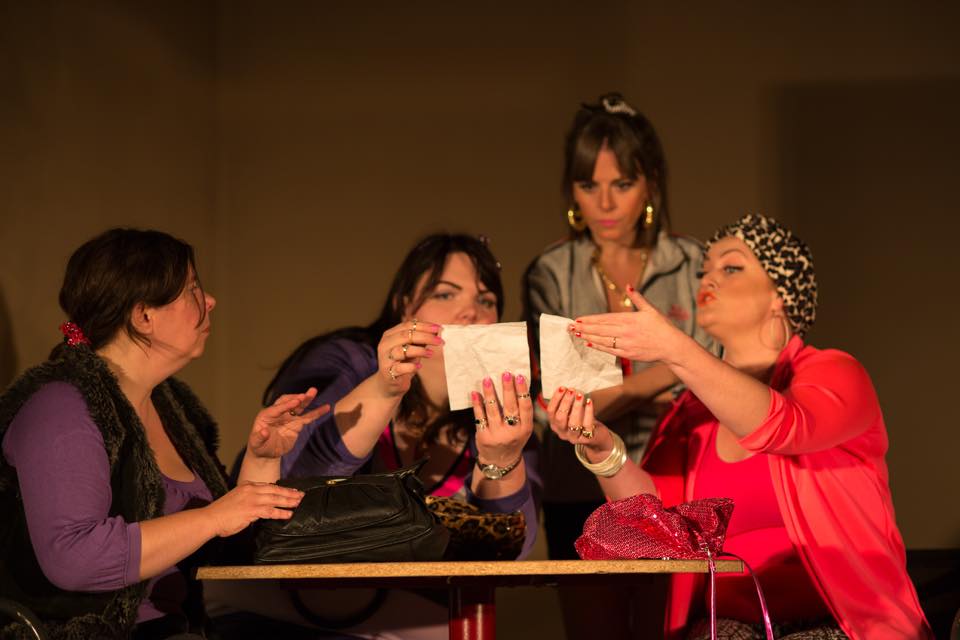
      The opera follows Falstaff plotting and scheming to pay off his dues by seducing the rich wives Alice (Catherine Rogers) and Meg (Jemma Brown). He produces duplicate love letters, on tissue, which he unhygienically coughs and blows his nose on.

      Yet these women are smart and well aware of Falstaff conniving plans that they decide to manipulate and exploit Falstaff with their own little game.

      As a consequence, Alice’s husband Ford (Oliver Gibbs) suffers the brute of misplaced jealousy and designs a scheme of his own. Nonetheless it’s all done in good humour and everyone lives happily ever after.
      [Left to Right: Mrs. Quickly (Lindsay Bramley), Meg (Jemma Brown), Nannetta (Caroline Kennedy) & Alice (Catherine Rogers)
      The marvellous singing cannot go unmentioned. Keel Watson is our scary, farcical and arrogant Falstaff and he does an excellent job of singing like it. Having sung at world concerts, his experience flows and weaves between the most sweet and most heated arias.

      Also having witnessed Gibbs as the sorrowful Rigoletto with Opera Loki, again, he strikes a heart’s chord even if there’s no deeper tragedy in the opera. His arias show Ford’s naïve jealously and loving loyalty to Alice which is exhibiting in Verdi’s great music.

      Hot pink booby top wearing Alice is excitingly sung by Rogers. She shows off her soaring voice while Perth born Roberto Abate’s manages to impress with his smooth tenor timber as the smitten lover boy Fenton. And Caroline Kennedy as the impish Nanneta sang high notes in an utterly butterly manner.

      The build up of the real farce, where Nannetta and Fenton are mistaken for Falstaff as he hides away in a pile of laundry, is rather messy, but gives the audience the giggle expected from the opera.

      The music and cast were irresistible and engaging. The musicians’ talents and vocal tenacity of its singers cannot go unquestioned. Bizarrely funny and something Shakespeare would have laughed about too.

      This production as ended but is currently showing in a brand new location for Grimeborn's 2015 Programme until the 22nd August! Click here for more details and to purchase tickets

      This review was first published in Flock To The Crown.

      Tuesday, 11 November 2014

      Fulham Opera: Falstaff ****


      By Mary Grace Nguyen

      [Left to Right: Oliver Gibbs, Catherine Rogers and Keel Watson]

      There’s much to enjoy about Falstaff; the final opera composed by Verdi. It refuted many of his contemporaries including Rossini and proved that he could write comedy operas just as well as his great tragic operas like La Traviata. Loosely based on Shakespeare’s play The Merry Wives of Windsor, Verdi and his librettist Arrigo Boito produced a witty and vivacious opera that has charmed audiences since its premier in 1893. Now the little opera company Fulham Opera have stepped in and created a larger-than-life production of Falstaff at their resident St John’s Church.
      Given the success of Wagner’s Ring Cycle, earlier this year, it is to no surprise the company’s musical director Ben Woodward has brought a blizzard of Verdi’s mesmerising score into the medium sized hall swimmingly. With a reduced orchestra, of double basses, strings and sassy woodwinds, on the left, the opera opens up with the church altar as a pub, with a beer dispenser, and our grumpy Falstaff dressed in a tracksuit shouting out, ‘Musica!’ to the orchestra. Then, the grand music and silliness begins.
      Director Daisy Evans sets the opera in contemporary East London where sports gear, chunky earrings and caked on make-up co-exist. The opera follows Falstaff plotting and scheming to pay off his dues by seducing the rich wives Alice (Catherine Rogers) and Meg (Jemma Brown). He produces duplicate love letters, on tissue, which he unhygienically coughs and blows his nose on. His lackeys (Jonathan Finney and Antoine Salmon) are useless and clownishly back out of his scheme leaving Falstaff to hand the letters to his quiet pageboy Robin (superbly played by Richard Marshall) to carry out the deed.
      Ford (Oliver Gibbs), Falstaff (Keel Watson) and Robin (Richard Marshall)
      Yet these women are smart and well aware of Falstaff conniving plans that they decide to manipulate and exploit Falstaff with their own little game. As a consequence, Alice's husband Ford (Oliver Gibbs) suffers the brute of misplaced jealousy and designs a scheme of his own. Nonetheless it’s all done in good humour and everyone lives happily ever after.
      The marvellous singing cannot go unmentioned. Keel Watson is our scary, farcical and arrogant Falstaff and he does an excellent job of singing like it. Having sung at world concerts, his experience flows and weaves between the most sweet and most heated arias. Also having witnessed Gibbs as the sorrowful Rigoletto with Opera Loki, again, he strikes a heart's chord even if there’s no deeper tragedy in the opera. His arias show Ford’s naïve jealously and loving loyalty to Alice which is exhibiting in Verdi's great music.
      Hot pink booby top wearing Alice is excitingly sung by Rogers. She shows off her soaring voice while Perth born Roberto Abate’s manages to impress with his smooth tenor timber as the smitten lover boy Fenton. Caroline Kennedy as the tiny and impish Nanneta sang high notes as if they were second nature to her in an utterly butterly manner.
      [Left to Right: Mrs. Quickly (Lindsay Bramley), Meg (Jemma Brown), Nannetta (Caroline Kennedy) & Alice (Catherine Rogers)


      Stage gags include Falstaff handing a present: a piece of bounty chocolate out of its wrapper to Mrs Quickly who was cheekily sung by Lindsay Brown and Ford repetitively stealing Falstaff's beer away from him. The build up of the real farce, where Nannetta and Fenton are mistaken for Falstaff as he hides away in a pile of laundry, is rather messy, but gives the audience the giggle expected from the opera.
      The music and cast were irresistible and engaging, yet it was a strain to watch at times as the stage was split between the altar and the back of the room with members running up and down of it. With that, some audiences had difficulty reading some of the subtitles. I can’t help but think that if the audiences’ chairs were positioned on one side of the room that they could have enjoyed it a bit more. Staging aside, the musicians’ talents and vocal tenacity of its singers cannot go unquestioned. Bizarrely funny and something Shakespeare would have laughed about too.  
      For more information about Fulham Opera and to book tickets please click here. Next two showings are on the 14th and 16th November 2014
      Fridays at 7.30pm, Sundays at 5pm
      St John’s Church, Fulham: North End Road, SW6 1PB
      My review ticket was provided by Fulham Opera and photos are courtesy of Fulham Opera.