Showing posts with label unexpected opera. Show all posts

Sunday, 20 March 2016

How to get cheap Opera Tickets in London, even if they are sold out


There seems to be two misconceptions about opera tickets. Firstly - a point which has been argued to death - that 'opera tickets are expensive' and secondly, once a show, or production, has sold out there is no way you can see it, ever!

As a reviewer and blogger, I have the advantage of seeing many operas in London through press tickets, however, this is not ALWAYS the case. With the amount of theatre and opera I see per week (which can range between two to five shows in a week), there are occasions where opera and theatre companies do not provide me with that complimentary ticket. This has encouraged me to seek alternative ways of gaining access to sold out shows and finding the cheapest tickets, which might not always offer the best view but still provides me with a means to view 90% of the opera, and hearing beautiful music and amazing voices.

Opera, theatre, even ballets and classical music concerts, are not only composed and written for the rich and affluent. Keen culture vultures can go and enjoy shows without breaking the bank! Alongside discounted theatre websites and (believe it or not) newspaper, magazine and online publications, actual opera companies offer reduced tickets and special offers as well! 

Here are two examples from newspaper, magazine and online publications:
For the 5-Star rated Akhnaten at the ENO, Time Out were offering 40% off on tickets. 
  • Dress Circles tickets on Thursdays, Fridays and Saturdays were £79 (now £47.40) and Upper Circle tickets were £39 (now £23.40).
  • Dress Circles tickets on Tuesdays were £59 (now £35.40) and Upper Circle tickets were £34 (now £20.40). (Click here to see the offer.)
The Daily Mail also, at times, offer £10 tickets to Sussex Opera House at Glyndebourne. Although they might not be available on ideal dates (or close to the stage), it's still a massive chunk from the usual £90+ to £200+ tickets, which is the going rate for most Glyndebourne operas. (Click here for article.)

Keeping a close eye on the schedules and calendars of your favourite opera companies, opera festivals (Grimeborn, Tête-à-Tête) or concert halls (Barbican, Royal Festival Hall, St John's Smith Square), is probably the most effective way of knowing what operas are being showed so you can prepare ahead and purchase the ticket(s) you want, before they get snapped up by someone else. 

Social media, particularly Twitter, is another way of keeping tabs on opera tickets (including returns) on the day. Sometimes fellow Tweeters (and opera lovers on other social media platforms) let people know if they have tickets up for grabs. I've been fortunate enough to meet some very generous operagoers and classical music aficionados who have offered me their spare ticket last minute through Twitter and Facebook.

I've provided a list of opera companies (unfortunately not all) that not only dispel the idea that opera tickets are expensive but provide ways for customers to see a sell out show on the cheap!

The English National Opera (ENO)

    • Cheap tickets: Balcony tickets, in the first and second rows, are worth £12, but they come with a restricted view e.g. a pole or safety bar is in front of you, but I've never been fazed by this as I tend to see the majority of the staging. These tickets sell out fast, so find out when the ENO release tickets for the opera and book early!
    • Cheap tickets: Opera Undressed (£25) (Click here for more info) I've managed to get stall seats from Opera Undressed, which is usually worth £100+. All you need to do is register and you will get an email that will indicate when you can purchase your Secret Seat ticket(s). At the end of the performance, you also get the chance to meet some members of the cast and a lovely drink (G & T) on the house. However, there's only one or two opportunities to take advantage of Secret Seats, so perhaps get a friend to register thereafter to ensure you can continue to use Secret Seats. It should be noted, however, that these tickets are targeted at newbies to opera, so for those that that are regular operagoers...
    • Cheap tickets: Secret Seat (£20) is probably the best option (Click here for more info.) Secret Seats are released during the priority booking period and are for stall and dress circles seats, which are usually priced at £30. First, you decide when to see the opera and then you book online, in advance! From those who have experience booking them, they suggest you book Secret Seat tickets for several operas in the season. The only catch is that if you book for a group, of say four, sitting next to all of them isn't guaranteed, but you're promised to sit next to at least one. Also, although the website says there are a limit on Secret Seat tickets, there have been occasions whereby operagoers have managed to get Secret Seat tickets on the day of the opera, so it is worthwhile keeping an eye on the ENO social media accounts in case they pop up.
    • Cheap tickets:Access All Arias - If you are aged 16-29 or a full time student, you can purchase stall tickets for £30, dress circle tickets for £20 and upper circle tickets for £10 through Access All Arias. You can also bring another adult with you for the same price, and purchase a programme booklet for half the price. Talk about convenient! (Click here for more information.)
    • Cheap tickets, and great for sell out shows: The £10 Standing ticket - I recently discovered this method for ENO's Ahknaten, which was completely sold out. Surprisingly, I felt that while I was watching the opera, I had a better view than those sitting in the row in front of me. You can only purchase them in person on the day, and sometimes you can buy an extra ticket for your friend if they are running late (which I was.) When I arrived at 6.30pm (for a show that started at 7.30pm) there were many standing tickets available, therefore there isn't a limit of them on the day. My advice is - just grab your opera glasses and ensure you wear the most comfortable shoes, then enjoy the show! Of course, I'm not recommending this to anyone who has been advised by their doctor to avoid activity that requires standing for a long period of time. 
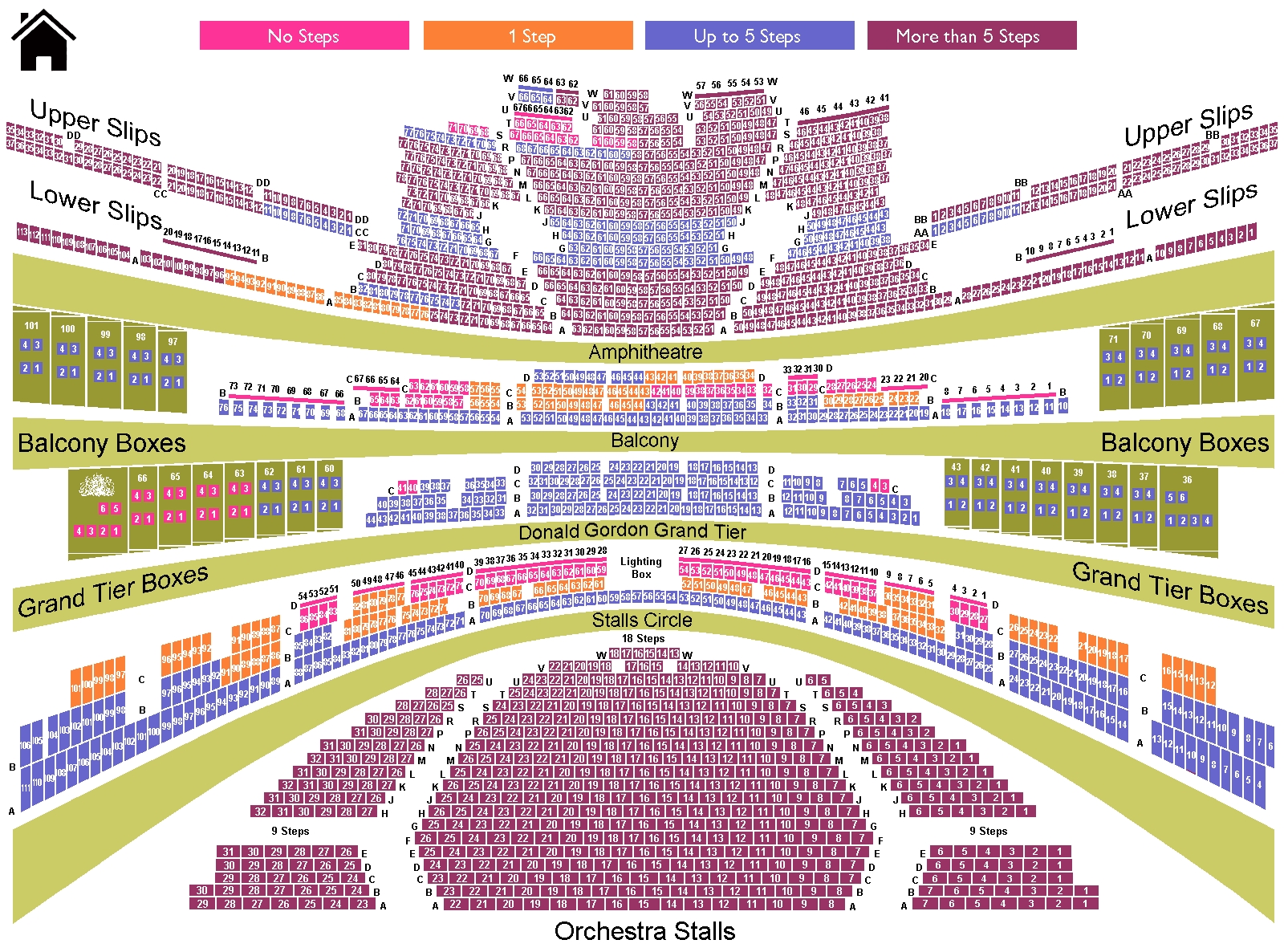

      • Cheap Tickets: Upper Slips for £4 - £18 - Last year, to my joy, I discovered £4 Upper Slip tickets to see one of Tchaikovsky's ballets. I also managed to see La Traviata with Sonya Yoncheva for £14. These seats are on the side of the stage, high up, more so than the amphitheatre level, with a restricted view, yet I was pretty satisfied with what I was paying for. It's worth mentioning that it's a game of luck when purchasing these tickets - you don't know which side has the best view. Unfortunately the ROH box office doesn't know where the best side to view the production is until a week before the first night, usually the time when dress rehearsals have taken place, so you might be out of luck on choosing the wrong side to sit if you book months in advance. But there are...
      • ... Day tickets, which range from various prices. These can be cheap tickets and are great for sell out shows: On the actual day of the opera (or ballet), the ROH offers between 60 to 70 day tickets, so you can physically queue up to get a ticket of a sold-out performance. For your information, it's one ticket per person and the box office doesn't open until 10am! However, depending on the cast, conductor or popularity of the opera, you might have to get there very early. For the in-demand Tristan und Isolde production with Nina Stemme, two years ago, I queued up from 8am and managed to get an extraordinary view from the Grand Tier Boxes for £40. For Jonas Kaufmann and Eva-Maria Westbroek in Andrea Chénier, I was very tired - I queued up from 7.45am, and managed to see the hot cast from the Upper Slips for less than £20. And for the latest Il trittico, I arrived at the opera house at 8.41am and purchased an amphitheatre (S-Row) ticket for roughly £33, which allowed me to view the entire stage and see the wonderful Ermonela Jaho reprise her role as Angelica. 
      • Cheap tickets, and great for sell out shows: Phone in Day tickets - But you can't queue up on the day I hear you cry! Not to worry, from 10am you can still call the box office and see what tickets are available. When I want to see an opera on its opening night and all the seats are taken, there are standing tickets. For Wayne McGregor's ballet, The Ravel Girl, I managed to book a standing circle stall ticket for £6. Yes, £6! Again, wear comfortable shoes! Another example is this week's opening of Musorgsk's Boris Godunov with Britain's favourite baritone, Bryn Terfel where I managed to get a standing ticket for the same location, which was originally £18 reduced to £10. The reason being that it was a restricted view. The actual staging had two levels, which meant that it was hard for some, depending where they sat or stood, to see the higher level. I appreciated the fact that I was advised and made aware by the box office of this disadvantage; despite the restriction, I was still pleased with my view, though some people may not agree. 
      • Cheap tickets: Student Discounts: If you are a student, you can register to get e-mails from the ROH which will update you on special student days whereby tickets, no matter where they are located - orchestral stalls, amphitheatre, grand tier or upper slips - tickets are £10 each. During my student days, I would rely on these a lot and although they are only available on special days e.g. a weekday and not for all productions, they still give newbies an opportunity to get to see an opera live for a tenner.
      Opera Holland Park (OHP): The company offers thousands of ticket for free through their Inspire Tickets range and they go like hot cakes, so you have to apply early to get your hands on them. They also have many tickets at £17 per person. (Click here to look at last year's offer of Inspire.)
      • FREE tickets: 1,000 tickets are available for free for those aged between 7 - 18 and up to four people can apply, such as an adult and three young people. There's a deadline for applications for these free tickets, however, these seats are available for all 32 productions during the summer season. (Click here for more information)
      • FREE tickets: Patrons of the OHP (ages 60+) also have access to free tickets. Each year OHP offer 500 free tickets for the older audiences as well!
      • FREE tickets:Under-30's tickets - 300 tickets are offered to those under-30's and available to book on the phone for each production. (Click here for more information.)
      Small-scale opera productions
      Here are a few example of prices for small and local productions, which also prove how cheap opera tickets really can be.

      And for those that love chamber music and recitals, there's Wigmore Hall's Under 35s Scheme where certain performances are accessible for £5 only. (Click here for more information.)

      I have only provided a handful of examples based on my experience. If you know other ways of getting cheap opera tickets, please let me know and volunteer this information. I believe that I've provided fair examples proving that opera ticket are cheap. If this doesn't convince you that this is the case, I don't know what will. 

      Sunday, 21 February 2016

      One week, many operas: L'Étoile, The Magic Flute, Norma and The Rinse Cycle


      Five operas in a space of seven days may seem like a tall order but somehow I managed to do all of them. The range included works by Fringe companies like Opera Vera (read review here) and Unexpected Opera as well as those at the Covent Garden and English National Opera (ENO). To my delight it was an even spread that pretty much captured the kind of operas happening in London - and my, (oh, my) there are plenty! 

      Royal Opera House: L'Étoile, Covent Garden ★★★★
      (Photograph from the ROH website)
      L'Étoile was composed by Emmanuel Chabrier and premiered at Offenbach's Théâtre des Bouffes in 1977. Parisians absolutely loved it back then and now, at the Royal Opera House, with some commendable additions - British comedian Chris Addison, breaking of the fourth wall with maestro Mark Elder and add-on slapstick dialogue - it is a fun-packed, entertaining production that I'd happily recommend anyone to see. Yet if you like your opera serious, sans kinkiness and completely covered with passionate and I-am-going-to-die-tragically singing, then this one may not be for you.

      However I must admit that the music glows and is highly addictive. The ROH Chorus sing wittingly to Couplets du Pal as they celebrate King Ouf's execution by impalement (yeah, I know - it's very weird!) By the end of it, I was humming a few catchy songs I hadn't heard before including Le chartreuse verte. The opera is performed entirely in French, which is a good way to re-cap on your beginner's French (which you probably left behind after GCSEs), and like a Shakespeare, Mozart or Strauss narrative, there's a master of disguise, a trouser role, multiple plots going on and ridiculous love triangles. 

      Addison and Jean-Luc Vincent, as Dupont, are the two comedy commentaries who interject throughout and sporadically, but I favoured this - I thought Addison was actually funny, especially when he points at the surtitles and realises he's in a real opera! Elder conducts jubilantly (and happily), and it's not hard to see why with Chabrier's highly spirited music. Hélène Guilmette (Princess Laoula) melted my heart with some scintillating singing, and mezzo-singer Kate Lindsey, as Lazuli, was a great match to her as the wandering pedlar who falls in love. In Lazuli’s solo aria (in Act 2) Lindsey's voice truly blooms.

      Much hilarity is maintained by exceptional performances through Samuel Sakker (Patacha), Samuel Dale Johnson (Zalzal), Christopher Mortagne (King Ouf), Simon Bailey (Siroco), Julie Boulianne (Aloès) and Aimery Lefèvre (Tapioca). And the flamboyant and freshly coloured set designs shouldn't go unnoticed - thanks to Julia Hansen for the crazy anachronistic satire of the 19th century and Arabian Night styles. Sadly, this one isn't PC enough for the kids as it is pretty saucy. No - it's very sexy! Unless they've past puberty then, of course - by all means, bring them! 


      English National Opera: The Magic Flute  ★★★★
      (Photo from the Guardian website)
      Things are not getting better for our opera house at the London Coliseum. More negative news keeps coming in and the most recent is the livelihood of its Chorus which has been stated to reduce, including the number of opera productions taking place next year by ENO CEO, Cressida Polluck. With many internationally known musicians, performers, conductors, directors and classical music journalists signing a petition via @SaveEno (here), it is only a matter of time before the ENO's management has to face up to the inevitable and give the people (audiences, singers, performers, musicians and tax-payers), an answer to their financial dilemma.


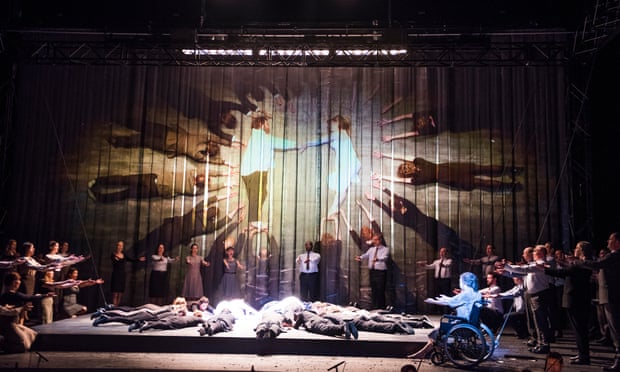
      Yet in the face of such crisis, the show must go on and the nation's supposed opera house has introduced a revival production of Complicite artistic director Simon McBurney, The Magic Flute, which was first shown in 2013. Admittedly I didn't enjoy that production; I re-read my review (here), which seemed like I was in agony by the end of it. Influenced by social media, however, with rave reviews of the revival's opening night, I got myself a ticket hoping that they were right and luckily I wasn't disappointed - phew!


      The set hadn't changed much in three years - the ENO orchestra was elevated from the pit and a simple platform moved in mid-air. The staging was recycled from the last production but this time round the opera was executed to a better standard. Here's my reasons why.

      Firstly, it seemed much more together; there was no fuss on stage among the performers and they seemed on top of what they were doing. Secondly, the voices of its brilliant cast were stronger. This was enhanced by stimulating conducting from ENO’s resident maestro, Mark Wigglesworth. The grand overture, The vengeance of Hell by the Queen of the night and blissful duets such as Pa … pa … pa ... were performed to a hugely satisfied mixed audience of children and adults. And thirdly, there were Finn Ross's video projections which were previously implemented, but here introduced with some extra additions, making it more imaginative and mythical (I won't spoil it by telling you what - visually - happens.) Overall, though, there was a real sense that the performers and singers believed in the production, making it a far more gratifying production. 

      Allan Clayton and Lucy Crowe performed convincingly as star-struck lovers and although they were not the comedy starlets, they were able to stay in character while their zany companion creatures, Papageno (Peter Coleman-Wright), Monostrato (John Graham-Hall) and Papagena (Soroya Malfi) kept the childish humour of Mozart at bay. I had seen Crowe perform at the ROH in L'elisir d'amore, so I wasn't surprised she gave an impressively delicate and sweet sounding Pamina, particularly in her solo aria in the final act. 
       
      Ambur Braid performed courageously as the wheelchair-stricken OAP version of the Queen. The ENO Chorus was tremendous in voice and played a pertinent part with McBurney's tacky paper birds. Coleman-Wright's Papageno, however, was much more friend-down-the-pub and had other handy gimmicks compared to the last production's bird catcher, Roland Woods. Though with saying that, they played a version of Papageno that was entirely their own. Woods was much more sharper in voice for Mozart's harmonious and witty music while Coleman-Wright wanted to make the audience laugh – and that’s exactly what he did! James Creswell is the voice of authority, Sarastro and there was a moment when he looked on to the audience, as well as his political cronies, and said, 'we are in a crisis!' I thought he was referring to the ENO crisis but then I remembered this was the bit that they worry over Tamino's dedication to love and truth - BLAUGH! 


      English National Opera: Norma
      ★★★★
      Alastair Muir
      [From Review first published at CultureVulture.net]
      The English National Opera (ENO) first performed Bellini’s 1831 bel canto opera, Norma this month. Christopher Alden's production was first presented by Opera North in 2012, which is a co-production with Die Theatre Chemnitz and has toured to Bordeaux ever since. Bellini put down on paper, 'Carve in your head in adamantine letters: Opera must make people weak, feel horrified, die through singing' and to many composers, artists and philosophers they were heavily affected by the composer's artistry.


      Conducted by Stephen Lord, who demonstrates his aptitude for bel canto repertory, the production was dramatic in narrative and the music's sublimity that could only come together from a solid hand (and baton) to guide the roaring and heartfelt score. The opening night permitted its ENO Chorus to take to the curtain call twice, which was well-deserved for this chorus-heavy opera. They give a phenomenal performance as excellent actors and singers. Unforgettable scenes come in the final act where Norma reveals her treachery to them, and in their pain, they fall to the ground, then abandon her. It stressed the significance of the ENO Chorus’s role at the opera house at a time where their status is being compromised and negotiated by the ENO's management. 

      Due to a word count I have to follow, I wasn’t able to put down a couple of things to be wary of with watching ENO’s Norma in my CultureVulture.net review. To put it bluntly, it is one of those operas that you are really going to love or really hate, and for me I found that I truly loved the music.

      Listening to an opera where you can completely lose yourself in the music is one of the reasons  I love opera – and Norma is one of those operas, yet the production is, as I said, dry and woody as the staging, and the only beings capable of moving you are the cast, ENO Chorus and the gracious music, which has the ability to make you cry and feel vulnerable.

      Another thing to note is that towards the last act, which was the most musically interesting, it took a long time to end and in some ways dragged. It was almost approaching 10.30pm and yes, I was tired (having had a long week at work already) but, surely, there must have been other ways that the production could have more appealing?

      Should you go and see Norma, stick with it or at least go with the knowledge that there is nothing visually sophisticated to see and you must take the narrative and magnitude of the voices as they are.


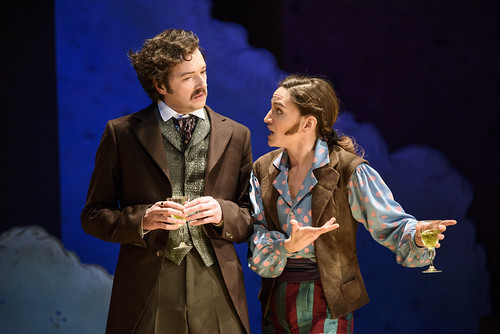
      Unexpected Opera: The Rinse Cycle, Charing Cross Theatre ★★★★★
      Photograph by Robert Workman
      I am an advocate of the fringe scene, a place where young and aspiring musicians and performers can reveal their trained voice and talent to an audience new to opera. Yet opera aficionados also like to check out small-scale productions too. Who knows if they might be seeing the next Maria Callas or Placido Domingo? (Honestly, who knows?) Some fringe opera companies are based locally while others go on tour, and this week I had the pleasure of seeing The Rinse Cycle by Unexpected Opera. It may sound rather cliché but I truly didn't know what to expect. The programme booklet reads, 'Wagner's Ring Cycle Conditioned with comedy and shrunk to 2 hours' and on analysis it did just that but in an inventive and intelligent way. 

      Unexpected Opera's artistic director, Lynn Binstock is on a mission to bring opera to those who think it's not for them as well as those who are devout operagoers through engaging and hilarious productions, and I've seen some funny operas but this one took comedy to another level. From the very beginning scenes I wasn't sure when Wagner's Rhinemaidens were going to fly in but it really didn't matter at this point as I got stuck in to the bizarre laundry stage and odd props: Patisserie Valkyrie sign post, mermaid aprons, disputed leitmotifs, an ironed out sword, Norfolk accents and oven gloves for Wotan’s giants.  Somehow Top Gun's Tom Cruise, with a phony American accent, also seemed relevant.

      What's smart about this show is that it eases the audience in with its own light-hearted story. Ronnie (Simon Thorpe) and ex-opera singer Edith (Harriet Williams) are the married couple with son, Tim (Edward Hughes) while Hilda (Mari Wyn Williams) and Robin (Anna Gregory) are like the waitresses from BBC Comedy 'Allo 'Allo, who go through the trouble of delivering the Ring cycle in a shrunken down version for the audience sat in front of them. However Tim didn't hear his dad properly and thought he said Rinse - not ring, hence, the hypnotic washing machines on stage.

      Though jokes aside, it is only by the end of the first half that you begin to get to the core of Wagner's music and all of that powerful Wagnerian singing. So while you may have spend the first hour doing stomach crunches in your seat, you'll be enlightened by real music drama, and the transition is, pretty much, seamless through the conviction of its passionate cast. 
       
      There are two casts for this production and on the opening night Thorpe sung both baritone roles, as Wotan and Alberich, yet he also played other characters with strange accents, including Sean Connery, on his knees and standing up. He gave a sensitive performance for the audience by the second half. The same can be said for Williams who sung as Fricka and her voice was intense, bold and alluring - my favourite voice of the night! 
      Photograph by Robert Workman
      Mari Wyn Williams sung the prelude of Die Walküre almost effortlessly with utter assurance and she had multiple roles to go on including Sieglinde and Ronnie's secret flirt. I also enjoyed tenor Edward Hughes who was marvellous as Siegmund and Siegfried - poor Tim kept getting confused playing both roles, but Hughes rose to the occasion and hit all those brave notes!
       
      Gregory has the vocal prowess for her roles as well ranging from Gutrune and Tim's knocked up girlfriend. Music director Kevin Lim had a shaky start on the piano but that was quickly forgotten when it came to performing the pithy and heartfelt songs sung by the cast.
       
      Some may only prefer their Wagner operas to be heard as the composer wrote it, or wanted it to be performed in Bayreuth, but that would be elitist, wouldn't it? For veteran operagoers who don't mind letting their hair down, having a beer and watching a cheerful and slightly cheesy opera that speeds through Wagner's 16-hour opera and neatly trims it down to 2 (with a break in between), then this is a perfect antidote. This is mutually beneficial for opera newbies, too, who will still get a taste of Wagner's profoundly dramatic music straight up from a versatile cast. Hats off to Unexpected Opera for ending my week on a high and making me sing Hoyotoho with the crowd - honestly, no one predicted that would happen and I love surprises.


      L'Étoile ends 24th February, 2016. (Click here for more information)

      The Magic Flute ends 19th March, 2016. (Click here for the ENO website.) 

      Norma ends 11th March, 2016 (Click here for more information)