Showing posts with label David McVicar. Show all posts

Tuesday, 28 July 2015

Glyndebourne Live Broadcast: Mozart's Die Entführung aus dem Serail ★★★★

Photo by
Die Entführung aus dem Serail (The Abduction from the Seraglio) (1782) reawakens audiences of Mozart’s genius with some heart-felt arias and a throbbing whirlpool of an overture. He was only 26-years-old when he composed the opera.

Die Entführung is famously known for being criticised by Mozart’s then commissioner, Emperor Joseph II for having ‘too many notes’, and although a comedy opera, its subject isn’t so innocent. Much like Die Zauberflöte (The Magic Flute), there are misogynistic and racial slurs honing in on Eastern and Western values, particularly the Ottoman Empire so, it’s always interesting to see how directors choose to stage a production.

This year, Glyndebourne has David McVicar directing the opera for their summer programme, which was broadcasted live at cinemas [July 19 ]. At the Gate cinema, Notting Hill, older audiences familiar with the work attended, yet some of them were a little too impatient to see its ending. McVicar’s instruction to include the full singspiel may have been the cause of this, which produced a half play, half opera concoction. One cinema viewer shouted, ‘hurry up!’ during a dialogue between Belmonte and Pedrillo in act I.

In spite of how long the opera was the singspiel didn’t spoil my experience, which, surprisingly, was refreshing. The fine German diction and frivolity between the oafish Osmin (Tobias Kehrer), artful Pedrillo (Brenden Gunnell) and noblemen Belmonte (Edgaras Montvidas) were things to relish about the opera. The merciful efforts from heart-broken Pasha (Franck Saurel) to claim Konstanze’s love (Sally Matthews) were also significant parts of the production.
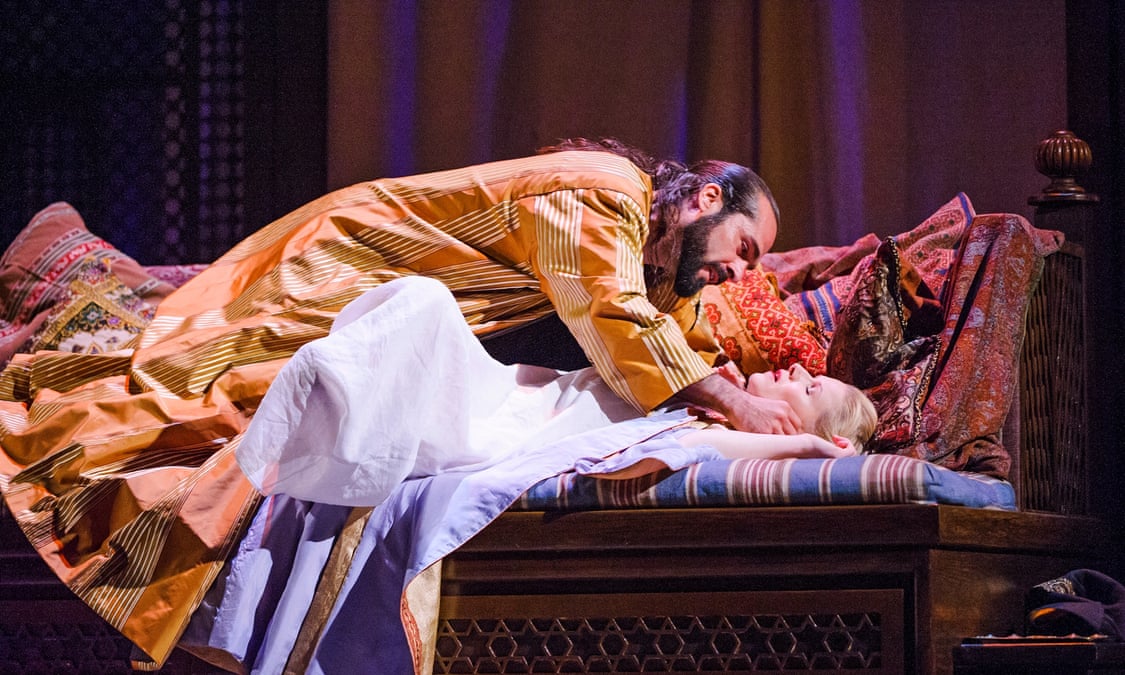
Photo by Tristram Kenton for The Guardian
 McVicar’s traditional and safe staging seemed to go well with the beautiful score. The overall set was visually pleasing with period costume, green gardens and Ottoman Empire-inspired, lavish interiors for Pasha’s harem, designed by Vicki Mortimer. The Orchestra of the Age of Enlightenment and their period-specific instruments appropriately added a unique touch to the decadent opera with Glyndebourne’s music director Robin Ticciati at the helm. The overture was gutsy and Ticciati conducted with aplomb.

Undoubtedly radiant and sensual was Matthews as our trapped heroine who says one thing but does the other - she allows Pasha to kiss her one second but rejects him in another. Her ability to reach stratospheric notes seemed effortless though it had me thinking, at times, how cruel Mozart was to make sopranos sing such top notes so often and between one another. And because of this, I could hear her straining in ‘Martern aller Arten’, but, resilient as she was, she kept singing until the end.
Montvidas was lyrical as his character’s virtuosity and bass singer, Kehrer sang as an awesome, but nasty Osmin. He soon became a favourite amongst the audience, even though he displayed an evil ogre and less of a comedian. His scene with Mari Eriksmoen, as Blonde, throwing pans and dishes at each other was one of the funniest moments of the opera.

Eriksmoen performed as a crafty and cheeky Blonde, and with Gunnell’s speedy Pedrillo made a cute and hilarious couple on stage, cleverly depicting the social divide with Belmonte and Konstanze’s relationship. 

Despite not having to sing Franck Saurel was a thrill to watch too as the sensitive Pasha. With saucy scenes of a sexual violence, teary eyes, passionately said words and a half naked torso, Saurel was the stuff of great acting.

Thanks to Live broadcast of Glyndebourne audiences can gain insight of Glyndebourne performances, minus the dinner jacket and fascinator.

Die Entführung aus dem Serail is still showing at Glyndebourne until the 10 August. Click her to purchase tickets. They are also going on Tour this autumn so there’ll be another chance to see it at other venues in England – book early to see the production on Tour.

The next cinema Glyndebourne showing is Fiona Shaw’s Rape of Lucretia on the 9th of August also showing at Gate Cinema, Notting Hill. Click here for Gate Cinema website or here, for other UK cinemas.

Saturday, 24 January 2015

ROH: Andréa Chénier : Charming, captivating and eclectic, but where's all the grit? ★★★★★


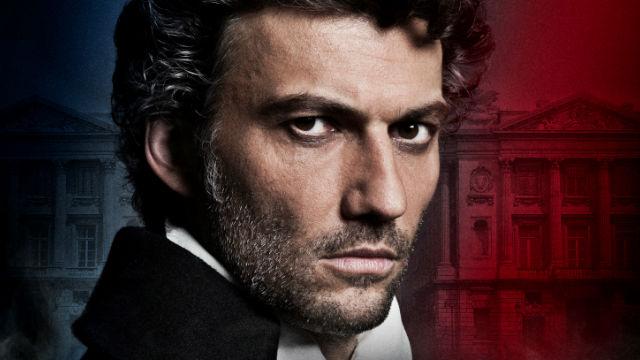
The highly anticipated opening night of Andréa Chénier, after 30 years of absence from the Royal Opera House (ROH), fulfilled almost everyone’s expectations. David McVicar’s extravagantly traditional production provided a gracious setting for Umberto Giordano’s lusty score.  This was topped off with world-class singing from tenor-of-the-moment, Jonas Kaufmann, the front-running star who many had spent their 'bottom dollar' to see. Rest assured many won’t be asking for their money back. 

Based in the 18th century, the historic Andréa Chénier was a poet who wrote against the status quo and was executed during the French Revolution -a tale that coincides and echoes the recent atrocities in Paris. For this verismo and classically tragic opera, however, Giordano sticks in a dagger and invents Gerard, an anti-hero to cause heart ache and anguish in a rivalry for Chénier’s muse and lover Maddalena di Coigny.

Yet despite a gritty tale with a chilling guillotine and hoard of outspoken sans-culottes, Robert Jone’s staging was pretty and pristine with traditional décor, candle lit chandeliers and Jenny Tiramani’s clothes designs of pastel coloured dresses and Kaufmann’s noticeable purple socks. The dances, from gavotte to pastoral ballet, were traditional choreography as well. 
Even for the action scenes set at the ‘Reign of Terror’ to the moments before Chénier approached his impending death, the guillotine and jails appeared newly furbished. Yet compared to the last ROH production of Un ballo in maschera, the quality of the staging was worlds apart with far more cash to spend, it seemed. Perhaps this was the edge that McVicar was looking for in producing this verismo opera. By reinforcing the lack of grit and references to the Mala vita the production recreated a sumptuous and grander opera of romantic sharp music and higher emotional power, which worked marvelously for such a beautiful opera.

Long applause greeted Kaufmann's first aria, Un dì all'azzuro spazio, and no one dared to cough through it. Having been acclaimed for his recent performance at Wigmore Hall, he brought the same temperament and skill into the opera house. His handsome looks mirrored his glorious voice and portrayed a man of conviction, wisdom and lover of Maddelena. 

Željko Lučić also played a substantial role this evening, but had some warming up to do before impressing audiences with his bold voice in act 3. He sung with full force and sensibility particularly in ‘Nemico della Patria’. Despite not bringing the house down, as he did in last year’s production of Macbeth at the Metropolitan Opera, his acting abilities presented a visceral side to Gérald’s fickle and jealous conscience.
Eva-Maria Westbroek was suitably matched to ‘Esparanza’ Maddalena. When Westbroek sang ‘La mamma morta’, in act 3, she sang with courageous pathos, which was superbly followed by a gentle cello solo. Westbroek parked her former role as the starry and debauched Anna Nicole for a tender and vulnerable Maddalena; one could imagine her as a knock-out Mimi in La Bohéme. The opera had a victorious ending with a spectacular love duet evoked by our lead couple, which reached all the money notes: it was a duet that had all the stuff of a truly romantic opera.

 There were other singers that performed marvelously from Elena Zilio, who sang as the blind mother who gave away her son to the war, to Roland Woods as the honest friend of Chénier, Roucher. Peter Hoard, Peter Coleman-Wright, Rosalind Plowright, Carlo Bosi and Adrian Clarke had small roles, yet their theatrical and operatic contributions were valued by the audience.

As for the conducting, Antonio Pappano’s made Giordano’s opera seem almost too perfect. Although euphonious and harmonious, I felt that, the music sounded pure and virtuous for an opera about injustice and the grime nature of the ‘Reign of Terror’.

 One can only wish that there were more scenes with Chénier and Maddalena flaunting their love and more of Kaufmann's operatic prowess and profound presence. The opera, with its additional march music and lavish dances, is charming, captivating and eclectic. If you can’t get a ticket to the Royal Opera House, I’d highly recommend you grab a cinema ticket for the live screen on the 29thJanuary.
Photographs courtesy of the Royal Opera House. For more information, click here. The opera is showing until the 6th February. For more information about the live screening, click here.