Opera
Holland Park received many smiles and applause for their recent outings of
Jonathan Dove’s Flight and Puccini’s triple bill, Il trittico. Naturally, many opera-goers
will have high expectations for their new production of Aïda, extravagant costumes and a showy set design of temples devoted to Egyptian gods and
goddesses for Verdi’s highly dramatised opera, Aïda, but Opera
Holland Park director, Daniel Slater has another idea in mind that may shatter the audience’s
dreams. (Full review here. Click here..)
"The exhibition explores the pinnacle role shoes play in several
societies, not just the fashion world. Yet Pleasure and Pain is by no
means perfect and spectators may feel disappointed." Click here to read full review.
19th century poet Christina Rossetti once wrote, “Can anything be sadder than work left unfinished? Yes, work never begun”. In a similar vein, the Courtauld Gallery has curated a special exhibition dedicated to art from its permanent collection that was considered unfinished, from Renaissance to early 20th century. Unfinished…Works ... Click here to read more on LDNCARD blogs.
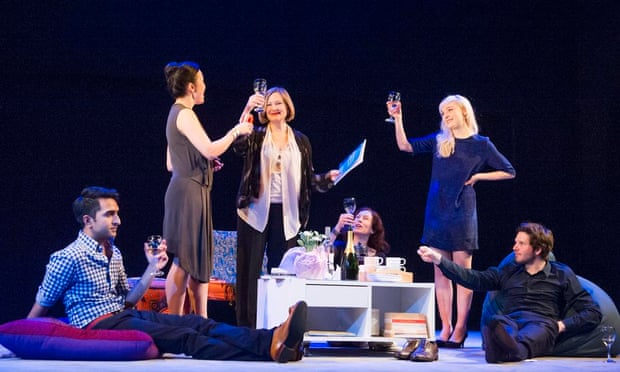
Theatre lovers will know Robert Icke for directing the
pathological whirlpool, 1984 with Headlongt heatre-company. The
production has gone from strength to strength and returns to the West End this
week. As part of the Almeida’s summer season – devoted to classical Greek
theatre – Icke has righteously kicked it off with his new, cool and jaw dropping production
of Aeschylus’s 2,500-year-old play, Oresteia. It’s a supremely important canon
of Greek drama and arguably the life-blood of theatre. Icke translates Aeschylus’s text for a contemporary setting that
is highly relatable, minus the kinship blood bath. (Those new to Greek tragedy are
welcome). Aeschylus’s emblematic narrative highlights family sacrifice, Greek
deities, death and morality and although there’s much talk of the supernatural Icke’s
production is entirely modern and doesn't try too hard with theatrical tactics.
The subject matter is barbaric: father kills daughter; mother
kills father; then, son kills mother. There’s
shocking scenes of violence, seeping blood and raging arguments, which is
mellowed with crafty moments of silence, which go part and parcel with
Icke’s Greek tragedy. The trilogy lasts, just under, 4 hours and although this might sound long it is
cleverly timed and fails to bore the audience. Stage director, Hildegard Bechtler utilises a table and large
glass panels, with subtle modes of technology (e.g. digital clock). The rest, of
the imagination, is left in the hands of its outstanding cast who play characters with their own depth of fascination.
Angus Wright as Agamemnon is a ballsy, authoritative leader but
shows pithy signs of fatherly fragility and warfare indecision when left with no
choice but to appease the gods and drug induce his daughter. Wright presents a
harrowing scene as a TV cameraman zooms into Iphigenia’s
face, played by little Clara Read, and the blood absorbs the poison and
she slowly closes her eyes. Downtown Abbey’s young beaut, Jessica Brown Findlay, is the
anxious, angry and disturbed daughter, Electra who moans the death of her
father and makes a moving and empowering statement on stage. And Luke Thompson
as the ‘snake’ born from his mother’s womb, Orestes gives a fine performance
of a deeply distressed and psychopathic son.
Lia Williams, as Klytemnestra, however steals the spotlight and
acts as a focal point of the tragedies that befalls her house. We see her as a
mother, wife, queen, supporter of her husband’s political battles and a monstrous
betrayer. She appears seamless in the role, as if Klytemnestra was written for
her. What’s
more interesting is how intelligent and tremendously irresistible Icke’s
adaptation is even though the stage is prosaic. Icke’s serious overtones, poetic
imagery with Greek drama qualities is inventive and authentic and
makes for an exciting and thought provoking show. Although the last segment,
where the Athenian jury judge Orestes for his barbarous crime, is slightly off
from the rest of the play, it’s a tense and interactive scene. The audience can decide whether or no Orestes
is guilty.
Icke manages to get the audience to put their thinking caps on. Do we look at Greek
tragedy as a form of theatre that should be left as it is or a genre that can be
moulded into another contextual environment? Almeida’s
other two Greek season "modern" productions, Bakkhai
and Medea
of Euripides, may help assemble our answer.
Complimentary ticket not provided. Pictures courtesy of Guardian and Almeida Theatre. Theatres for Oresteia is available until July 18th. Click here to purchase tickets and more information. Running time 3 hrs 40 with 2 intervals.
Lia Williams as Klytemnestra in @AlmeidaTheatre is dynamite. Robert Icke’s tense interpretation of Aeschylus' greek tragedy is worth seeing
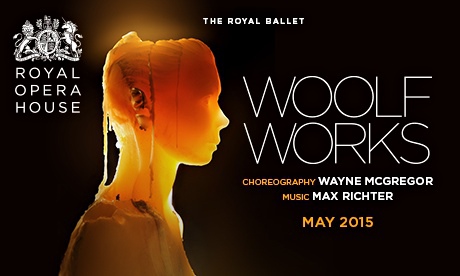
Woolf
Works, a brand new production conceived out of the works of 20th
century novelist Virginia Woolf, received an outstanding roar of applause and
standing ovations at its premier last night. The Royal Ballet’s own resident contemporary choreographer, Wayne McGregor was inspired to fulfil Woolf’s dream of combining her stylistic
prose which defied the writing rules of her era with the transformative and
emotional powers of dance. McGregor worked tirelessly with Uzma Hameed as the
production’s dramaturg to unravel ‘the luminosity, sonorousness and
poignancy of [Woolf’s] world.’
With
an array of the best principal dancers from the Royal Ballet including Natalia
Osipova, Federico Bonelli, Edward Watson and former ballet principal Alessandra
Ferri (now aged 52, can you believe?), Woolf Works brings together the flair and
multiple perspectives of the author’s non-linear writing through three of her
best loved novels – Mrs Dalloway, Orlando and The Waves.
Acclaimed
British composer Max Richter, who previously collaborated with McGregor on his
other ballets, including Infra and Kairos, revealed the delicate tinges of Woolf’s
moving works through simple melodies, orchestral influences from minimalist
composers, such as Philip Glass and Steve Reich, with structured fusion of
electronic and industrial music. Taking turns with Richter’s pre-recording
sonic music was the Royal Opera House’s orchestra who were conducted by Koen Kessels with craft and
subtlety; as of the start of the 2015/16 season he shall be the new Royal Ballet's music director.
I Now, I Then covers the tale of Mrs
Dalloway, which is delicately handled by Ferri. Ciguë and We not I, the stage designers
for the entire triptych, have large human-size photo frames rotating for the principals
to dance around and stand inside with projections of London and the countryside
from Clarrisa’s past. As the frames rotate, one by one the characters flow in just as
they had entered Clarrisa’s life in the book. Her puzzling choice of lovers
from Sally Seton, which is captured in a kiss shared with British rising star Francesca
Hayward, to her first meeting with her husband, Richard Dalloway danced by Bonelli who
enraptures her in his arms. The heart-felt trauma characterised in WWI sufferer Septimus
Warren Smith is set on fire by the soaring jumps and intensely courageous performances
by Edward Watson. Here, the audience get the most out of the Royal Opera House’s
orchestra through gripping strings that are tied down to the
rhythms of a ticking clock.
Orlando
is a renowned satirical feminist classic, which is shown through the piece Becomings. Male
principal dancers are dressed in Moritz Junge's tutus and metallic costumes’ cut from the Elizabethan period. The stage is bare but the dancers have Lucy Carter’s beaming
strobe and laser lights shinning above them that turn the Royal Opera House
into a nightclub scene, however, Richter’s electronic music is more subversive,
slow and reflective of Woolf’s emotive piece. A mesmerizing sight is also shown through a seductive pas
de deux that looked as if it had been dragged out of an Alexander McQueen fashion
show.
Orlando
is a tale about a nobleman who wakes up to find that he has changed into a woman. To abstractly depict this Osipova provides a dazzling solo that grows into eclectic group
choreographies with Akane Takada, Melissa Hamilton and Sarah Lamb providing
androgynous vibrancy with Steven McRae, Tristan Dyer, Eric Underwood, Matthew
Ball, Gary Avis and Watson presenting feminine foot steps and gestures to
relive the attributes of the metamorphosed nobleman. The climactic finale is
also a thrill with all the dancers assembled into three separate circles and
Richter’s score sky rocketing.
The
last piece is the shape-shifting Tuesday
from the book The Waves that commences with a letter by Woolf read by actress
Gillian Anderson. With a video clip of the sea and its waves, audiences watch
as children revive our memories of youth as the dancers intertwine and lock
together conveying the rich diversity of life. It ends with
Ferri supported tenderly by Bonelli who carries her until she lies on the
ground signifying the end.
Three
carefully created pieces pull together Woolf’s inner consciousness and convey
them in dissimilar ways through Richter’s immersive score and McGregor’s daring
contemporary style. This is a sensational piece of modern dance that shouldn’t
be missed. Don’t waste a moment. Go grab a ticket while you can.
Photos courtesy of @The Stage. Production ends on May 26th. Click here for more details.
#ROHwoolf Ooh, this one for luck. 5-star performance.Don't waste a moment.Go get a ticket before it ends.Sensational! pic.twitter.com/CAxKpY5vup
A new production of Szymanowski’s mystical opera led by powerful singing, creative staging and firm conducting
With fighting austerity and cutting costs across The Royal Opera House, director of opera Kasper Holten recently announced a ‘risk taking’ 2015/16 programme filled with classic and novel operas. This week is no exception as he introduces a new, ambitious yet exquisite production of 20th century Polish composer Karol Szymanowski’s opera, Król Roger, which captures the mysticism and moral questioning that burdens its protagonist, King Roger. Written during the turbulent Russian revolution and honed with Mediterranean, Oriental and Byzantine church music, Szymanowski’s opulent masterpiece grapples with deep-rooted concepts through a troubled Christianking and the turn of events that ensue when he encounters a preacher who worships a hedonistic faith.
Steffen Aarfing’s set design of the king’s towering head and Luke Halls’ cosmic video imagery takes shape from an ominous and pitch-black start, which is passionately evoked through soaring conducting by Antonio Pappano. In Act II, the monolithic head becomes the interior of the king’s temple and the macrocosm of his guilt-stricken mind, shown through nude, erotic dancers.
The production revels in a high quality cast. Mariusz Kwiecień comes on top as baritone singer, revealing the nuances of the king’s complex character. As Roxanna, Georgia Jarman’s hypnotic voice is intensely moving. And Saimir Pirgu adds charisma to the role of the heretic Shepherd, yet sings with a silvery voice.
Royal Opera House, London May 1-19, PN May 1 Composer: Karol Szymanowski Conductor: Antonio Pappano (Librettists: Karol Szymanowski, Jarosław Iwaszkiewicz) Director: Kasper Holten Design: Steffen Aarfing (set design), Jon Clark (lighting design), Luke Halls (video design), Cathy Marston (choreography), John Lloyd Davies (dramaturg) Technical: Chris Harding-Roberts (production manager), Lorna Robinson (costume supervisor), Emma Turner, Adam Lawley, Jessica Stanton, Aisling Fitzgerald (stage management) Cast: Alan Ewing, Agnes Zwierko, Mariusz Kwiecień, Kim Begley, Georgia Jarman, Saimir Pirgu
Back in the Gate cinema on April 16, a crowded audience
gathered for the NT Live screening of The Hard Problem, directed by Sir Nicolas
Hytner. It is his last production at the National Theatre as he bids farewell to his post
as the artistic director of the National after a 12-year stint.
Tom Stoppard’s first play in nine years is
a mean feat of critical theorising about consciousness and everything connected
to it: philosophy; evolution; biochemistry; neurology; and much more. Even
religion gets a mention and plays a part in this head scratching performance.
The Hard Problem speaks for itself. It is a question that has been bugging
intellectuals since the 4th century in classical Greek philosophy (and
even earlier for Eastern philosophers.) For those who are a novice to critical
theory or have never stepped into a philosophy a-level class, they might be in
trouble here though.
This isn’t the first of its kind for Stoppard. He is known for writing brilliant theatrical works that include themes of
political freedom, linguistics and the meaning of life, and for this The Hard
Problem shoves audiences into a dialectic much like the way Plato and Socrates challenged each other five hundred years ago.
By comparison, many who expect the
wittiness and cleverness of Stoppard’s 1993 play Arcadia will be let down. That is not to say that
The Hard Problem is not as witty or as clever as Acadia. No, in fact the play is both these things but
in a different way. Arcadia combines the
manifestations of pre-19th century Romanticism idealism with nature. While Arcadia brushes upon some interesting thought
provoking ideas, The Hard Problem gets deep, so deep it hits the academic books
and looses the audiences’ attention unless they are
familiar with the terminology and theoretical notions e.g. the Prisoner’s dilemma, which
crops up almost twenty times in the play.
Between the young psychology student Hilary and Spike, played convincingly by Damien Molony as Hilary’s university mentor, cinema viewers can see the dynamic
movement in their heated debates as camera focus onto one another. Camera 1
focuses on Hilary. Immediately after, camera 2 moves into Spike who
aggressively rebukes her with a brutal and gutless definition on altruism, the
‘selfish gene’, if you will, and so on. Their intellectual frustrations are set
aside while they maintain an odd, attachment-free relationship.
Olivia Vinall gives an electrifying
performance of Hilary not only in seasoned application of verbal assaults but
with Hilary's deep-seated passion as a young mother who gave up her child for
adoption at the age of 15. After gaining a position at the Krohl Institute for Brain Science
Hilary delivers a paper hypothesising God as
the answer to all things including consciousness, which isn’t good; it won’t
fund the institute’s research facilities.
This is other side of Stoppard’s
play that he highlights through the character of Jerry, who is wickedly acted by Anthony Calf. He exhibits a hedge-fund millionaire who swears and shouts down at his employees whilst portraying
a genuine and caring father. There’s an emotional twist to the story that ends
the play in a hopeful fashion, but I shan't share any spoilers here.
Vera Chok, Jonathan Coy, Rosie Hilal,
Parth Thakerar, Lucy Robinson and little Daisy Jacob come on top as playing
small parts of this mind-boggling 'abstract' of a play, yet not much depth is offered about their
characters. The emphasis is ultimately on Hilary’s journey who tries to find
herself, understand her conscience and grapple with her own hard
problem.
With Bach’s enthusiastic piano solos
that are lightly and lyrically played by Benjamin Powell and Bob Crowley and
Mark Henderson set design of colourful light rods and wires; that light up like
brain neurons or brain currents, Hytner ensures audiences gain a sense of the profound and complex mindset of its protagonist.
NT Live Encore of The Hard Problem on the April 21 in Gate Cinema at 12pm. The Encore is also available throughout the week in London cinemas including Picture Houses on the 24th. Check your local cinema.