Showing posts with label review. Show all posts

Wednesday, 5 November 2014

Royal Festival Hall: Les Martyrs with Opera Rara and the Orchestra of the Age of Enlightenment ★★★★

 By Mary Grace Nguyen
Last night, Opera Rara and the Orchestra of the Age of Enlightenment (OAE) came together to introduce Donizetti’s Les Martyrs at the Royal Festival Hall. It is an opera that is rarely performed, and was a pleasure to hear, for the first time, in a concert format with performances from a selection of buoyant and sumptuous singers including the exciting conducting of Mark Elder. 
Poliuto is the original Italian opera written by Donizetti in 1838; two years later he re-wrote the opera in French hence, Les Martyrs. It was perfectly composed by Donizetti to entertain the Parisians of the 1840s. The story is loosely based on Pierre Corneille’s 1642 tragic play Polyeucte and - at the time -  blasphemous subject of Christian Martyrdom. Just before its premier in 1838, it was censored in Naples due to the controversial nature of the opera.  
Les Martyrs is a ravishing piece filled with recitatives, Italian musical forms and sweet choral sounds. The overture alone is filled with a variety of melodies that conjure beauty, joy, love and religious tension, which was elegantly applied by the OAE’s strings, harps and enthusiastic double basses. The energetic force of Elder was present through the outstanding performance of the OAE particularly the woodwind and oaky brass instruments who were also accompanied by fanfares; these musicians would poke out from up and beyond the stage, intermittently, throughout the opera. 
Donizetti originally wrote the opera with a divertissement but this was taken out for the evening’s performance. This didn't have a negative effect on the evening as the opera had some of the most lavishly sung operas including 'O sainte mélodie! Concerts harmonieux.'
Rehearsals: Mark Elder with  Joyce El-Khoury
The story is set just after the Romans had conquered Armenia. The Roman Polyeucte (Michael Spyres) decides to convert to Christianity and his wife Pauline (Joyce El-Khoury), who is confident of her Pagan religion, tries to encourage Polyeucte to believe otherwise. Pauline’s father Félix (David Kempster) is the Governor of Armenia who instructs his secretaries to transcribe edicts sentencing Christians to death. The opera which is finely written with potent themes of heroism, religious devotion and revelation is constructed with glorious music which ends  dramatically: Christians are served on a platter to lions as ordered by the high priests and governors of Romans, including Pauline who miraculously converts to Christianity. This scene was cleverly encapsulated in Donizetti’s music: you could hear the energy of the OAE (and the roar of the lions.) 
Opera Rara singers, both as Christians and pagans, sang with strength and vigour which brought audiences back to Paris as it would have been experienced in the early 1800s. Some solos were also reinforced by Andrew Friendhoff, Rosalind Waters and Simon Preece.
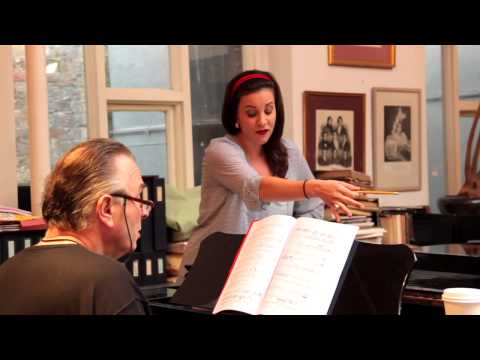
Joyce El-Khoury sang as the tenacious and graceful Pauline. Dressed in a black, elegant and ‘poofy’ dress, the Canadian soprano sang with endearing charm that took the audiences’ breathe away. Such songs including ‘O toi, qui fus témoin de l'amour de Sévère’ were sung with delicacy and (may I say) spiritualism, finely portraying her coloratura talents.
Michael Spyres sang as our troublemaker and Roman rebel Polyeucte. As a bel canto tenor, he bought out an elated spirit in Polyeucte which is well suited for a man who has seen the light, so to speak, and converted religion. Yet there was also something silky smooth about Spyres voice that got the audience excited. This was re-affirmed when he sang an e natural in the aria ‘Oui, j'irai dans leurs temples’ (as he told me on twitter), which was part of the original score of Donizetti, which he also admitted was ‘a bit mad!’. Mark Elder was just as shocked as the audience as he had to turn around to make sure it was real.

David Kempster, Brindley Sherratt and Clive Bayley were on top form too boldly making their Roman authoritarian presence known. They managed to heighten the ominous tone of the opera that lead onto the sextet ‘a la lucia di Lammermoor’ which includes Wynne Evans as Polyeucte's Christian friend Néarque. Evans proved that he does more than simply sing Go compare! adverts. The honest and genuineness of his character was vocally carried with loveliness.
Christian Husband and Pagan Wife: Joyce El-Khoury & Michael Spyres
The opera was an absorbing experience. The Royal Festival Hall’s acoustic also showed off its skills as I could hear the OAE, Opera Rara chorus and opera singers clearly - as far back as row SS! Here’s hoping that next year's season of Glyndebourne can live up to the standards that this show has successfully executed. 

The South Bank Centre has more evants with the OAE. Click here for more information. For more information about the OAE click here and for Opera Rara, click here. (I purchased my own ticket for the evening's opera.)

Monday, 3 November 2014

REVIEW of Martin Kušej's IDOMENEO ★★★ Shark without enough bite


Sophie Bevan (Ilia) and Matthew Polenzani (Idomeneo) 
By Mary Grace Nguyen 
Mozart’s earlier opera Idomeneo first performed in 1781, 5 years prior to Le Nozze de Figaro, is regarded as one of his maturer operatic works, which is honey-soaked in mythology, and tales of rulership and fatherhood. Sea monsters, princesses and Greek soldiers permeate the opera’s sublime score; we find similar musical traces in some of his later works including Don Giovanni and Requiem. Unfortunately Austrian director Martin Kušej and his regietheatre (translated as 'director’s theatre' in German) production with Annette Murschetz’s minimalistic, rotating stage - set in no particular time or space - let the show down through its sheer lack of imagination and inability to inspire the audience.

Yet Kušej would argue that despite being lumped with the regietheatre crowd, he works collaboratively with production teams and doesn’t understand what regietheatre means, anyway.

For a start there's no hint of a divine creature in this production, but that of a man. Kusej says, “... I don’t believe in gods. Religion, ideology — it’s all a fake.” So, we set off with a re-written story. Consider that the original is based on King Idomeneo’s vow to the god Neptune who must sacrifice the life of the first human he sets his eyes on to survive a sea storm; luckily he lives but, shamefully, his son Idamante is the victim. For Kušej's production religion is ditched for realpolitik and Idomeneo rationalises the killing of his son for the sake of his throne.
Father and son: Polenzani & Franco Fagioli (Idamante)
The semi-love triangle remains intact nonetheless, which shakes up these political tension between Idamante and Ilia, daughter of Idomeneo’s enemy. Elettra, the adamant Princess of Argos and Greek ally to the King, wants to rule Greece with Idamante as her betrothed husband, which adds more juice to the dramatic piece, and some hearty arias.

These slight amendments by Kušej foreshadow many of the arbitrary and abstract concepts thrown onto the stage: red flags to symbolise rebellion; children dressed in white vests and shorts to represent a prosperous future; heaps of bloodied clothes to depict the number of war dead; and a giant shark (as oppose to a mythic sea monster) to signify a made-up sacrilegious cult. This somewhat modern and minimalistic take of the opera, with large rooms sliding through with things you wouldn't expect, is quite artsy.  In some scenes of act I and act II they were set amongst rain, which was audibly enhanced simultaneously by the ROH's orchestra and brilliant conducting of Marc Minkowski. 

Yet these gestures were often enigmatic and ambiguous. The audience were left trying to fill in the gaps as oppose to figuring out what the so-called regietheatre director Kušej was trying to say about the opera. It seemed that the cold moving stage didn’t move me nor engage my interest as much as I would have liked particularly for a score brimming with warmth and affection. 
Austrian director Martin Kušej
The French conductor Minkowski and the Royal Opera House orchestra were on top form splendidly enchanting the audience with Mozart’s spellbinding work. American Tenor Matthew Polenzani acted as a Tony Soprano version of Idomeneo; yet his dewy voice painted another story about the love for his son and his position as a feeling King that was vocally distant from a tyrant. Sophie Bevan sang expressively and beautifully as the moral captive presented in a white sexy Athenian dress. Malin Byström needed a bit of warming up before easing into her role however. ‘Tutte nel cor vi sento furie del cupo averno’ was promising enough, but her diction wasn’t always clear. She perfectly clashed with Bevan’s physical image dressed in a navy tight-fitted business suit with red killer heels to match.

Also making their debuts to Covent Garden, amongst Minkowski and Kušej, were Argentinian counter-tenor Franco Fagioli as Idamante and French tenor Stanislas de Barbeyrac as Arbac. Kušej decided against a mezzo-soprano for Fagioli; a voice I haven’t heard of before, which also took some time to get used to but soon realised was rather fruity and unique once acquainted with. He was wobbly when he first entered the stage, yet this was redeemed as he continued to remain consistent and impassioned throughout. Barbeyrac  didn’t make a large impression on me, but I can imagine his singing becoming perfect as the production goes on. Full praise goes to all of the chorus singers for working hard on the stage being pulled and tugged by gangsters that were plucked out of a Matrix film or rock band like Kiss, minus the wild make up.
When asked by Neil Fisher whether he was worried about how he would be received by London audiences, Kušej said: “I don’t care. You can’t imagine what I’ve already survived” Kušej has been booed at and ridiculed for his extreme productions, which he regrettably also had to face this evening: the opening night. A particular choice by the Royal Opera House was to implement a long ballet sequence at the end with no singing or words, which was ghastly to watch but lovely to listen to. Just before this took place, these words were projected on the curtain: ‘the souls of the people are cold. Rigid...’ and I couldn't help but think that there were a few frozen members of the audience in the amphitheatre. That’s for sure. 


The production is showing until 24th November. Please click here for more information.
I purchased my own ticket for this viewing.
References: 


Thursday, 26 June 2014

Lear at the Union Theatre - An enamoured mother downtrodden by maddness ****


Ursula Mohan’s Lear is the King’s widow in Phil Wilmott’s new production at the Union theatre that begs the question: “what if King Lear were a woman?”. In a stuffy and smoke-lit room, the audience is warned that ‘some of the immersive production is promenade’.  

The first scene is set in a black tie event where Cordelia (Daisy Ward) gently plays the piano as her self-controlled stately mother announces handing down her kingdom in return for lavish words of endearment. The older sisters, Goneril (Claire Jeater) and Regan (Felicity Duncan) although, insincere and secret plotters could have been a bit more sinister. Yet, it is only within a matter of minutes before Lear looses her head and all logic is lost as she throws her younger teary-eyed daughter at Burgundy (Riley Madincea, who also plays Oswald) and France (Alexander Morelli).

The subplot between the illegitimate son, Edmund (Rikki Lawton) and the real son, Edgar (Tom McCarron) couldn’t have been showed in any neater form. Edmund is a spitting, in-your-face and rough-around-the-edges type of fella who reveals his bloody endeavours in a zany manner. Yet, Edgar is fooled by his half-brother’s antics and is spurred on to leave his fitness regime, of push ups and sit ups, and to hide away, ultimately becoming the naked beggar of bedlam. McCarron develops Edgar’s character from hitting rock bottom to become a stronger and more clear-minded ‘Tom’ towards the end - the polar opposite of Lear.

Standing has its perks particularly for getting close to the cast during the torture scene of Gloucester (Richard Derrington). The cocaine addict, Cornwall (Stephen Harakis) and Regan use cigarette butts and a spoon to pluck out Gloucester’s eyes and it’s just as juicy and gory as Shakespeare would have liked. 

Madam Lear quickly becomes madder, hitting her head whilst asking members of the audience, ‘who am I? And ‘are you my daughter?’ It is an immediate sign of the bitter onslaught of dementia and her indecisive conscience. One moment she hugs Goneril, her sympathetic noble blood, and then hastily pushes her away calling her an ‘ungrateful hag.’ In the second part, her fool (Joseph Taylor), dressed in a NHS uniform, accompanies her through the rain with a trolley filled with a laundry bag. She is later hidden under brown cardboard boxes to denote her mental poverty and lack of royal sanity.


 By the final part, a large table is brought in and the audience can get near to the action. A light cheesy saxophone plays a lady’s love song whilst Edmund asks himself which sister to pursue sexual liaison with. His violent struggle with France ends with a loud neck crack, having a domino effect on everyone else’s death, besides the awakened Edgar and bystander, Albany, confidently played by John Rayment. 

Overall, the use of Lear’s widow has a more enamoured effect on the audience given the relationship subscribed to a mother and child. Yet, the intrigue of an interactive stage is an unnecessary gimmick. Often the audience spends half their time concentrating on the show and the other half trying to figure out where to stand to avoid a collision. Luckily in part two and three there’s opportunity to sit down.
Ends on the 28th June


Saturday, 25 January 2014

La Bayadère: An array of synchronised white tutus, salvaged by the stunning Spanish heart, Tamara Rojo


La Bayadère (the Temple Dancer) like Swan Lake, is a masterpiece bought to life by musical composer Ludwig Minkus and Marius Petipa’s French and Russian inspired choreography, however, it lacks the exposure and necessary praise that it truly deserves. Soviet-Russian-born prima ballerina Natalia Makarova managed to captivate the American audience for the first time back in 1974.

One of Makarova's repertoires was staged at The Royal Ballet in 2009, which was screened this week by Francesca Secola from Birkbeck’s Spanish and Portuguese Speaking society. She hosted this open evening to devote time to those who enjoy classical ballet at the college. There were a small group of us from different courses who attended this rare occasion - the majority had not seen the ballet before.  

The cast for the ballet included a Latin mix of collaborations underpinning the ethnic connection which Francesca wanted to share. Cuban born, then Royal Ballet principal, Carlos Acosta, played the charming Solor; he has danced numerous times at the Royal Ballet as a highly accomplished talent. Argentinian ballerina Marianela Nuñez led as the devilish rival Gamzatti who steals Solor’s heart with her divine, seductive looks and dancing ravishingly poised yet, with Acosta there seemed to be minimal symmetry Acosta’s portrayal of a confused protagonist, spiraling hopelessly with both Bayadèr and Gamzatti in an ménage a trois scene, did not leave his strength and agility to question though.

Pier Luigi Samaritani’s colourful Indian scenery and Yolanda Sonnabend’s eastern set design added a unique flavor to the classic ballet, not forgetting the small springy bronze idol played by another latino dancer Jose Martin. Yet, it was the Spanish heroine Tamara Rojo that was the star of the stage who proved to be a better match for Acosta, with her natural, seemingly effortless and seamless turns. 

Rojo’s performance was exciting to watch. It's hard for the audience to not marvel at her flexible, sculpted body with her passion for dance. She danced as if it were her last. In the mysterious Kingdom of Shades, twenty-four delicately synchronized dancers concentrated on their arabesque penché, pacing slowly in a harmonious trail of shining tutus, to a dreamy stage of heart-felt strings in the background. 

Makarova once said the, “…corps de ballet is the leading role… Yet, the corps
must always work together as a unified whole.” This contrasts with the beginning acts’ vitality, variety of post-colonial Indian hues and a collection of gypsy scarfs and high-jumping savagery choreography. Viewing this extravagant work through a DVD, allows the audience to zoom in on techniques that a live performance would not have access to.

After the screening the classroom was lit with content students all saying the words, ‘that was enjoyable!’ Secola is a student ambassador for the Royal Opera House, who promotes their productions to Birkbeck. This screening is the first of many to take place at the university. The intention is to provide an awareness of how accessible the so-called elitist and unaffordable performances at the Royal Opera House are, which can be attainable for a measly tenner.

Please visit their website for more information on ‘Student Standby’ discounted tickets.

Click here for more information of Student Standby, goodies, discount tickets at the Royal Opera House website. Sign up to their e-mail list to get the best deals. 

Monday, 20 January 2014

Review: THE WOLF OF WALLSTREET ****


By Mary Grace Nguyen
I wish I was as rich as a trader, that got high and satisfied at the same time.
There are so many things to love about the Wolf of Wall Street, not only for Leonardo Di Caprio's handsome face as millionaire trader Jordan Belfort, not only for his loud mouth crony and confidante Donnie Azzoff' (Jonah Hill) and the endless humour that got you cracking up in hysterics but, for the endorphins and drive for money, drugs and sex with a lot of high class hookers. It is a parallel universe to the 95% of people who will end up watching this movie, because only a small cohort of actual traders will have the time, while the rest of them will be too busy making that money or not bother to view this lavish explosion of gluttony party mayhem to which they probably endure day in, day out. Matthew Macconaughey  plays a cameo role as one of Jordan's first mentors (Mark Hanna,) and tells him that there are two factors that keep him going in the business, 'cocaine and hookers', after having screamed at a bunch of wall street money mongers. 'Let's f***!', is what he screams when it turns 9.30am on the ticket clock - the time when they start picking up the phones and making those millions of dollars.


Unusual incentives and comradery perks in the office take place once the market closed in forms of throwing dwarfs on velcro dart boards, prostitutes and strippers running around naked (out of nowhere,) half dressed marching bands trumpeting and banging away on the drums and a female colleague agreeing to $10,000 in exchange for a shaven head Oh, and let’s not forget that there was a lot of coke and alcohol around to feed a small island. It's almost too ridiculous to be realistic but, according to Belfort himself, this ridiculousness was how far it got and for Martin Scorsese, the setting and scenes bear fruit - money made these liars richer. 


The misogyny is also too gruesome from Jordon's constant need to steer away from his home life and resume hookerville and infidelity that led to him meeting his second wife (Naomi Lapaglia,) played by the gorgeous Margot Robbie. With such phrases as the girls being 'bald from the eyebrows down,' to the physical violence he inflicts on her when she first lets him know that she wants a divorce, you can see how the corruption slowly festers in his head within the past 5 years from when he created his criminal enterprise. 


The movie is electrifying with beautiful unaffordable homes, unfathomable mansions, dreamy backgrounds of Manhattan, Switzerland and Italy. All you need is a yacht with Nicola's name on it to feel like you have made it. Leonardo rocks up in Armani suits and a pearl white Lamborghini Countach, which is loaded with Belford’s calibre and sense of style, let alone his pocket. The film's focus on a spoilt plot follows with mini snippets where he would look at the camera and tell us point black that nothing he was doing was legal, giving off a wariness and skewed perception that Belfort was aware of his own paranoias of being found out by the FBI.


Most memorable scenes that topped if off, for me, was the moment Belfort and Donnie started to pile on the Lemmon pills. As soon as Jordan had reached the cerebral palsy stage it was a painful stomach that got you giggling childishly, hugging your tummy and hissing. From the crawling into his soon-to-be trashed toy car and getting into it with great difficulty, both of their inabilities to communicate to each other, the twists and turns of the telephone wires and Donnie almost dying from ham stuck in his throat soon resuscitated by Pop-Eye spinach and cocaine fiend induced Jordan. Scorsese achieved taking the edge of drugs by allowing it to be comical as the movie, Hangover, me thinks.


Any professional that has to close deals with clients, attend sales meeting, listen to motivational speeches and aim to win hard earned commission, will empathise with this pressure 'boiler room' environment. It is a reminder that with much greed and money, there is a downfall to be had with all this happiness if not monitored and traced. In one of Jordan's last speeches to his employees he says, 'I want to help you get rid of your problems, pick up the phone and get rich.' This is the a poignant phrase that resonates everywhere because time is precious in a cut throat money grabbing world, and for all it is worth, this is just a biography of one of the many historical anti-heroes who get founded out for trying to corrupt the system and thinking they can get away with it. 

**** (4 STAR)